8:52 Recorded at KubeCon + CloudNativeCon Europe, Amsterdam
Observability without the lock-in
Open standards, AI that actually understands your telemetry, and the two kinds of vendor lock-in that keep observability bills growing faster than insight.
Sven Mößbauer, Dash0 · with  Luca Berton
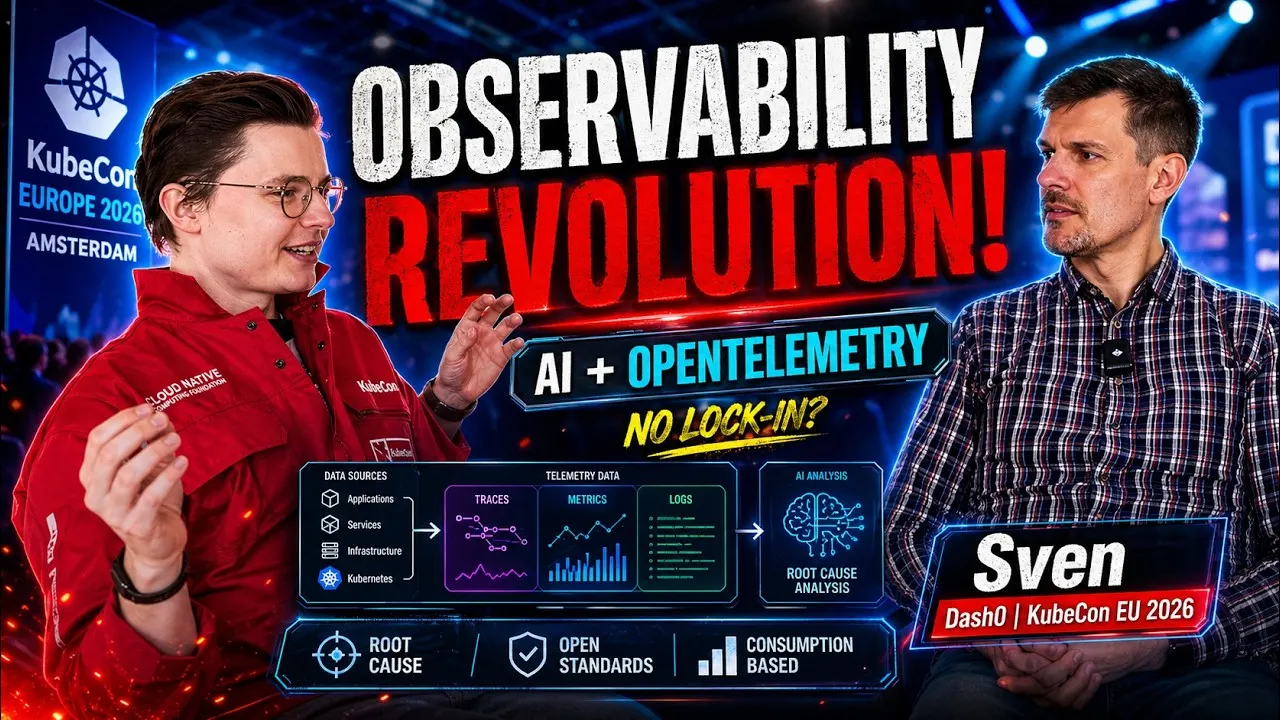
Sven Mößbauer works at Dash0, an observability platform built on OpenTelemetry, PromQL and other open standards.
- YouTubeVideo
- SpotifyVideo
- Apple Podcasts
- Amazon Music
- Pocket Casts
- Overcast
Rather just listen?
In brief
- Open standards are not optional: if your queries, alerts and dashboards are not portable, you are locked in.
- AI in observability only pays off when it is deeply integrated and has context, not bolted on as a chatbot.
- Technical lock-in and commercial lock-in compound. Watch for both.
- Telemetry volumes are exploding; consumption-based pricing aligns the incentives.
- The best retention strategy is a product people want to stay with, not contracts and exit costs.
Chapters
Why this conversation
Observability is where platform teams spend some of their most critical and most expensive budget, and it is where the industry’s quietest problem lives: lock-in. At KubeCon in Amsterdam I sat down with Sven from Dash0 for one of the most honest conversations I have had about where observability is broken, where AI actually helps, and why “we support OpenTelemetry” often means less than it sounds.
Built on open standards
Dash0 is building an observability platform from the ground up on open standards. Not “we accept OpenTelemetry as an ingestion option”, but genuinely open foundations: OpenTelemetry for instrumentation and collection, PromQL for querying metrics, Prometheus alerting rules for notifications, and open dashboard standards for visualisation.
The goal is simple. When an incident happens, the platform should help with root cause analysis so the team can move faster and spend its time troubleshooting rather than searching through dashboards. Sven explained why the standards matter in practice: when the query language, the alert format and the dashboards are proprietary, every alert rule you write and every dashboard you build becomes an exit cost. You are not paying for observability, you are paying for the privilege of staying.
AI in observability: when it works and when it does not
We had a frank discussion about AI in product development. The hype is everywhere, and Sven was clear about where AI creates real value versus where it is a checkbox feature. Adding an AI agent on top of an existing platform is not enough; a chatbot that queries your metrics is marginally useful at best. For AI to create real value in observability it needs to be deeply integrated into the product and understand the telemetry.
Where it actually helps: onboarding, by detecting what runs in a cluster and suggesting instrumentation; root cause analysis, by correlating signals across traces, metrics and logs; issue identification, by recognising patterns across high-cardinality data no human can scan by hand; and dashboard creation from a plain description of what you want to watch. The common thread is context. An AI that understands your telemetry, your topology and your deployment patterns surfaces in minutes what would take an engineer hours. An AI that wraps a query box adds almost nothing.
The two types of vendor lock-in
The most illuminating part of the conversation was Sven’s distinction between technical and commercial lock-in. Technical lock-in is when your data, queries, alerts and dashboards live in proprietary formats, so leaving means rebuilding everything. Many platforms accept OpenTelemetry at the door and still lock the data in a proprietary vault behind it. Commercial lock-in is when long-term contracts, volume commitments and pricing make leaving economically painful even when the migration is technically possible. Many vendors rely on both at once.
Dash0’s approach is deliberately the opposite: consumption-based pricing, so you pay for what you use; no long-term contracts, so customers stay because they want to; and fully open standards, so queries, alerts and dashboards remain portable. The philosophy, in Sven’s words, is to build a platform people stay with because they love it, not because they are trapped inside it.
The exploding telemetry problem
Every platform team is dealing with telemetry volumes that keep growing, and the drivers compound. Kubernetes emits signals from every pod, container, node and control plane component. High-cardinality labels create combinatorial explosions in time series databases. AI-assisted coding produces more code faster, which means more services, more endpoints and more telemetry. And every new microservice is another source of metrics, traces and logs.
The result is that companies pay more and more for observability without always getting more value in return: the cost curve grows faster than the insight curve. Consumption-based pricing is more than a billing model here; it is an incentive alignment. When you pay only for what you use, you are naturally pushed to optimise the pipeline, filter noise early and focus on the signals that matter.
Why this matters for platform teams
If you build an internal developer platform or run Kubernetes at scale, your observability stack decides how fast you respond to incidents, how much you pay as cluster and service counts grow, how portable your investment is, and how useful the AI features will ever be. Dash0’s bet is that the future belongs to platforms built on open standards with AI woven into the product, not platforms that trap you with proprietary formats and add AI as a marketing feature.
Big thanks to Sven for joining me in Amsterdam.
Mentioned in this episode
Transcript
Read the full transcript (automatic captions, unedited)
0:00 Ice man, welcome to the show. I’m super excited to be here at CubeCon 2026 with the zero. Not not that show. Not the show, yeah. It’s the zero. So, what are you bringing to this great event? I mean, I think we bring the most fantastic observability platform but fully based on open standards that you have ever seen and that everyone should have a look at, right? Yeah, I see that especially with AI there is a demand for observability. It’s something that you know, it’s not one of the first priority developing one product. But how do you think that it fits in a product development? The specifically Dash Zero or an observability platform in Yeah, I think both both of them.
0:46 I mean, the idea behind Dash Zero is really to make sure that engineers and platform teams can focus on what they should focus on and not without the necessity to constantly keep doing root cause analysis and all that stuff. But ideally the platform does the root cause analysis for them if there’s something going wrong, if there’s some incident and they can make sure that they are working on troubleshooting, right? That’s the idea of Dash Zero. And I think as you were also mentioning the the agentic part in the AI world. I think AI puts us in a very unique position that we can delegate those tasks basically to an AI whereas our human capacity can focus on what we are best at and that’s kind of solving
1:32 solving problems, right? Not identifying them in the first place but then then solving them, right? And what I see a lot in the in the current days is that everyone kind of tries to engage with AI, everyone tries to adopt AI in a way that they just built an AI agent on top of some platform and then they say like, yeah, we are an AI platform. I mean, sounds good, right? But the reason is AI is only as good as the context that you provide it with. And if you just bolt an AI on top of something, like you have like a legacy infrastructure, you put an AI on top of it that the AI has little understanding of the context what’s actually going on there. And therefore, and I think we all know that, right? We are sometimes using ChatGPT or whatever, we are asking it a question and then the answer is pretty unsatisfying.
2:18 So, for us at Descript, it was very important that we actually changed that. And so, the first kind of line of code that was written for Descript Zero was written with the intent that we have AI engage like fully embedded in the product um that it gives the that it has the full context to actually give meaningful answers and to kind of be yeah, put the put the human in the position to be quicker with things and not just uh spending some time with AI and then it’s it’s worthless. Yeah, this is fantastic because I think one of the main messages that AI is accelerating everything. And this creates a new business opportunity. And especially in this world, we need to be competitive and you to every industry is is changing changing the product and we
3:04 need to go faster. But not on the shallow technology, another another window on our desktop. Yeah. We need to create value. I couldn’t agree more. I mean, the idea like currently I think especially like this year is a very transformative year for AI because I think a lot of people not not companies companies are maybe a bit behind with that, but a lot of individual people start realizing the the proper value of AI because what we were doing with AI in the last years is kind of we were writing emails, improving emails, whatever like so those little use cases. And this year is the year especially like with Anthropic Claude, you can see that a lot that you actually start using AI to collect a lot of data. And basically what we were speaking about when when talking about big data 15 years ago, this is like what now actually brings value to the AI
3:51 that the data is available and now we can put it into a meaningful context and the AI can start, especially with agents, can start to actually do something which helps us. Not only improving some sort of text or so or generating some sort of text, but actually I mean we can like in Dash0 we can do so much with it. We can help people getting on-boarded to the software if they want to integrate their data. The AI can help doing that. The AI of course can help with root cause analysis, issue identification and that stuff. And you can use it to create dashboards. So you can so you can do so much which actually improves the way you work and not just is a nice to have on the on the sideline. That that is the the biggest I think 2025 will be the 2026 will be the
4:36 biggest um most most transformative year of how we use apply and apply AI personally, but also in businesses. Yeah, I definitely agree and this is sound like we are going to want a very interesting trajectory. And I know that you guys build this wonderful platform on top of open source. Yeah. Um you’re using hotel or open telemetry and all this kind of stuff or some secret sauce? I mean there’s no secret sauce. I think the like before we speak about Dash0 the biggest issue currently if we look at the space of observability vendors is that um they are all doing their stuff. So they want kind of to lock you in in what they are doing, right? So everyone is using
5:22 proprietary standards for everything. There’s little open source and now that there’s more open source, especially open telemetry. I mean it’s like such a big topic. So everyone kind of claims, “Yeah, we are doing open telemetry.” I’ve seen it also here at the venue that many put on their booth like we are open telemetry native, but what they are mostly doing is basically they take the open telemetry and then they convert it into their proprietary standard again, making it in fact not open source. So, the idea of Dash Zero is basically two things to solve like two major challenges um for for people or like for for companies that are currently having a big observability vendors in use. The first one is like the technical lock-in and the second one is the commercial lock-in. So, technical lock-in means if you are not based on
6:09 open standards, but you have a lot of proprietary agents running and stuff. Even if your contract is coming to an end or so, it’s very hard for you to move to another solution uh because it might have better functionality, it might might have a better pricing model or whatever. Because like from a technical side, all your data is in that proprietary standard. So, even if you get them out, you don’t really understand what’s going on there. Or if you go to a new platform, you completely have to retrain your entire team. And that’s a technical lock-in. The second is what we oftentimes see is a commercial lock-in. That basically we have like long-term contracts, 1 year, 3 year, you name it. And within those within those contracts, the companies can’t go out, but at the same time telemetry volumes are just exploding. I mean, everyone is I think familiar with
6:55 high cardinality data. You know, we’re all going to Kubernetes, which is great. It’s also CNCF, so fantastic. Um we are uh seeing a lot of live coding in the recent days that uh people use cloud to code, which generates more lines of code, more telemetry. So, you’re paying more and more for observability at the moment. But, you would expect that if you pay more for something, you would get more. You would become quicker in troubleshooting or so. And the the the situation is you’re not, right? You’re just paying more and you’re locked in in that contract for another 3 years, so you can’t change it. And the idea behind Dash Zero is basically to solve those two biggest issues. So, we don’t do any technical lock-ins because everything is based on open standards, not only open telemetry, but maybe PromQL, like uh Perses for the dashboards, Prometheus for alerts and
7:41 stuff. So, there’s all those open standards so we never convert anything into our proprietary standards so no technical lock-in. And what surprises like when I’m talking to people down there at the at the venue what surprises a lot of people is we don’t do contracts, right? We have a fully consumption-based model you only pay for what you use not even for what you ingest. So if you for example ingesting a lot of data and a lot of that data telemetry data is waste you can drop it, right? You can simply filter it out you’re not paying for it anymore and therefore our customers actually love our platform because they could go away any day but they love our platform because it’s so good instead of kind of having this love-hate relationship with our platform because it might be a good technology but at the same time we can barely afford it and we know that it
8:27 will be very hard to move out if we need to. Wow, I think we need more solution like this and I see that probably the SaaS model is is not up-to-date anymore. Probably we need more consumption-based solution. Thank you very much for staying with us and I wish you a fantastic KubeCon. Thank you so much for having me Luca. Thank you. Bye guys. Bye-bye.
About Sven Mößbauer
Sven Mößbauer works at Dash0, an observability platform built on OpenTelemetry, PromQL and other open standards.
Built something the rest of us run on? Save your speaking slot
More episodes
All episodes →-
Episode 02 · 25 Mar
Kat Cosgrove: Securing containers before they ship
-
Episode 04 · 26 May
Luca Galante: Platform Engineering 2.0
-
Episode 05 · 1 Oct
Chris Aniszczyk: After Kubernetes, what's next
-
Episode 07 · Coming
Frédéric Barthelet: MCP in production
Discussion
Questions for Sven, or something we got wrong? The conversation continues under the video on YouTube.