Kubecon
5 min read
KubeCon + CloudNativeCon Europe 2026: who we met
Amsterdam, 25 and 26 March: four conversations at KubeCon + CloudNativeCon Europe, on container security, observability, agents and a European cloud.
By  Luca Berton
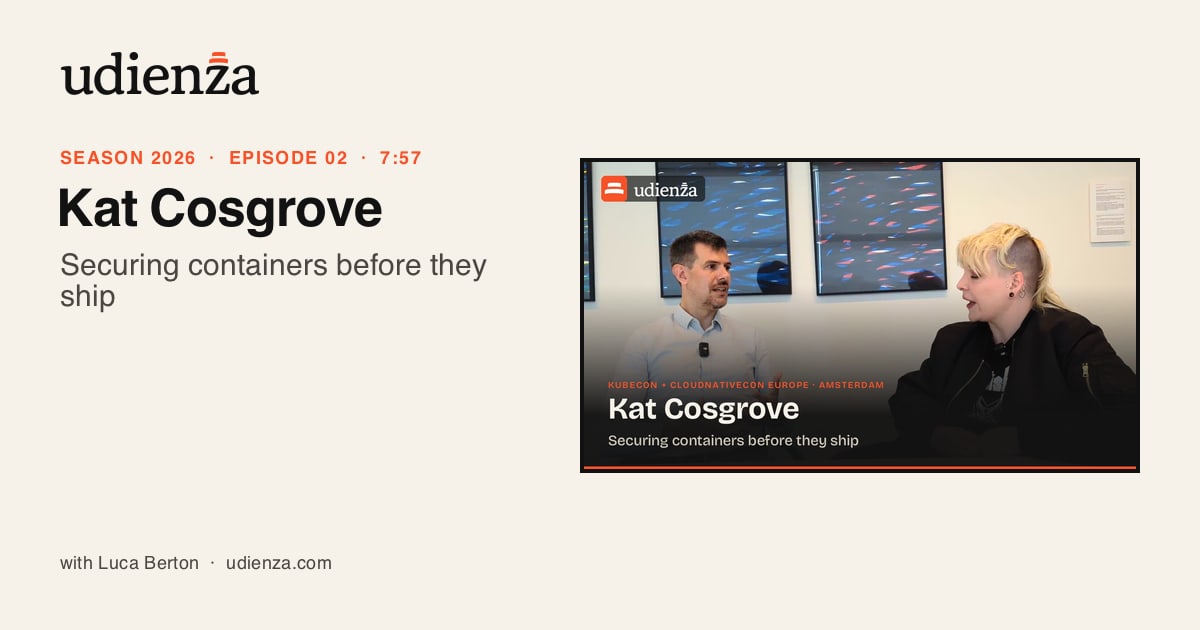
KubeCon + CloudNativeCon Europe 2026, in Amsterdam. Luca Berton recorded four conversations there for Udienza, on Wednesday 25 and Thursday 26 March 2026, the last day of the conference: container security with Kat Cosgrove of Minimus, observability with Dash0, platform engineering with the community’s Luca Galante, and a European public cloud with OVHcloud. Two themes kept coming back. One was AI: “there has been a huge spotlight on AI capabilities throughout this whole conference”, as Guido Laout put it. The other was what a team can still leave, replace or move: an archived ingress controller, an observability contract, a cloud.
The days in numbers
- 4 conversations, recorded over 2 days.
- “a little bit less than 50%” of cloud native environments were still using Ingress NGINX when it was archived, according to Kat Cosgrove.
- 5 levels of agentic adoption in the research Luca Galante presented that week.
25 March — Kat Cosgrove, Minimus
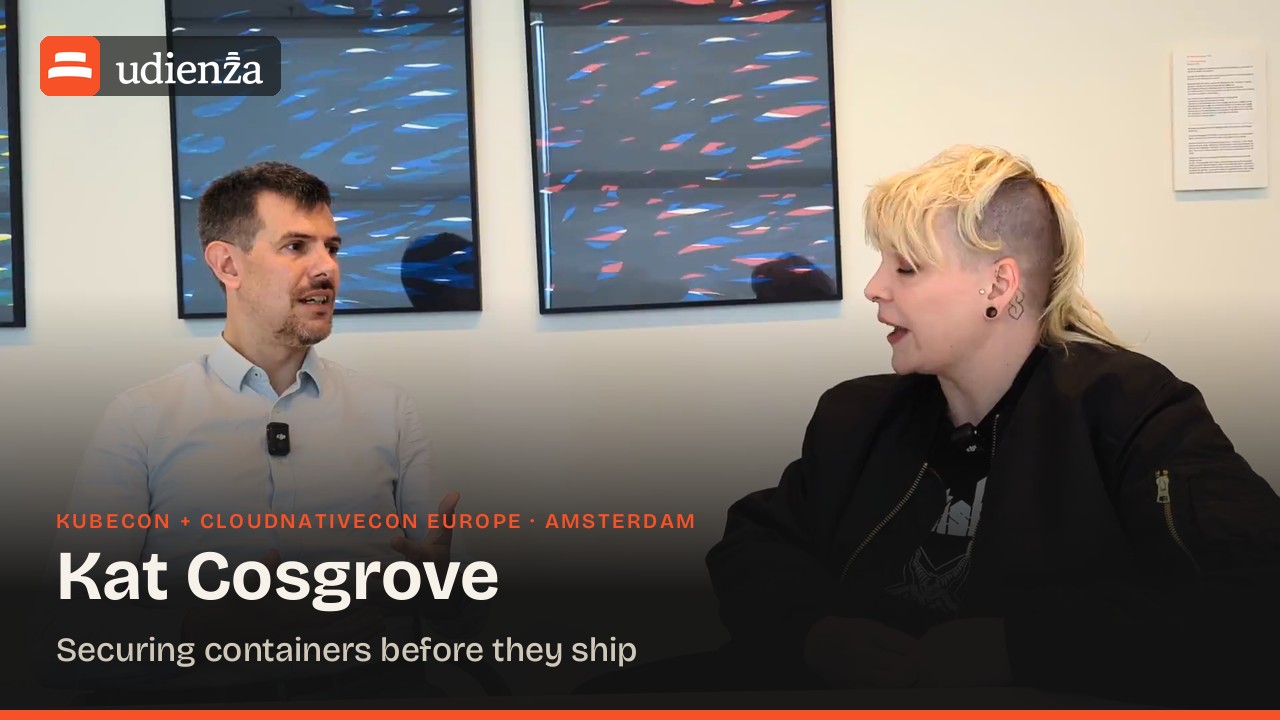
“I am the head of developer advocacy at Minimus, a hardened container images company”, said Kat Cosgrove, “but I am also an elected member of the Kubernetes steering committee, a technical lead for SIG Docs, also within Kubernetes, and the owner of the Kubernetes release team subproject.” The first topic was a project that had just ended: Ingress NGINX “was archived on stage yesterday. And at the time, a little bit less than 50% of cloud native environments were still using it.” With no more patches, “every one of those installations is now in active danger.”
Kat Cosgrove’s argument is that “people need to start considering open source projects to be part of their security posture”. The recommended path is Gateway API, “which can be a significant amount of work”, but the project officially warned about this six months ago: “So at this point, still being on it is a choice.” At Minimus, the hardened images mean “around, like, a 97% to 98% reduction in CVEs”, rebuilt every time upstream ships a patch: “The official SLA for that is like 48 hours”. FIPS and STIG compliant images, air gapping and signed SBOMs came up too. The aim: “We don’t want security to be a thing that’s hard for people to implement correctly.”
26 March — Sven Mößbauer, Dash0
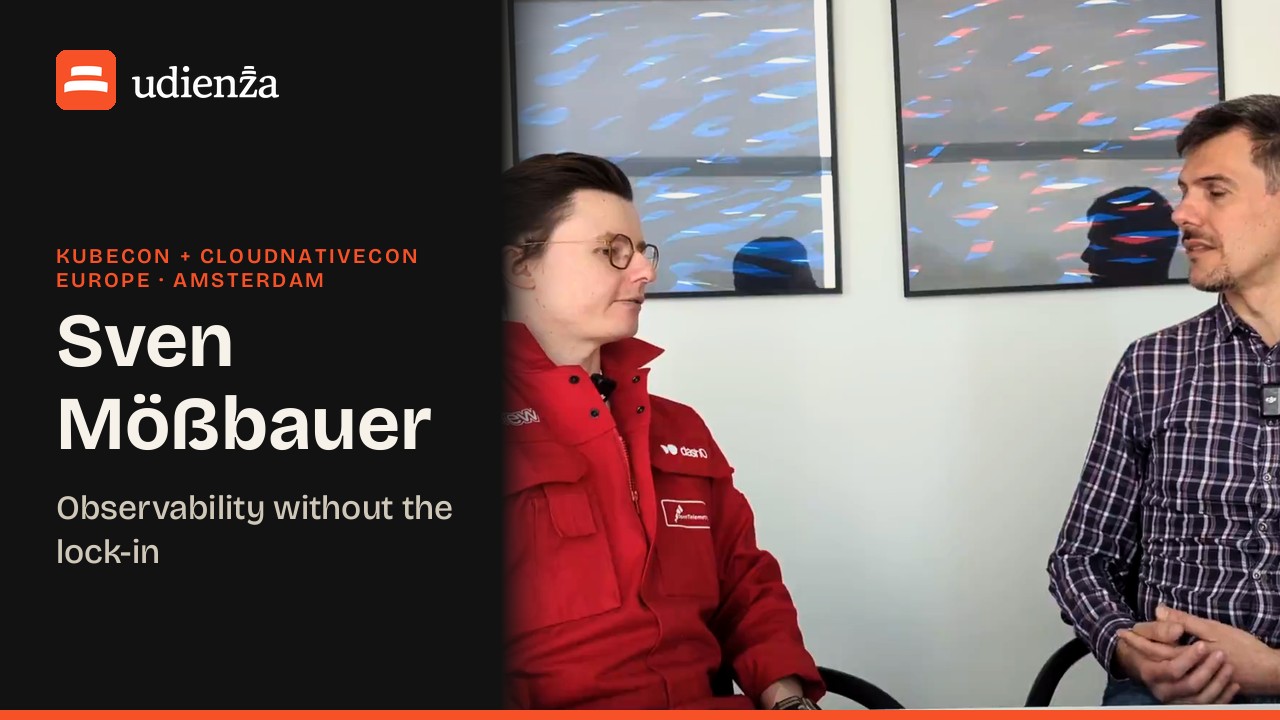
Sven Mößbauer, Director Commercial Sales, EMEA at Dash0, came with “the most fantastic observability platform, fully based on open standards”. On AI: “AI is only as good as the context that you provide it with.” Bolt an AI on top of a legacy infrastructure, and it has “little understanding of the context of what’s actually going on there”.
On the show floor, “many put on their booth, like, we are OpenTelemetry native.” What most of them do, Sven Mößbauer said, is “they convert it into their proprietary standard”. Dash0 sets out to solve two problems, “the technical lock-in, and the second one is the commercial lock-in”: data in proprietary formats on one side, and on the other “long-term contracts, one year, three year, you name it”, while telemetry volumes keep exploding. Dash0’s answer is open standards, OpenTelemetry, PromQL and Prometheus for alerts among them, and no contracts: “You only pay for what you use, not even for what you ingest.”
26 March — Luca Galante, Platform Engineering
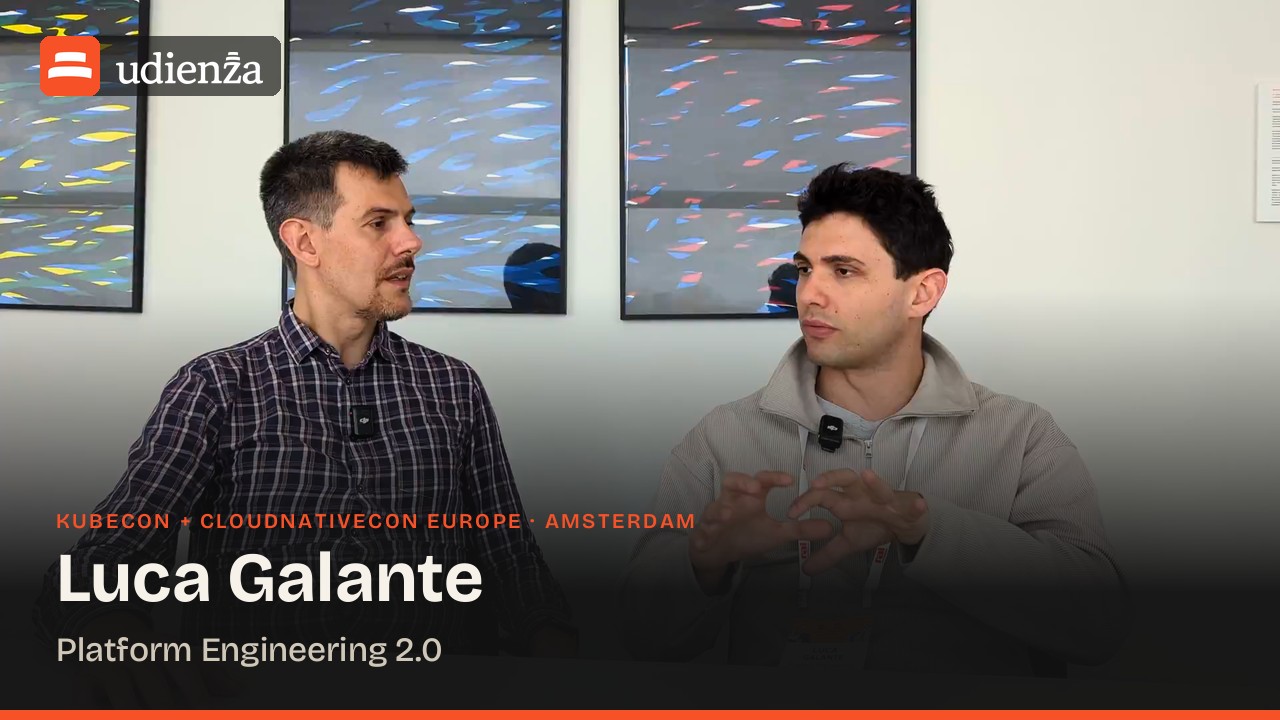
Introduced as the founder of Platform Engineering, Luca Galante says “more like core contributor to the Platform Engineering community”. The community runs PlatformCon, with “40,000, 50,000 people online, two live days in New York and London, about 1,000 people each”, a world tour to Paris, Sao Paulo and Sydney, a party at KubeCon, and a research arm, Weave Intelligence.
AI has overshadowed most enterprise trends, in Luca Galante’s view, but not platform engineering: “AI is actually turbocharging the need for well-designed platforms”. To go from a day zero demo to something to rely on “for day 100 operations”, an enterprise needs a well-designed platform. That week Luca Galante gave a talk on research into agentic coding in the enterprise, which outlines five levels of agentic adoption. When many developers’ agents feed “the same CI pipelines and the same deployment flows”, the system clogs down the line. The move is from the internal developer platform to, potentially, an agentic development platform: “instead of like one lane highway, now it’s like, you know, a million lane highways”. And in top performing organisations, platform teams and data teams are told they “need to sit down at the same table and figure this out”.
26 March — Guido Laout, OVHcloud
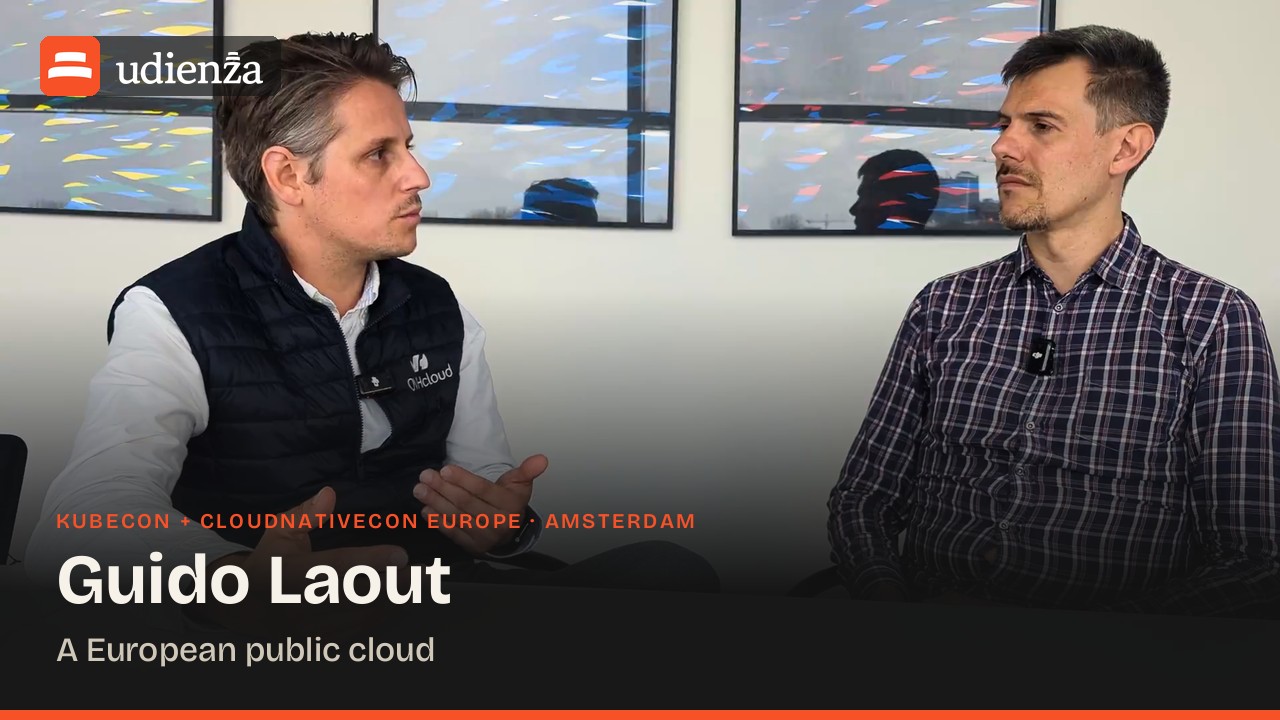
Guido Laout, Director Netherlands at OVHcloud, spent the conference at the booth: “I must admit, I haven’t gone to any of the talks”. Sovereignty, in Guido Laout’s words, is “a response to growing concerns over digital autonomy, over data processing, privacy, and not being exposed to non-domestic laws”, and “the topic gets hotter and hotter”. Many visitors to the booth were surprised by the breadth of the public cloud: managed databases, Kafka, OpenSearch, Valkey and managed Kubernetes.
Some organisations hope the topic will dissolve. Guido Laout does not think so, and expects the future to be about understanding the dependencies and “making sure that there’s an exit plan”: “So I think we’re only at the beginning of the sovereignty topic”. Customers come with lift-and-shift projects, but many are rebuilding on open source, so that what they set up is “portable even beyond an OVHcloud”. On the crowd: “It’s a very mixed crowd.”
The thread
Four guests, in their own words. Kat Cosgrove wants security to be easy to get right. Sven Mößbauer wants customers who “could go away any day” and stay anyway. Luca Galante wants platforms ready for the “10x, 100x increase in throughput” that agents bring. Guido Laout sees an exit plan, and setups that stay portable, as the way forward.
The conversations
All four have their own page:
- Kat Cosgrove: Securing containers before they ship
- Sven Mößbauer: Observability without the lock-in
- Luca Galante: Platform Engineering 2.0
- Guido Laout: A European public cloud
Like every episode, they go out on YouTube first, then on Apple Podcasts, Spotify and Amazon Music.
Built something the rest of us run on? Being a guest is free. Take the other chair
Related articles
All articles →-
Conferences · 5 min read
KubeCon Europe 2026 Amsterdam: four conversations
Udienza at KubeCon Europe 2026, Amsterdam: Kat Cosgrove, Sven Mößbauer, Luca Galante and Guido Laout on security, observability, platforms and a European cloud.
-
Kubecon · 4 min read
KubeCon + CloudNativeCon Japan 2026: Yokohama
29 July 2026 in Yokohama: one conversation at KubeCon + CloudNativeCon Japan, with CNCF CTO Chris Aniszczyk on agents, local AI and young engineers.
-
Dutch Cloud Native Day · 7 min read
Dutch Cloud Native Day 2026: who we met
Friday 30 October in Utrecht: nine conversations at Dutch Cloud Native Day, on sovereign clouds and forges, security, feature flags and community.
The episodes in this article
All episodes →-
Episode 02 · 25 Mar
Kat Cosgrove: Securing containers before they ship
-
Episode 03 · 5 May
Sven Mößbauer: Observability without the lock-in
-
Episode 04 · 26 May
Luca Galante: Platform Engineering 2.0
-
Episode 10 · 6 Oct
Guido Laout: A European public cloud