
Kubecon
4 min read
KubeCon + CloudNativeCon Japan 2026: Yokohama
29 July 2026 in Yokohama: one conversation at KubeCon + CloudNativeCon Japan, with CNCF CTO Chris Aniszczyk on agents, local AI and young engineers.
By  Luca Berton
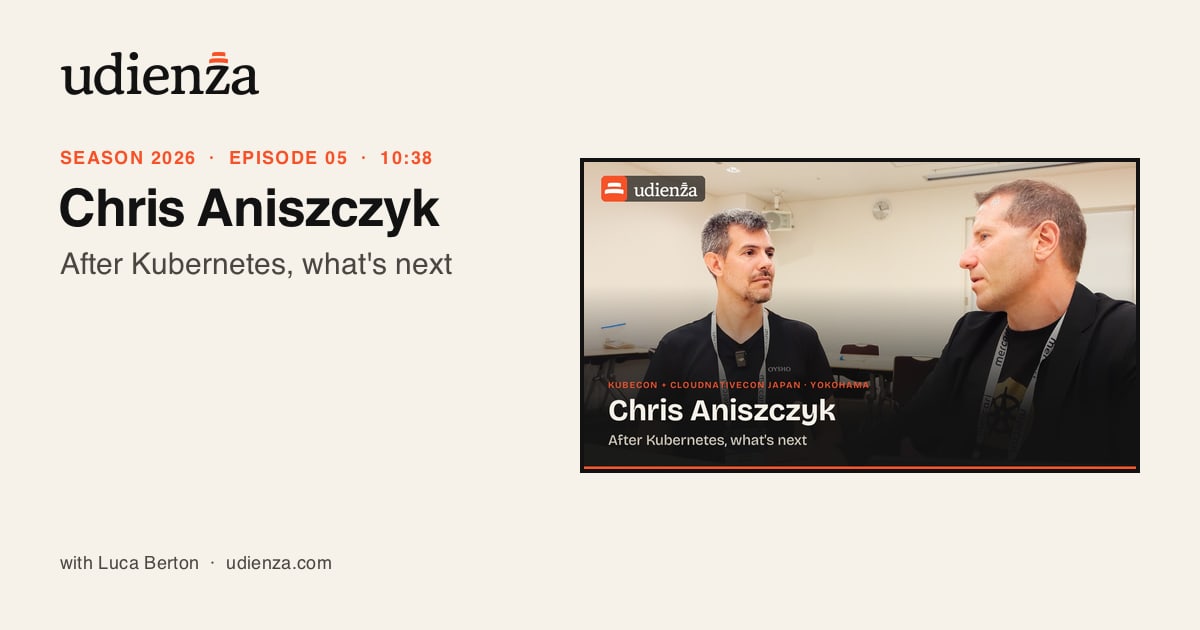
Wednesday 29 July 2026, KubeCon + CloudNativeCon Japan in Yokohama. Udienza recorded one conversation there, with Chris Aniszczyk, CTO of the Cloud Native Computing Foundation, on the day Chris had been on the keynote stage. In ten minutes, the conversation covered the Japanese market, the workloads coming to Kubernetes, the next ten years and what Chris tells young engineers.
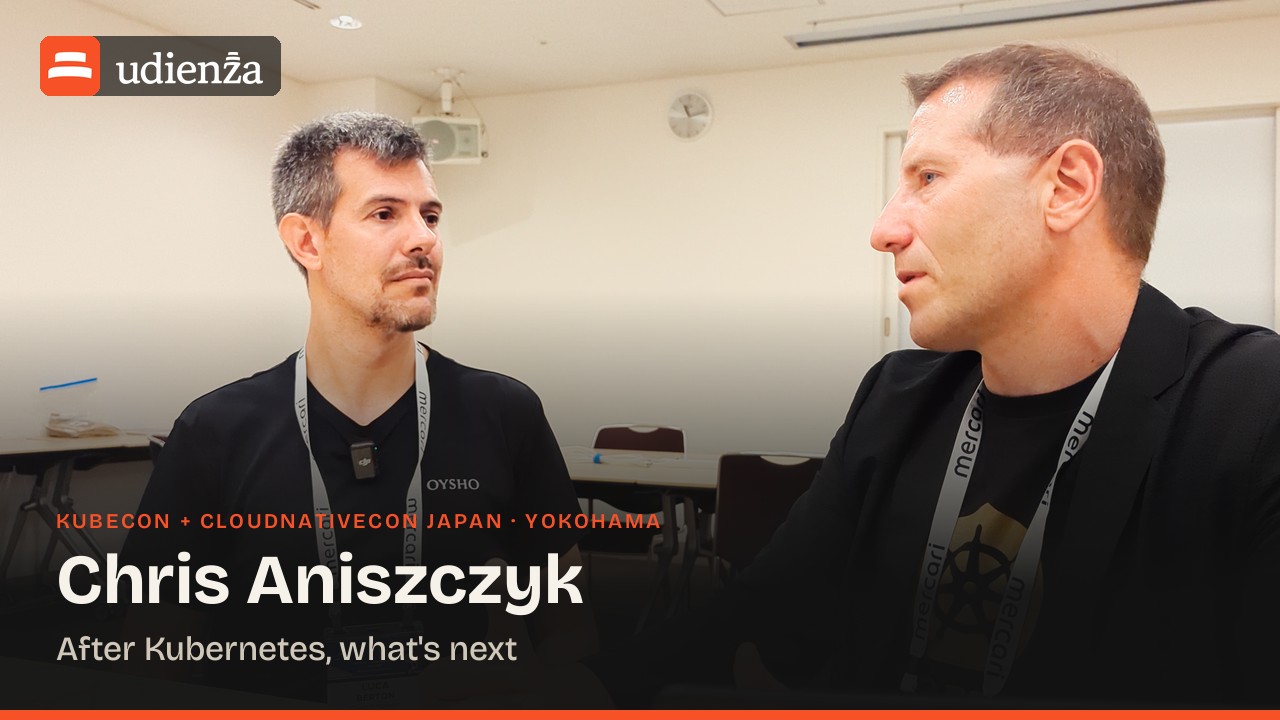
Chris Aniszczyk, CNCF
Japan is booming
The conversation opened on the host’s line that Japan is booming. For Chris Aniszczyk, it is “one of our largest, you know, KubeCon in Asia”, and one of the larger cloud events too. The CNCF released a state of cloud native report for Japan, on trends in the Japanese market, among them the companies “that are requiring developers to upskill for AI related stuff.” Japan, Chris said, historically lagged maybe Europe and North America in cloud native adoption, and the CNCF sees “a little bit similar patterns from kind of AI inference adoption.”
Agents are the new microservices
“I always say like agents are kind of the new microservices, like they’re a new type of workload.” On the keynote stage, Chris said, the point was that “Kubernetes was really designed to really help, you know, scale distributed systems”: a reconciliation loop, a simple API server and an extensibility mechanism. Agents have different characteristics. They tend to need GPUs, they sometimes load a large model, they are “a little non-deterministic”, and sometimes they need custom ASICs. “But at the end of the day, you’re dealing with a distributed system, things that could go away, go wrong, fail.” When the host suggested agents are not a different animal, Chris answered “it’s a different species”, and “the stuff that we’ve been doing in CNCF for the last, you know, 10 years is still extremely relevant.”
The next ten years
“I think everyone’s going to have their own personalized agent that probably runs locally in some way.” AI will be pervasive, inference more localized, and that will “put a lot of demand on the infrastructure.” Chris’s frame: “cloud native originally was built for essentially human speed”, for people shopping or calling a lift through a mobile app. “Agents operate significantly faster, you know, have a lot more demand on infrastructure.” The example is One Medical, the app Chris uses in the US to book health appointments, which recently added an AI feature: “that’s essentially an inference-based service.” “Imagine like every app we interact with is gonna have some type of inference workload.”
The other prediction is choice. Open source had very limited options in its early days; now there are many open source databases, and AI will bring many open models. “It’s just like the number of Linux distros out there.” The normal consumer will not care, in Chris’s view, but developers will have so much choice: “And I think all that choice and competition is going to lead to innovation.”
191 countries
“We have 191 countries contributing to CNCF”. Some contributors learn the technology on their own; others work for companies, sometimes companies that compete with each other. At the CNCF governing board meeting the day before: “In the room, you have Google, Microsoft, Apple, Red Hat, Huawei. They all both collaborate and compete at the end of the day.” Ecosystems with one dominant winner do not allow for innovation. “You need to enable that competition. I think that’s what CNCF does.”
Advice for young engineers
Two things. First, the basics: how Linux works, how networking works, the basics of operating systems, akin to a computer science degree. “I think learning the fundamentals is always good.” Second, “set up your own Hermes agent or set up your own OpenClaw”, and figure out how to run models locally: “Ollama makes it pretty easy to run models locally on your computer.” There are tricks to learn by doing, such as the long history that makes a model’s answers worse: “sometimes you have to flush the history”. For Chris, it is akin to learning to compile and build your own Linux distribution when growing up with computers: “I remember building the kernel.” The last word of advice: “Always tinker, always try to run locally.”
The conversation
Like every episode, it goes out on YouTube first, then on Apple Podcasts, Spotify and Amazon Music.
Built something the rest of us run on? Being a guest is free. Take the other chair
Related articles
All articles →-
Conferences · 4 min read
KubeCon Japan 2026: the week in Yokohama
The Udienza podcast at KubeCon Japan 2026: ten minutes with CNCF CTO Chris Aniszczyk, the press briefing, the keynotes and the community around them.
-
Kubecon · 5 min read
KubeCon + CloudNativeCon Europe 2026: who we met
Amsterdam, 25 and 26 March: four conversations at KubeCon + CloudNativeCon Europe, on container security, observability, agents and a European cloud.
-
Conferences · 5 min read
KubeCon Europe 2026 Amsterdam: four conversations
Udienza at KubeCon Europe 2026, Amsterdam: Kat Cosgrove, Sven Mößbauer, Luca Galante and Guido Laout on security, observability, platforms and a European cloud.
The episodes in this article
All episodes →-
Episode 05 · 1 Oct
Chris Aniszczyk: After Kubernetes, what's next