Conferences
4 min read
KubeCon Japan 2026: the week in Yokohama
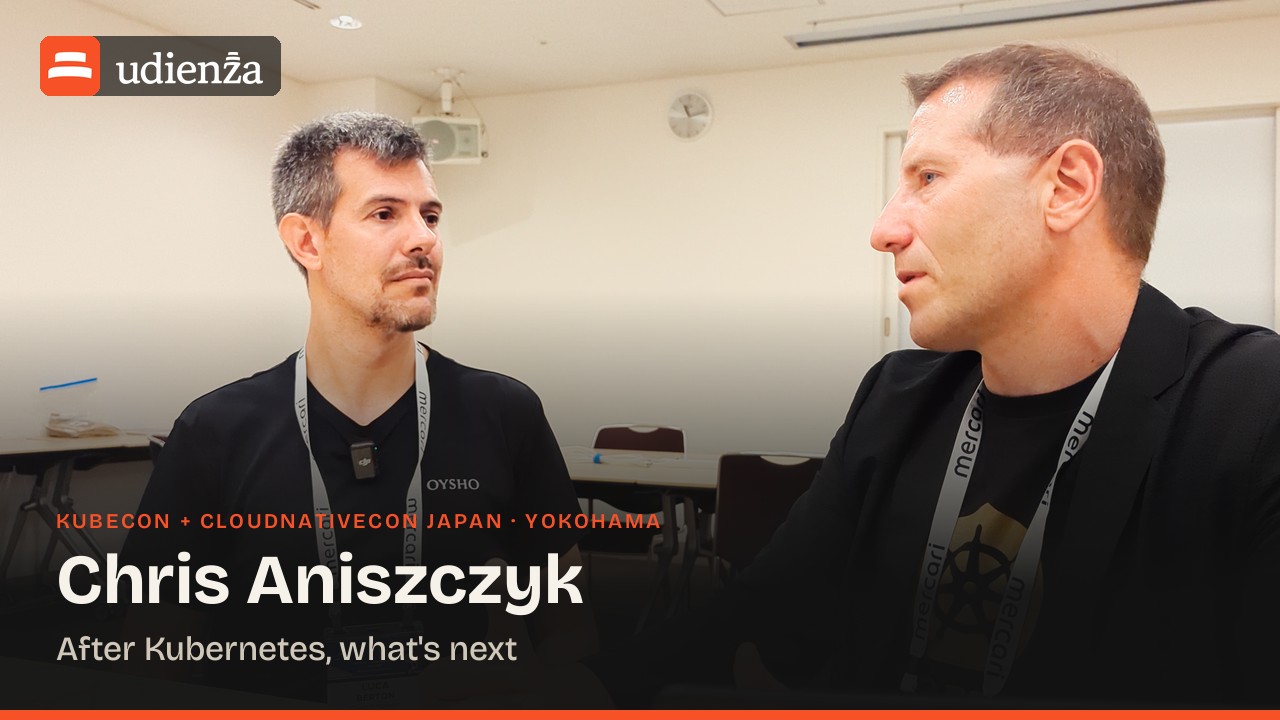
The Udienza podcast at KubeCon Japan 2026: ten minutes with CNCF CTO Chris Aniszczyk, the press briefing, the keynotes and the community around them.
By  Luca Berton
KubeCon + CloudNativeCon Japan 2026 ran from 28 to 30 July at PACIFICO Yokohama. The show was there on a press badge from the CNCF: accreditation, not a partnership. The badge opened two rooms on 29 July, the keynote hall in the morning and the CNCF press briefing around midday. One ten-minute conversation came out of the week. This is what it covers, what the two rooms said, and what the host, Luca Berton, saw between them.
Ten minutes with the CNCF’s CTO
Chris Aniszczyk is CTO of the Cloud Native Computing Foundation, and he opened the keynotes with Jonathan Bryce. The episode starts with the report the CNCF released for the event: about 950,000 cloud native developers in Japan, and a growing number of companies asking them to upskill for AI. Japan came to cloud late compared with Europe and North America; Chris sees a similar pattern now with AI inference.
The core of the conversation is one comparison. In his words, “agents are kind of the new microservices”: a new type of workload that is still a distributed system, where things fail and go away. Agents need GPUs, load large models and do not behave the same way twice. Asked whether that makes them a different animal, he calls them “a different species”. His conclusion is that ten years of CNCF projects built to scale distributed systems still apply.
Looking ten years ahead, he expects AI to be everywhere and more of it to run locally. Cloud native was designed for people shopping or booking a ride on a phone; agents work far faster and ask far more of the infrastructure. He also expects as many open models to choose from as there are Linux distributions. On the foundation itself: contributors from 191 countries, and Google, Microsoft and Huawei in the same board meeting. “You need to enable that competition,” he says. The episode closes with his advice to young engineers: learn the fundamentals, then run a model on your own machine and build your own agent. “Always tinker.”
What the press briefing said
The briefing put the report’s numbers on slides. According to the CNCF and SlashData, 41 percent of developers in Japan are cloud native, against 39 percent worldwide, and about 100,000 of them work on AI. One slide argued that Japan is not behind on AI but waiting: companies intend to adopt it and are hiring for it, and the limit is training. Others covered sovereignty, with Kubernetes AI Conformance presented as a vendor-neutral standard, and Japan’s focus on physical AI in cars, electronics and infrastructure.
Buildpacks and Kubeflow appeared as graduation milestones. HAMi, for sharing GPUs, and Confidential Containers had moved into incubation. CoHDI and llm-d were shown as sandbox projects for AI infrastructure. And the CNCF announced a wider partnership with the IOWN Global Forum, which brings CoHDI onto IOWN’s All-Photonics Network. The host’s briefing notes go through every slide and link the CNCF’s own announcements.
What the keynotes showed
After the opening, a run of short company keynotes each used Kubernetes to run something larger than containers. SoftBank described agents that turn one request into many pods, against a fixed supply of data-centre capacity. Fujitsu argued for GPU-centric, composable infrastructure. Preferred Networks explained how it shares accelerators between tenants with namespaces and dedicated nodes, and keeps quotas fair with Kueue. LY Corporation grew from 5 clusters to more than 1,300, operated by 15 engineers. Hyundai AutoEver runs more than 5,000 applications from a single Argo CD.
What these five shared: each started from existing CNCF projects and tuned them, instead of writing a platform of its own. The SoftBank talk is the episode’s argument seen from an operator’s seat: if every agent request fans out, capacity has to be planned for agents, not only for people. The host’s keynote notes cover each talk in turn.
The community between sessions
In the hallway the host met the CNCF Platform Engineering technical community group in Japan, which hopes to become a full user group, and heard the same question in conversation after conversation: how to manage agentic AI, and how to use it to run Kubernetes and build applications. His community notes tell where to find the group.
The briefing gave that picture some numbers. CNCF, Linux Foundation Education and Udemy now offer one training path for the CKA, CKAD, CKS and CNPE certifications, Kubestronauts in Japan grew 170 percent in a year, and Subaru won the CNCF End User Case Study Contest. In the afternoon, a hands-on tutorial taught people to translate the Kubernetes documentation into their own language: a first contribution that needs no code.
Where to read more
- The CNCF press briefing: the Japan numbers, the project news and a lightning talk on Kubernetes logs.
- The keynotes: the company talks, one by one.
- Community and takeaways: the platform engineering group and the hallway track.
- Chris Aniszczyk on agentic AI: a separate, earlier conversation, filmed at KubeCon Europe in Amsterdam and published in April. It is not from Yokohama.
Next
The episode is on YouTube first; the episode page adds the chapters, the takeaways and the full transcript. New episodes come every Tuesday.
Built something the rest of us run on? Being a guest is free: how it works.
Built something the rest of us run on? Being a guest is free. Take the other chair
Related articles
All articles →-
Kubecon · 4 min read
KubeCon + CloudNativeCon Japan 2026: Yokohama
29 July 2026 in Yokohama: one conversation at KubeCon + CloudNativeCon Japan, with CNCF CTO Chris Aniszczyk on agents, local AI and young engineers.
-
Kubecon · 5 min read
KubeCon + CloudNativeCon Europe 2026: who we met
Amsterdam, 25 and 26 March: four conversations at KubeCon + CloudNativeCon Europe, on container security, observability, agents and a European cloud.
-
Conferences · 5 min read
KubeCon Europe 2026 Amsterdam: four conversations
Udienza at KubeCon Europe 2026, Amsterdam: Kat Cosgrove, Sven Mößbauer, Luca Galante and Guido Laout on security, observability, platforms and a European cloud.
The episodes in this article
All episodes →-
Episode 05 · 1 Oct
Chris Aniszczyk: After Kubernetes, what's next