Coming soon 13:57 Recorded at AGNTCon + MCPCon North America, San Jose
When agents hit an LLM thousands of times, can any AI optimization be premature?
PyTorch, vLLM and the brain behind agents
Jonathan Bryce, Executive Director of Cloud & Infrastructure at the Linux Foundation, on PyTorch and vLLM, and why token-hungry agents must get efficient.
Jonathan Bryce, Executive Director of Cloud & Infrastructure, Linux Foundation · with  Luca Berton
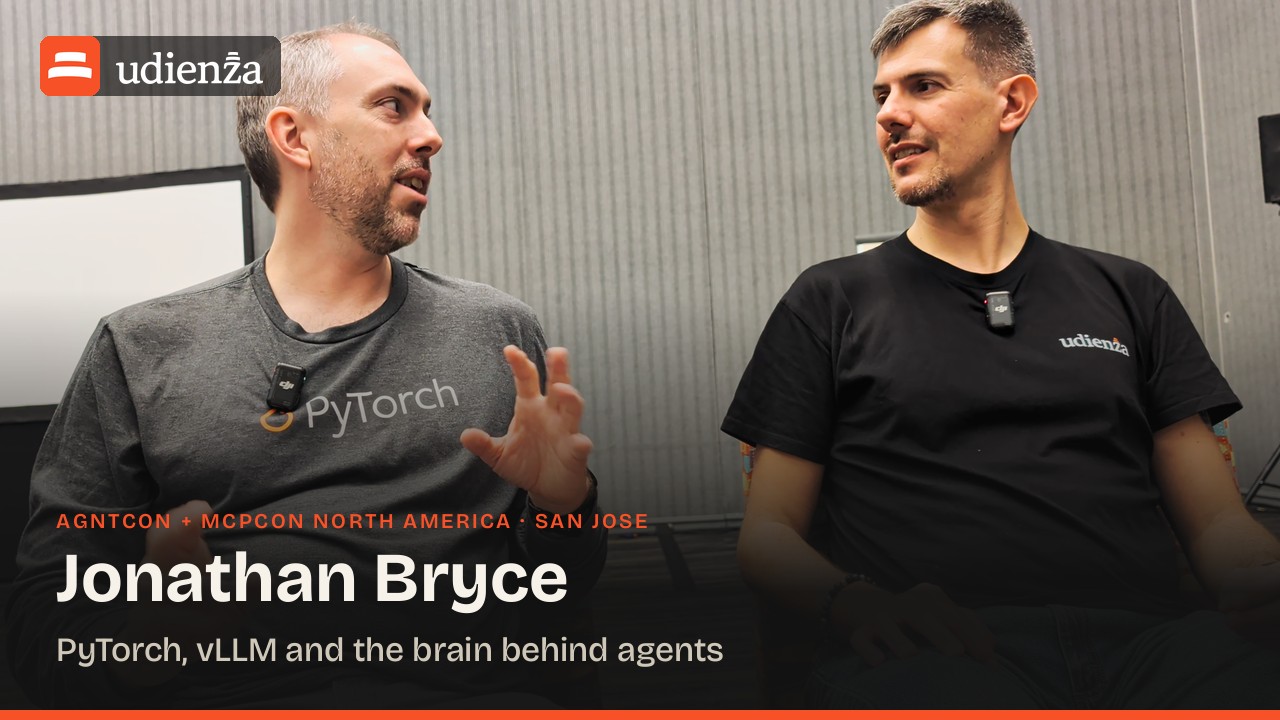
Not filmed yet.
At the Linux Foundation, Jonathan Bryce is Executive Director of Cloud & Infrastructure, and he is involved with the Cloud Native Computing Foundation. At AGNTCon + MCPCon he gave a short keynote on the PyTorch community and the PyTorch Foundation, where the open source projects that create and serve AI models live.
Follow the show and the episode arrives the morning it's published.
In brief
- Agents and harnesses rest on intelligence, and the PyTorch Foundation's projects provide it: PyTorch turns data into a model, and vLLM, an inference engine, serves it from a GPU.
- On the cloud native side, where Kubernetes is the original project, PyTorch and vLLM now run in clusters: inference must be distributed, and training runs even more so for their data.
- Adoption has exploded in the last year or so, from chatbot mode, a prompt and a response, to agents that chase a goal by hitting the LLM hundreds or thousands of times and spinning off sub-agents.
- Agent frameworks first pointed at frontier models, expensive by the token, so enterprises facing millions of customer interactions must make agents efficient for speed, cost and quality.
- The cutting edge, long the model layer of PyTorch, vLLM and Ray, now spreads to tools that start agents in sandboxes and contain them, and Kubernetes is changing at its core to match.
- No AI optimization is premature today: adoption has gone vertical, the limits are power and data center space, and software gets more capacity out of the same footprint.
- Jobs once predicted to disappear have more roles than ever, and as agents write most of the code, expertise shifts from knowing syntax to breaking a problem down and guiding it toward the true outcome.
Chapters
- 0:00 The PyTorch Foundation, the brain of AI
- 1:10 Six projects, with PyTorch and vLLM
- 2:36 PyTorch and vLLM on Kubernetes
- 3:33 From chatbots to agents
- 5:18 Making agents efficient
- 6:18 Containing agents at scale
- 7:41 No premature optimization in AI
- 9:54 More experts than ever
- 11:12 Careers in a world of agents
Why this conversation
Agents get the attention at AGNTCon, but each runs on a model, and models come from open source software. Jonathan Bryce, Executive Director of Cloud & Infrastructure at the Linux Foundation, had given a short keynote that morning on the PyTorch community and the PyTorch Foundation, and he arrived in a PyTorch t-shirt. The host recorded with him in San Jose on Friday 23 October, the second day of AGNTCon + MCPCon North America. That keynote and the rest of the Friday are in AGNTCon + MCPCon North America 2026: day two.
Where the models come from
AI may be two letters, he says, but it covers many things. Agents and harnesses consume tokens and models, and the PyTorch Foundation hosts the open source projects that create and serve those models: the brain for the agent. There are six: PyTorch, vLLM, Ray, DeepSpeed, Helion and Safetensors. Of these, PyTorch and vLLM matter most for building the brain. With PyTorch you build the pipeline, feed the data in and get a model out. vLLM is the inference engine: load a model on a GPU and it answers requests by running them through the model.
The host uses vLLM for distributed inference, when a model outgrows one GPU or server. To Jonathan, PyTorch and vLLM are the deepest technology in the AI stack. Through the Cloud Native Computing Foundation, where Kubernetes started, he sees both moving into clusters: inference must be distributed, training runs even more so because of the data, and cloud native frameworks orchestrate the work.
From chatbots to agents
PyTorch is seven or eight years old and has moved fast all along. What changed in roughly the past year is that adoption exploded, into completely new uses. First came the chatbot era: ChatGPT, then Claude from Anthropic, then many open weights models. “The sort of standard interaction mode was I talk to a chatbot, the chatbot gives me a response.” Now you give an agent a goal, it calls the LLM hundreds or thousands of times to reach it, and it sends sub-agents off to browse the web, write code or do math.
The host wondered whether that is brute force. Early agent frameworks, Jonathan says, were aimed at frontier models, which are expensive when you pay by the token. An enterprise with millions of customer interactions has to make the work efficient: fast, affordable and good. The cutting edge, long found at the model layer, now includes a whole set of tools for starting agents in sandboxes, kagent among them, and keeping them contained, while Kubernetes itself is changing at its core. Earlier that week, at the PyTorch conference, folks from Google, Red Hat and IBM showed off a vLLM deployment over both GPUs and TPUs that managed 1,000 agents inside a cloud native environment.
No room for premature optimization
Software engineers warn against premature optimization: polishing code before you have the users to benefit from it. Jonathan does not see any of that in AI. Adoption has gone vertical and the industry is catching up. The real limits are physical, power and data center space, and GPUs cannot be built, bought and brought online as fast as the demand. Software is how the industry gets more capacity out of the same footprint. “So software is playing a really critical role in that.”
Experts, and the start of a career
The host brought up an exchange with Tim O’Reilly on what experts are for once intelligence is plentiful. Jonathan points to the jobs that were predicted to disappear over the last two years: there are now more of those roles, and more demand for experienced software engineers, than ever. Parts of the employment cycle are being disrupted, as happened with the internet. Simple economics, though, says that when each person produces more, you want more people, because more value gets created.
The five- or ten-year picture is still unclear, and he expects careers to change most at their beginning. When he first did software, in the 1990s, training went down to transistors and assembler. Then the internet arrived with higher-level languages and frameworks that made building e-commerce much faster, and universities needed time to adjust. With agents writing most of the code, expertise means breaking a problem down and describing the outcome you really want, not knowing a language’s syntax. “So really that understanding, that analysis, that type of expertise I think is where the value is going to lie.”
When it comes out
The episode is edited and in the release order. Like every episode it goes out on YouTube first, then on Apple Podcasts, Spotify and Amazon Music.
Mentioned in this episode
About Jonathan Bryce
At the Linux Foundation, Jonathan Bryce is Executive Director of Cloud & Infrastructure, and he is involved with the Cloud Native Computing Foundation. At AGNTCon + MCPCon he gave a short keynote on the PyTorch community and the PyTorch Foundation, where the open source projects that create and serve AI models live.
Running this in production? Luca Berton helps platform teams take it from prototype to reliable production. See how he works
Built something the rest of us run on? Being a guest is free. Take the other chair
More episodes
All episodes →-
Episode 68 · Coming
Sean Knight: Docs for agents, from the other founder
-
Episode 70 · Coming
Andre Elizondo: AURA, an open source SRE agent
-
Episode 37 · Coming
Roman Swoszowski: One catalog for every AI system
-
Episode 30 · Coming
Sudeep Goswami: Runtime governance for AI agents