Coming soon 7:10 Recorded at AGNTCon + MCPCon North America, San Jose
How can an SRE agent reach production in hours, without guessing?
AURA, an open source SRE agent
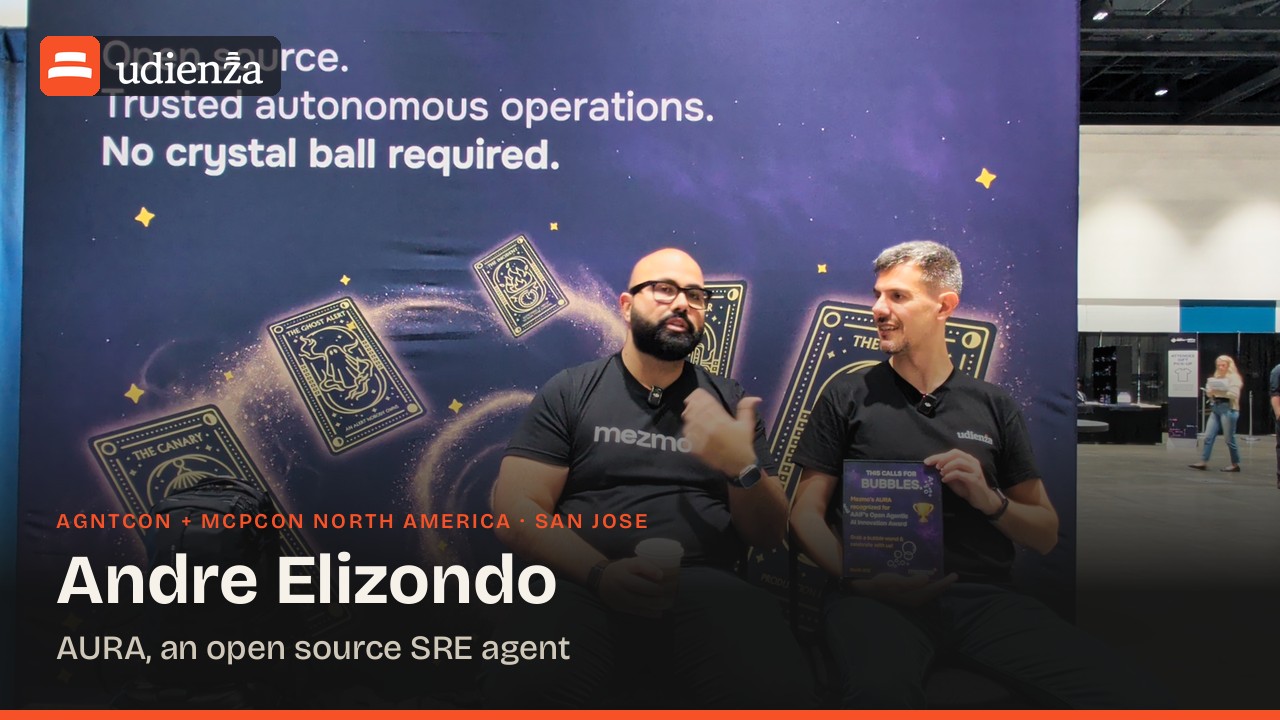
Andre Elizondo, Head of Product at Mezmo, on AURA, an open source SRE agent: declared in a config file, traced from day one, with a human approving each fix.
Andre Elizondo, Head of Product, Mezmo · with  Luca Berton
Not filmed yet.
Andre Elizondo is Head of Product at Mezmo, which enables teams to build agents that help them run production safely. Mezmo's own SRE team started AURA, open sourced in February.
Follow the show and the episode arrives the morning it's published.
In brief
- The booth's slogan, fortune tellers make bad SREs, is about production's one-way doors at scale: a fortune teller guesses, and production is no place for guessing.
- Mezmo open sourced AURA in February so that getting an agent to help manage production takes a couple of hours rather than weeks or months.
- AURA takes a Kubernetes-style approach: you declare the outcomes you want from the agent, and the system handles orchestration, tracing, human in the loop and governance.
- Mezmo's SRE team built in what it wished had existed: better root cause analysis, and a strict human in the loop that approves each remediation and keeps an auditable trail.
- It is Apache 2 licensed: a one-line install from the mezmo/aura repository, then an init command that generates an agent made for SRE work.
- What sets it apart, he says, is the declarative approach: one simple config file in source control instead of 28 things to build, and tracing so an agent with a problem does not hallucinate silently.
- Root cause analysis of incidents is the most common use; teams also run it for security incidents and SecOps, performance, capacity and cost planning, from ad hoc to proactive work.
Chapters
- 0:00 Fortune tellers make bad SREs
- 0:50 AURA, open source since February
- 1:45 A declarative, Kubernetes-style agent
- 2:20 Built by an SRE team
- 2:46 RCA and a strict human in the loop
- 3:18 Two commands to start
- 4:00 Why declarative matters
- 5:02 From incident RCA to SecOps
- 5:42 Capacity, cost and proactive work
- 6:25 Where to find it
Why this conversation
An agent that is allowed to act on production can do things that cannot be taken back, and the work of making it safe usually falls to the team that runs it. Andre Elizondo heads up product at Mezmo, whose open source project AURA is an SRE agent with much of that safety work already done. The host found him at the Mezmo booth in San Jose on Friday 23 October, the second day of AGNTCon + MCPCon North America, not long after the project had won an award. Everyone else the show met that Friday is in AGNTCon + MCPCon North America 2026: day two.
Fortune tellers and one-way doors
The booth carried a slogan, “fortune tellers make bad SREs”, and the host wanted to know why. Mezmo, Andre explains, is focused on letting teams build agents that help them run production safely. Running it at scale means facing many one-way doors, decisions that can go badly wrong, and a fortune teller is someone who guesses. As he puts it, “you don’t want to be guessing in production.”
Getting an agent ready for production use is hard, he says. Anyone who has built one has seen how much can go wrong, and how plans pile up as the agent runs into one wall after another. Mezmo open sourced AURA in February to shorten that path: from deciding you want an agent to help with production to having one running should take a couple of hours, not weeks or months.
The design borrows from Kubernetes. You describe, declaratively, the outcomes you want from the agent. The system then handles the orchestration, turns on tracing from the start, and wires in human in the loop and governance, so the glue code that agents usually need goes away.
The project was started by the SRE team inside Mezmo, and plenty of its staff come from SRE themselves. What went in was what that team had wished for: better root cause analysis, an easy picture of the state of a system, and an account of what led to a failure. When the agent wants to fix something, a person has to approve the step first, and every approval is kept as an audit trail.
Two commands, one config file
AURA is Apache 2 licensed and lives in the mezmo/aura repository on GitHub. Near the top of the readme there is a one-line install, and an init command then generates an agent built for SRE work. Andre says that narrow focus is on purpose: people should not be handed a pile of parts and left to assemble a finished system themselves. Two commands, and AURA is running in your environment.
The host pointed out that other incident management systems sound similar. For Andre the difference is the declarative approach. Without it, setting up an SRE agent can mean building 28 separate pieces. With it, there is a simple config file to look after, which can sit in source control. “You know predictably what the agent’s going to do at any point.” Because tracing is there from day one, an agent that runs into trouble cannot quietly hallucinate and do things nobody expected. Claude and Codex are great, he says, and people do use them to manage production; the point is that the safety you would otherwise have to build around them comes with AURA from the start.
Incidents, security and cost
Finding the root cause of an incident is what people use AURA for most often. “The problem that everybody has is that no matter how good you build your system, they fail in interesting ways.” Operations takes other forms too, and some teams use AURA to troubleshoot security incidents and for SecOps workflows, while others use it for performance, capacity planning and cost planning.
Andre sorts the work into three kinds: ad hoc questions and tasks for a central SRE agent, reactive incident management, and proactive work to keep systems as optimized as possible. The host was pleased that somebody was taking care of the proactive side at last.
The quickest way in is the repository. For a gentler start than a readme, mezmo.com/aura describes some of the use cases and how to get going quickly, and Mezmo’s engineers, he says, are glad to help anyone who has an idea for a use case and does not know where to begin.
When it comes out
The episode is edited and in the release order. Like every episode it goes out on YouTube first, then on Apple Podcasts, Spotify and Amazon Music.
Mentioned in this episode
About Andre Elizondo
Andre Elizondo is Head of Product at Mezmo, which enables teams to build agents that help them run production safely. Mezmo's own SRE team started AURA, open sourced in February.
Running this in production? Luca Berton helps platform teams take it from prototype to reliable production. See how he works
Built something the rest of us run on? Being a guest is free. Take the other chair
More episodes
All episodes →-
Episode 69 · Coming
Jonathan Bryce: PyTorch, vLLM and the brain behind agents
-
Episode 71 · Coming
Jacek Migdał: What agentic coding is really worth
-
Episode 60 · Coming
Nikhil Mishra: Billing for AI agents
-
Episode 68 · Coming
Sean Knight: Docs for agents, from the other founder