Coming soon 5:28 Recorded at TalosCon, Amsterdam
Can a private cloud with open-weight models keep AI sovereign?
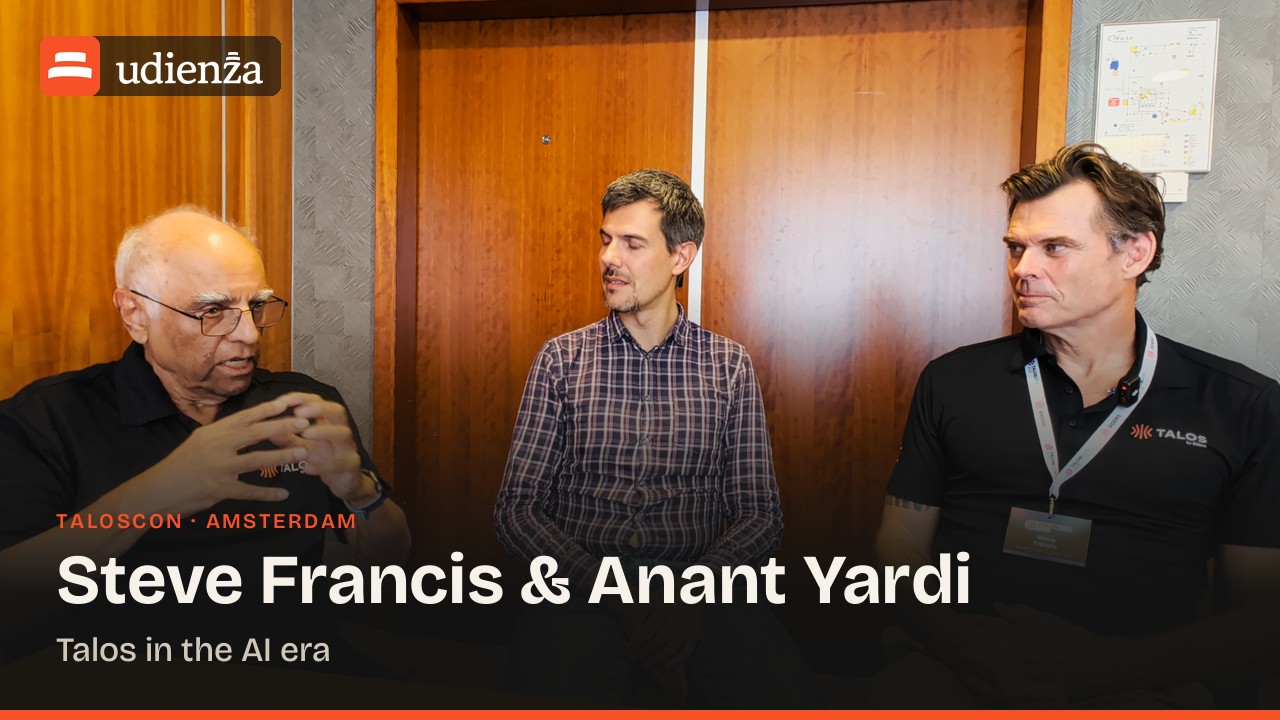
Talos in the AI era
Steve Francis of Sidero Labs and Anant Yardi at TalosCon: Talos Enterprise Linux, the hypervisor, Talos AI, and private clouds that keep AI data sovereign.
Steve Francis and Anant Yardi, President, Sidero Labs, and Founder, Yardi Systems, Sidero Labs · with  Luca Berton
Not filmed yet.
Steve Francis is President of Sidero Labs, the company behind Talos Linux and Omni. Anant Yardi founded Yardi Systems, which acquired Sidero Labs in September 2026.
Follow the show and the episode arrives the morning it's published.
In brief
- Talos Enterprise Linux packages the security artifacts enterprises need for NIS2 and Cyber Resilience Act compliance.
- It is followed by the Talos hypervisor, Talos AI and Talos Director.
- Sidero Labs and Yardi went from first contact to joint announcements in about four months.
- Sovereignty: Talos Linux and Director set up a private cloud, and open-weight models keep a company's data inside it, at lower cost.
- TalosCon grew from about 100 attendees to about 250 and then about 500; a first US edition is planned for January.
- Talos Linux has released in step with Kubernetes; with containers and virtualization in it, it will likely release more often, with upgrades that need fewer reboots.
- Everything starts at siderolabs.com: Talos, Talos Enterprise Linux, Omni and the Talos Director limited availability.
Chapters
- 0:00 Welcome to TalosCon
- 0:19 Talos Enterprise Linux, the hypervisor, Talos AI and Director
- 0:55 Four months from first contact to the announcements
- 1:37 Sovereignty: private clouds and open-weight models
- 2:28 TalosCon grows, and goes to the US
- 3:19 How often Talos will release
- 4:44 Where to try it
Why this conversation
Most platform teams meet Talos Linux as a small, locked-down operating system for Kubernetes nodes. At TalosCon in Amsterdam it was presented as something bigger: the base of a private cloud that can also run virtual machines and AI workloads. I sat down with Steve Francis, President of Sidero Labs, and Anant Yardi, founder of Yardi Systems, which acquired Sidero Labs a month earlier, to hear what changed and why.
This is the whole conversation. One interruption in the middle, which the guests asked to remove, has been cut.
A run of announcements
The first announcement was Talos Enterprise Linux, which delivers the security artifacts that enterprises need for NIS2 and Cyber Resilience Act compliance. It is followed by the Talos hypervisor, demonstrated at the conference, then Talos AI and Talos Director. Anant asked to step back for a moment to explain the pace: he and Steve did not know each other four months earlier. An email and a call in New York later, the two companies were announcing all of this together. The reaction on the floor, they say, has been very positive, with solid reviews for Director and, they believe, a first sale already.
Sovereignty and cost
Sovereignty is a big topic in Europe, and they see their products as part of the answer on two levels. On the infrastructure side, Talos Linux and Director help set up a private cloud environment. On the AI side, open-weight models mean the data that belongs to a company can stay inside that company’s private cloud. The added benefit, they point out, is that it can save a lot of money.
The community around it is growing too. This was the third in-person TalosCon, and attendance went from about 100 people in the first year to about 250 and then about 500. A first TalosCon in the United States is planned for January, another European one will follow, and the team will be at KubeCon in Salt Lake City with more to share on the product and the vision.
How often Talos will release
The practical question for anyone running it is the release cycle: long-term support, or a release every six months? Nothing is decided yet. It will depend on what clients ask for and what the industry and the market need, and the expectation is a release at least every three months, possibly more often, because the field is changing so fast. Then the history behind it. Traditionally Talos Linux followed Kubernetes: every new Kubernetes release was supported by a Talos release the next day, roughly every four months. Now Talos does more than Kubernetes. It runs standalone containers and the hypervisor, so it will probably release more often. That does not mean upgrading more often: customers already find a four-month cycle hard to keep up with. The work is going into making upgrades and configuration changes friction-free, applying configuration without reboots and keeping nodes running while they are upgraded.
Everything starts at siderolabs.com: downloading Talos, signing up for Talos Enterprise Linux and the Omni management plane, applying for the Talos Director limited availability, and hearing when Talos AI is available.
Mentioned in this episode
Transcript
Read the full transcript (automatic transcription, unedited)
0:00 All right. So, Mr. Yardi and Stephen, welcome to Udienza. Super excited to be here between you and especially at TalosCon. Thanks very much. Delighted to be here with you. So, what are the news? What are you working on? Well, the big announcements that we have had recently was Talos Enterprise Linux, which delivers all the security artifacts for enterprises that need NIS2 compliance or CRA compliance. The big announcements following that are the Talos hypervisor, and then that’s leading us to… Talos AI and Talos Cupar, which is an exit.
0:47 And Talos Director, too. Yeah. And all of these are just such exciting developments. And can I back up a little bit? Because Steve and I didn’t know each other four months ago. No. You called me, sent an email, and I called you when I was in New York. Yes. And look, three months later, we are announcing all of these things. In the hypervisor program, the demonstration looks so good. The conversations that I’ve had with some of the attendees have been very positive. The director reviews are very solid. And I might add, we have, I think, one sale already. Which is amazing.
1:33 Which is amazing. Well done. I’m super excited, especially for very young. There is a big discussion about sovereignty in Europe. Yeah. How do you see declining in your product? One more time. How do you see the sovereignty discussion in your product? Ah, yeah, yeah. So it is a big topic, sovereignty. And our products, I think, will help. Because on the cloud side, Director and Talos Linux help out with setting up a cloud, a private cloud environment. And then on the AI side, with open-weight models, we hope that we can make sure that data that belongs to a company can be sovereign and stay inside that company’s private cloud.
2:21 And it has the added benefit of saving them a lot of money. Yeah. That’s very important. Yes. So the future of TalosCon is brighter than ever. Is what? Brighter than ever. Brighter than ever, for sure. Matter of fact, we are going to be doing our first TalosCon in the U.S. early in January next year. There will be another one in Europe next year. But this is our third in-person TalosCon and attendance has just gone up and up and up every year. So from 100 people in the first year to 250 or so and now about 500. So it’s going really great. Yeah. Great. And we’ll be at KubeCon in Salt Lake City. And that should be a major event. And I’m hoping that we’ll have even more to share in terms of product development and our vision,
3:13 making sure that our vision resonates with the audience. Cool. Are you planning like a life cycle, like long-term support releases? Or will it be like one release every six months? What are you planning? So I don’t know that we have decided, but it will be based on what our clients ask for. And it will be based on what we hear in terms of things that the industry and the markets need. My suspicion is it will be at least once every three months because it is changing so rapidly and it might be more frequent. Traditionally, Talos Linux has had its life cycle synchronized with Kubernetes releases because every new release of Kubernetes, Talos would release the next day to support that Kubernetes version.
4:02 Now, of course, Talos does more than Kubernetes. It also does standalone containers. It also does the hypervisor. So I suspect we will actually be releasing Talos Linux itself more frequently because there’s more in it, but you don’t have to upgrade. One of the things we hear from our customers is keeping up with even a four-month release cycle is quite tricky. But we are working to make the, as you may have seen today, releases and configurations are becoming more and more friction-free. You can apply configurations that don’t trigger reboots. You can keep the nodes running while you are upgrading and keeping things, changing the configurations live. So releasing more frequently but getting it easier to do so. Lovely. How can I try and get in contact with your Marvelous team?
4:50 siderolabs.com. You can download Talos directly from there. You can sign up for Talos Enterprise Linux. You can sign up for the Omni management plane which is part of Talos Enterprise Linux. You can apply for the limited availability of Talos Director and be notified when Talos AI is available. It all happens there. Cool. So guys, go and check it out and thank you for having me today. Thank you very much. Thank you. Bye. Bye.
About Steve Francis and Anant Yardi
Steve Francis is President of Sidero Labs, the company behind Talos Linux and Omni. Anant Yardi founded Yardi Systems, which acquired Sidero Labs in September 2026.
Running this in production? Luca Berton helps platform teams take it from prototype to reliable production. See how he works
Built something the rest of us run on? Being a guest is free. Take the other chair
More episodes
All episodes →-
Episode 24 · Coming
Alastair Turner: Open source databases, in short
-
Episode 26 · Coming
Paula Grzegorzewska: What makes a good partnership
-
Episode 23 · Coming
The openKylin team: What AI changes in the OS
-
Episode 16 · Coming
Thilo Fromm: Why the host OS still matters