Coming soon 10:00 Recorded at Open Source Summit Europe, Prague
Kubernetes hides so much, so why should a platform team still care about the host OS?
Thilo Fromm: Why the host OS still matters
Thilo Fromm, maintainer of Flatcar Container Linux, a CNCF incubating project, on why a platform team should still care about the host OS.
Thilo Fromm, Flatcar maintainer, Microsoft,  Flatcar Container Linux · with
 Luca Berton
Recorded, coming soon.
Thilo Fromm is a long-time maintainer of Flatcar Container Linux at Microsoft. Flatcar is a minimal, image-based Linux for containers and a CNCF incubating project.
Follow the show and the episode arrives the morning it's published.
Why this conversation
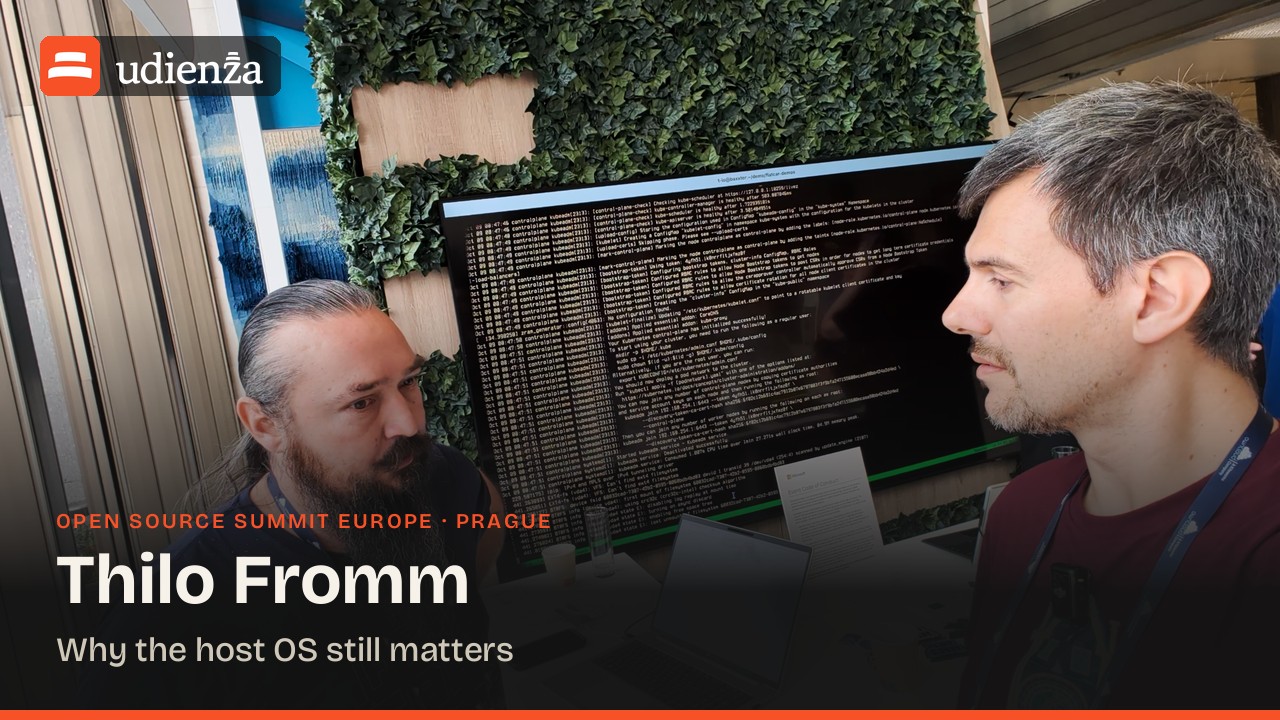
Right after the Friday keynote with Linus Torvalds and Dirk Hohndel, the show recorded Thilo Fromm at the Microsoft booth. The question: Kubernetes hides so much, so why should a platform team still care about the host OS?
Immutable, for peace of mind
“So, the benefits you gain from immutable operating systems in general is robustness and security.” “You give up a lot of customization options though, so it really needs to fit your purpose”, and Flatcar tries to stay very flexible within the boundaries of an immutable operating system. “So, I always say check the problem that you want to solve and then see if we are the right solution for that.” If it is, the biggest win is peace of mind: “Like, we like you to sleep in peace. That’s what we’re here for.”
Containers and Kubernetes first
“So, Flatcar is a special purpose operating system optimized for container and Kubernetes workloads.” Podman, Docker, Docker Compose or Kubernetes, on bare metal or in clouds, small or large: that is where it fits best. Some more adventurous users run it on embedded systems at the edge. “These are literally edge cases because they’re doing edge computing.”
The host knows the Red Hat side, with OpenShift and CoreOS underneath. “History-wise, Flatcar is a fork of the original CoreOS container Linux, which has been modernized, of course, a lot because we’ve been on our own for like seven or eight years now.” Flatcar supports as many runtime environments as it can: cloud providers natively, bare metal and virtualisation, OpenStack, and even OpenShift. Hosting images or registries depends on the environment and is out of scope, but any friction with the operating system itself is something the project wants to fix. Its documentation got a thorough review: “The documentation is something that we got massive help with from the CNCF.”
In-place updates, and who runs it
“So the biggest use case for us is straight out Kubernetes.” Flatcar has worked a lot with the Cluster API project on in-place updates of both the operating system and Kubernetes, where Kubernetes traditionally does blue-green. “Now, we on the operating system level have been doing in-place updates since forever.” Some single-node users put Flatcar in appliances, provision their containers and forget them, because the system updates itself.
Vendors have adopted it for hosted Kubernetes. “I’m going to name Stackit here because they were among the first”, with Flatcar as their default operating system: “And I have heard from them that about 90% to 95% of their capacity basically runs on Flatcar.” And there is Azure, Thilo’s employer, Flatcar’s first downstream: “It’s Azure Container Linux and they’re basically tailoring the Flatcar concept to their needs”, in a healthy upstream and downstream collaboration.
The contract
Kubernetes moves fast, and keeping clusters up to date is still hard. “So what I keep seeing quite often is just people being scared and afraid of updates”. Flatcar’s answer is a contract with its users, not quite an API: “And this is basically all of the user space bits and all of the kernel interfaces that you need to run containers. This is our contract and we are upholding this contract across minor and major operating system releases”, through very thorough testing and careful upgrades of the core packages. “So I wish operators would be more adventurous with their updates and just jump into the water to notice it’s not that cold.” Trust takes time: “You just keep not breaking user workloads over years and then they suddenly develop the trust to actually make those jumps with you.” The goal is to be as non-intrusive as possible: “And ideally, people eventually forget about operating system concerns, operating system problems in the long term because it just works.”
Getting started
“So of course there’s Flatcar.org, that’s kind of our main entry point, our main website.” “The landing page is a little bit advertising, please don’t be put off by that.” Users and developers should go to the docs. To try it without committing to anything, a learning series introduces the concepts hands-on, with throwaway VMs: “You can test everything without any regret locally on your machine.”
When it comes out
The episode is recorded and in the edit. Like every episode it goes out on YouTube first, then on Apple Podcasts, Spotify and Amazon Music. The story of the week it was filmed is in Open Source Summit Europe 2026: who we met.
About Thilo Fromm
Thilo Fromm is a long-time maintainer of Flatcar Container Linux at Microsoft. Flatcar is a minimal, image-based Linux for containers and a CNCF incubating project.
Running this in production? Luca Berton helps platform teams take it from prototype to reliable production. See how he works
Built something the rest of us run on? Being a guest is free. Take the other chair
More episodes
All episodes →-
Episode 15 · 3 Nov
Arnaldo Carvalho de Melo: Twenty years of pahole
-
Episode 17 · 10 Nov
Kavitha Daula: Isolating containers and agents
-
Episode 12 · 19 Oct
Bob Killen and Daniel Krook: How the CNCF judges
-
Episode 25 · 29 Oct
Steve Francis and Anant Yardi: Talos in the AI era