
14:51 Recorded at Open Source Summit Europe, Prague
How does the CNCF decide which of its 230 projects deserve your trust?
How the CNCF judges
Bob Killen and Daniel Krook of the CNCF on how the Technical Oversight Committee judges a project, and why AI agents stress Kubernetes.
Bob Killen and Daniel Krook, Technical program management and developer experience, Cloud Native Computing Foundation · with  Luca Berton
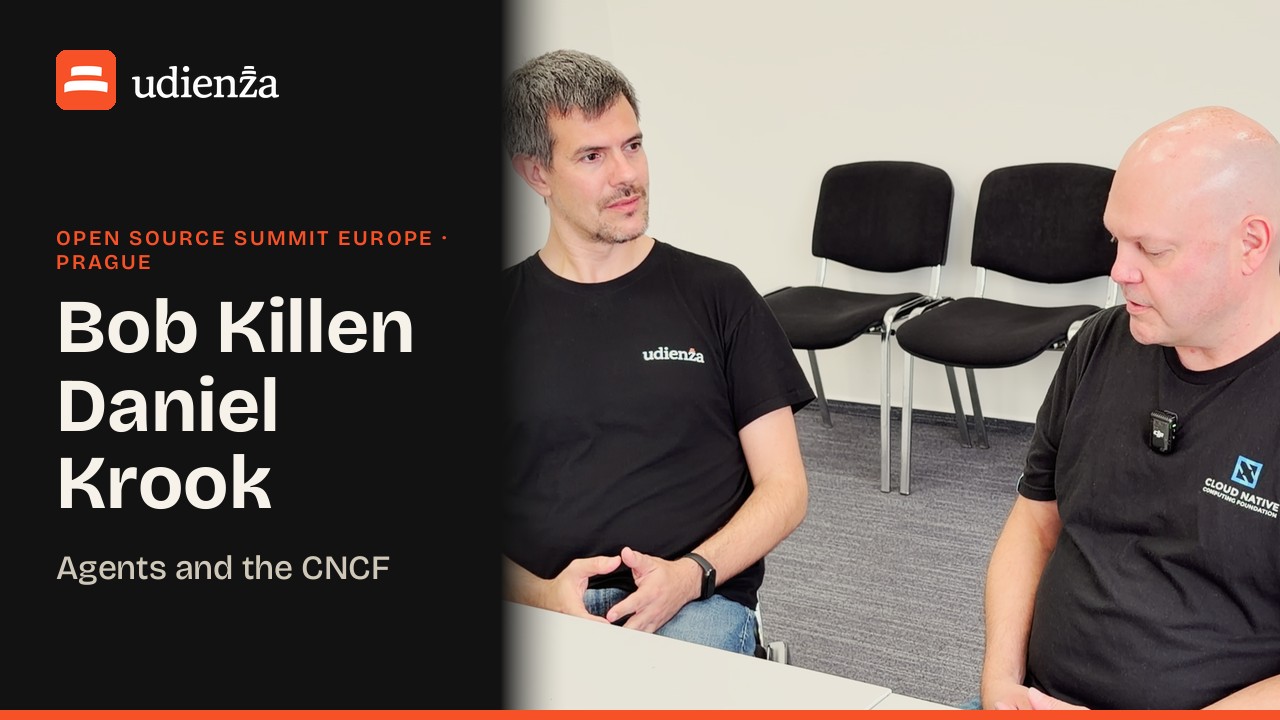
Bob Killen is Director of Technical Program Management at the Cloud Native Computing Foundation, where his work is split between the projects and the end users. Daniel Krook is the CNCF's Senior Director of Developer Experience; his team, Bob included, makes sure the projects the foundation hosts get the support, credits, docs and mentorship they need.
Rather just listen?
In brief
- The CNCF hosts about 230 projects: some 40 graduated, 40 incubating and a long tail in sandbox, plus 30 to 40 archived.
- Projects move between maturity levels through reviews by the Technical Oversight Committee, an elected group drawn from the community.
- For maintainers the basics are an enforced code of conduct, proper licensing, good documentation and transparent governance.
- The sandbox application is a public GitHub issue: its template shows what the TOC looks for before you apply.
- Agents change the load: one human action can fan out into some twenty agent requests.
- A pod takes about a second to start; agent workloads want under 200 milliseconds, and new projects bridge the gap with warm capacity.
- Getting started: pick one problem, get hands-on, and learn containers before jumping into Kubernetes.
- The next gap being closed is an end-to-end AI inference stack on Kubernetes, documented by end users' reference architectures.
Chapters
Why this conversation
A platform team that bets on a cloud native project is betting on its future: will it still be maintained, will it graduate, will something else replace it? The people who see that question from the inside are the ones who look after the projects themselves. At Open Source Summit Europe in Prague I sat down with Bob Killen, Director of Technical Program Management at the Cloud Native Computing Foundation, and Daniel Krook, its Senior Director of Developer Experience. Between them they support the projects the foundation hosts, about 230 of them that week, and they are watching what AI agents are doing to the platform those projects run on.
This is the whole conversation, start to finish. The story of the week it was filmed is in Open Source Summit Europe 2026: who we met.
How a project grows up
The numbers come first. Around 40 projects are graduated, the most mature level, and around 40 are incubating, building momentum and communities. Behind them is a long tail of sandbox projects, and another 30 to 40 have been archived, superseded or no longer relevant. Counting everything that has ever joined, the foundation is past 250, with about ten more joining at the time of recording.
Who decides which project moves up? Not Bob and Daniel’s team, they point out, but the Technical Oversight Committee: an elected group drawn from the governing board, the maintainers and the end users. It sets the criteria for moving from sandbox to incubating and from incubating to graduated, and it runs the reviews. What it looks for is health: whether a project can be depended on as a piece of critical infrastructure.
For maintainers the advice is concrete. Have a code of conduct and enforce it, license the code properly, write good documentation, and keep governance transparent so people can see how to join. The sandbox application itself is a public GitHub issue, so anyone can read the template before applying: how the project relates to the others, what unique problem it solves, and how it fits into the ecosystem.
What agents do to the platform
The most interesting trend of the last eighteen months, they say, is how many projects now treat Kubernetes as the base layer, the layer above the operating system for AI. On top of it, new projects are solving routing, gateways, model serving and the splitting of scarce hardware. There is no single stack, which is why end users contribute reference architectures that explain what they built and why.
Agents change the shape of the load. A human used to make one request, wait, and make the next. Now one human action can spin out twenty agent requests. A pod takes about a second to start, while agent workloads want answers in under 200 milliseconds, so new projects keep capacity warm to close that gap. Security follows the same pattern: established projects for isolation and machine identity are being extended to agents, alongside new ones built for them.
Where it goes next
Asked about the future, they expect AI to become as pervasive as mobile apps did: more load, from more kinds of clients, and much finer control over how that load reaches the right hardware. The next gap being closed is a complete AI inference stack on Kubernetes, with the reference architectures that come out of running it.
For people entering the field, the advice is to get hands-on. Pick one problem, build something small, try a couple of options, and learn containers properly before jumping into Kubernetes and the tools that run on top of it. For the community itself, the KubeCons and the local Kubernetes Community Days carry the conversation around the world.
Mentioned in this episode
Transcript
Read the full transcript (automatic transcription, unedited)
0:00 Hello, so welcome to Udienza. I’m super excited to be here today with you. And can you please introduce yourself? Okay. Hello, my name is Bob Killen. I am Director of Technical Program Management for the CNCF, or Cloud Native Computing Foundation. I tend to do a lot, well, my role is kind of split between doing a lot for the projects and a lot for, like, the end users and trying to bring them together. All right, and I’m Daniel Krook. I’m the Senior Director of Developer Experience, which is a long way of saying that me and my team, including Bob, we work on making sure that the 230 projects hosted at the CNCF are happy, have what they need to thrive, that they get support, credits, tech docs, support, mentorship, all sorts of benefits of being at the CNCF.
0:50 Wow, 230 projects. It’s still growing. In fact, there’s some that are basically still, well, that got voted in but haven’t completed the process, so it’ll probably be like 240 in the next two weeks. Yeah, yeah. So we have about 40 graduated projects, our most mature level, 40 incubating, which are building momentum, building communities, and a long tail of sandbox projects. And so we also have projects that are cycled out, right? So as they maybe are irrelevant or replaced by a different project, we’ve got about 30 or 40 archived ones. So all told, we’re over 250, 260 that have ever been. Yeah, and then we probably, yeah, there’s 10 more that are kind of joining right now that are not yet officially on board. So you have a lot of experience in choosing which part is good and which one has a good signal. Can you walk me through the process?
1:43 So that’s not so much on us specifically, but on the CNCF Technical Oversight Committee. It’s an elected group from the governing board, from the project maintainers, from the end users that sort of like help determine the criteria of, you know, when a project can, you know, what they need to meet to go from like sandbox to incubating and incubating to graduating. And they’re the ones that do the reviews of the projects to sort of, you know, move them on those levels. Right. And there are 11 professionals from the community, different companies that provide their unique insight into what makes a good project, what makes it healthy, and what it needs to go forward to become dependent on as a piece of critical world infrastructure. Yeah. And I could imagine that there is a lot of fantastic projects that would love to be part of this ecosystem.
2:32 So there’s a lot of great material that’s come out from our community. We used to have something called Tag Contributor Strategy that had best practices, templates, to make it easy to implement some key things that we’ve seen are great ways for projects to succeed. Having a strong code of conduct and enforcement of it, proper licensing, a great set of documentation. Governance. Governance, of course. Yeah. To make sure it’s transparent, mutually hosted, and people can contribute to it and see a way to join their communities. So we have a lot of resources for that. A lot of great content, checklists. And for example, if somebody did want to join the CNCF today, we have a sandbox application form. It’s a GitHub issue. So you can see what’s in the template, what we’re looking for, what the TOC is looking for, to what would be a good project fit for the CNCF.
3:32 So it asks them, how do they relate to other projects? What unique problem do they solve? How do they integrate into the overall ecosystem? So that’s a great way for people to see what’s going to make you successful as a CNCF project, even before you apply to join. Fantastic. And what are you doing interesting at the moment? Super curious to hear. Yeah, I think the really interesting trends in the last 18 months, just how many more projects are integrating into Kubernetes is kind of a base layer. Something we did yesterday was a talk about Kubernetes as the AIOS, right? So it’s now the layer above the operating system. But you have a whole bunch of emerging projects that are solving problems on top of Kubernetes as the default layer. And so just rapid evolution in terms of routing, gateways, serving, splitting up hardware resources.
4:24 And there’s no one stack, but there’s a lot of projects solving particular areas within that logical stack. It’s a lot of great innovation in the last few years. Yeah, we actually have a collection of reference architectures that are all contributed by end user members that sort of describe their stack and sort of the purpose of why they built it, how they built them, sort of describing the decisions that they made just because there is so much, there’s so many options. You know, if you go take a look at the landscape, there’s a thousand things on there and it can be quite confusing. And that’s kind of where, you know, some of the reference architectures really try and like help give at least a pointer to where people can start to learn a little bit more about this stuff. Yeah, thank you. Every time I’m looking at landscape, I got fascinated how big and fast it’s becoming.
5:10 It has become kind of a meme. Yes, since the early days, it was a meme. But yeah, it’s amazing. So there’s just so much innovation happening within the community. We’re trying to attract more projects in. And, you know, the CNCF doesn’t pick winners. We would see a lot of projects thrive within our ecosystem. And there’s a lot of, as you say, Kubernetes becoming a operating system for artificial intelligence, agenting AI, and many other innovations. Yeah, there’s a lot of, so agents have certainly been driving a lot of different types of, different workload or how the systems are being used. So like, for example, for every, you know, if it was just human speed of doing one request, waiting for the answer, doing their next request, right? There’s kind of not too many individual requests. It’s one human driving them all. Now you see one human, they make one action, 20 agents spin out.
5:59 So now you have for each one human request, like 23 agent requests. And of course, what that does to the systems handling the load, we see a lot of people trying to solve that. And for example, like Kubernetes itself is honestly not the best to handle that kind of workload. But we’ve now seen products come out like LMD or agent substrate that are basically tailored to fit that kind of workload. So like with a pod in Kubernetes, the guarantee of spinning one up is about one second. And now with the agents, you’re looking for sub 200 millisecond response time. That doesn’t work too well when you basically only have a guarantee of one second of spring of a pod. And that’s where these tools kind of bridge the gap of keeping sort of warm pods up and going. And they can rapidly spin up, you know, up to billions of agents in, you know, sub 200 milliseconds.
6:49 Wow, sub 200 milliseconds. Sub 200, yeah. It’s incredible. I have a chat yesterday with a gentleman who is working on BPF. And it sounds like security is getting more important. Yes. And having also, I would say, it was mentioning that having like continuous probing and just to make sure that everything is on track. Yeah. How can you cope with this very fast pacing scenario? Yeah. Well, I think there’s two different parts of the story, right? So there’s a whole bunch of problems that have already been solved in the Kubernetes ecosystem, which is great. So that gives you a good foundation. But then you have a lot of these brand new projects. So, for example, the most recent sandbox review, we had a couple of security projects around isolating agents.
7:35 So gVisor, when the project’s been around for many years, that isolate containers, it’s now being used to isolate. Yeah, being extended specifically for isolating agents. Correct. And then you’ve got the agent substrate, which Bob mentioned, to put more dense load on there. So we’ve got the traditional primitives and then these brand new projects coming in that are solving these emerging problems. Wow. I can’t. I want to go deeper and take a look on everything of this. So the agent has a new challenges upcoming, like credential, authentication, and there’s a lot of concern around this. Yeah. Yeah, I think OpenShell is probably a good example, too, of kind of declaring what agent can and cannot do. And there’s, like, you know, other historical projects like, you know, SPIFFE and SPIRE that
8:22 are much more like on, like, machine identity or pod identity and things like that and being able to tie that identity to, you know, a, like, say, like, an authenticated user or something else for initiating that kind of request. Yeah, because we see that the credentials, I think, should leave them more. Yep, exactly. Yeah, yeah. And where do you think we’re going to go? How do you see the future? I don’t know. That’s a good question. Well, I just look at it from, yeah, no, obviously, AI is going to become more pervasive, right? So just like when people started getting mobile phones, now communications were more pervasive, and then apps on mobile phones became more and more pervasive. So more happened, right? More load, more things going on at the same time. So we definitely see a lot more load coming from lots of different places from, you know,
9:09 non-traditional clients, you know, no longer just mobile apps hitting mobile backends or people hitting websites or using microservices. Something you’re just hitting on your behalf. Yeah, exactly. So just a ton more load and a lot more granularity in how that load is handled and routed to the right hardware and how that hardware is split up now to meet the load. So a lot of the interesting innovation I think happening in CNCF is this software layer above the scarce hardware. So making better use of these investments and kind of meeting that agent load for the future. Good example, the HEMI project, which is their, it’s like entire purposes being able to like slice up hardware and like other various like devices, be able to hand it off to the agents and, or the various things that are requesting them and much more trying to like right size
9:55 the request. And there is more work going into that too, where it’s just like, okay, the request from the agent is coming in. Let’s take a look at its size and its actual requirements. Then trying to map that out to, okay, what resources should it actually, you know, which resources should it be mapped to in terms of consumption on the substrate? Wow, I like that this, all these projects are trying to solve a different type of, optimize a different type of problem. I think this type of vibrant community is what is really driving the innovation. Yeah, yeah, yeah. And I saw that Kubecom is becoming worldwide. I was personally in Europe, in London, Amsterdam, next year in Barcelona.
10:44 But also in North America, establishment is sort of excited, is coming. And I was in Japan. I was surprised. It was fantastic. I was in Japan as well. Yeah, and I was at the one in India. So we see a lot of these growing communities around the world. And China as well, I was at that one. And so it’s interesting. Yeah, the regions that are emerging, starting off with Kubecom’s in the U.S. and shortly after in Europe 10 years ago. And then just the regions that are now building these amazing communities of builders in their local communities that are kind of influencing the direction of where the technology is going. And then there is also the KCD. Oh, yeah. The local branch. The cloud network community is absolutely a global community. It really, like, out of most of the products that I’ve been involved in,
11:33 you know, my history, OpenStack sort of led the way, but it really grew into this global, you know, very large community. Yeah, CNCF space. Exactly. Yeah, no, I think the KCVs are my favorite events to go to just because it’s one day, a whole bunch of material, and it’s run by the local community, right? But of course, KubeCon is where you want to go to be part of the larger conversation, but it’s always great. If you can’t get to a KubeCon, look for a KCV, find something local. But definitely, yeah, if you want to really see what the current state of the world is, I suggest going to KubeCon NA in Salt Lake City next month. Wow. Definitely, we need to go and check it out. And it looks like the cloud native is becoming the go-to profession. What advice do you give to young talents that just enter the market nowadays
12:23 and might be a little bit overwhelmed by the amount of innovation that are happening? Yeah, good question. And this is actually a traditional question that I’ve gotten from people like, well, how do you get into web? How do you get into cloud? It’s you’ve got to get hands-on. And generally, it’s a lot of fun. Just pick something. It doesn’t matter if it’s the most popular or maybe it’s just interesting. Or if you have like an itch you want to scratch, you want to build a type of application, maybe just build a local, you know, inferencing something on your machine. Just find a problem you think this stuff’s going to solve. Maybe try to play with a couple of different options until you get there. And that way you understand how it works kind of from the underlying principles. And then you can kind of understand the value of something more complex that’s hosted in the cloud that has a lot of moving parts and why you would go from building something simple
13:10 to scaling it. Something larger. The other thing I’ll say is that a common pitfall, I see a lot of people that are new to the space that don’t necessarily have a lot of container knowledge, they’ll jump right into Kubernetes. There’s some of these tools that are running on top of it. But since they don’t understand sort of the primitives, that winds up sort of like setting themselves up for failure downstream when they’re trying to spin these up. So I definitely recommend that when they do sort of dive into one of these projects, they do experiment and learn a little bit more about each layer as they go up to spin up. And what are the latest news from CNCF, how do you see the 2027? 2027, well, I do see like an emerging, like full end-to-end AI inferencing stack being brought
14:03 together on top of Kubernetes. I think that’s interesting because there were a few gaps in the ecosystem in CNCF. There was a lot of vendor-supported open source projects that are now actually going to be now actually come into the CNCF. So things like OpenShell, I mentioned earlier, gVisor, yeah, things from Google. So just all that coming together. And we’ll see what the reference architectures that emerge from people being successful with those stacks. I love the reference architecture. Thank you for bringing it in. So thank you very much for being on the show. And definitely thank you for having me. Let’s keep in touch. Thank you, Carlos.
About Bob Killen and Daniel Krook
Bob Killen is Director of Technical Program Management at the Cloud Native Computing Foundation, where his work is split between the projects and the end users. Daniel Krook is the CNCF's Senior Director of Developer Experience; his team, Bob included, makes sure the projects the foundation hosts get the support, credits, docs and mentorship they need.
Running this in production? Luca Berton helps platform teams take it from prototype to reliable production. See how he works
Built something the rest of us run on? Being a guest is free. Take the other chair
More episodes
All episodes →-
Episode 11 · Coming
Dilip Lukose: Orchestrating agentic systems
-
Episode 13 · Coming
Ben Potter: When the developer is an agent
-
Episode 09 · Coming
Shannon Williams: When enterprises trust agents
-
Episode 30 · Coming
Sudeep Goswami: Runtime governance for AI agents
Discussion
Questions for Bob, or something we got wrong? The conversation continues under the video on YouTube.