Coming soon 10:00 Recorded at Open Source Summit Europe, Prague
Where should an AI coding agent run when it is the one writing your code?
Ben Potter: When the developer is an agent
Ben Potter (Product, OSS & Developer Relations, Coder) on cloud development environments and AI coding agents: what changes when the developer is an agent.
Ben Potter, Product, OSS & Developer Relations, Coder · with  Luca Berton
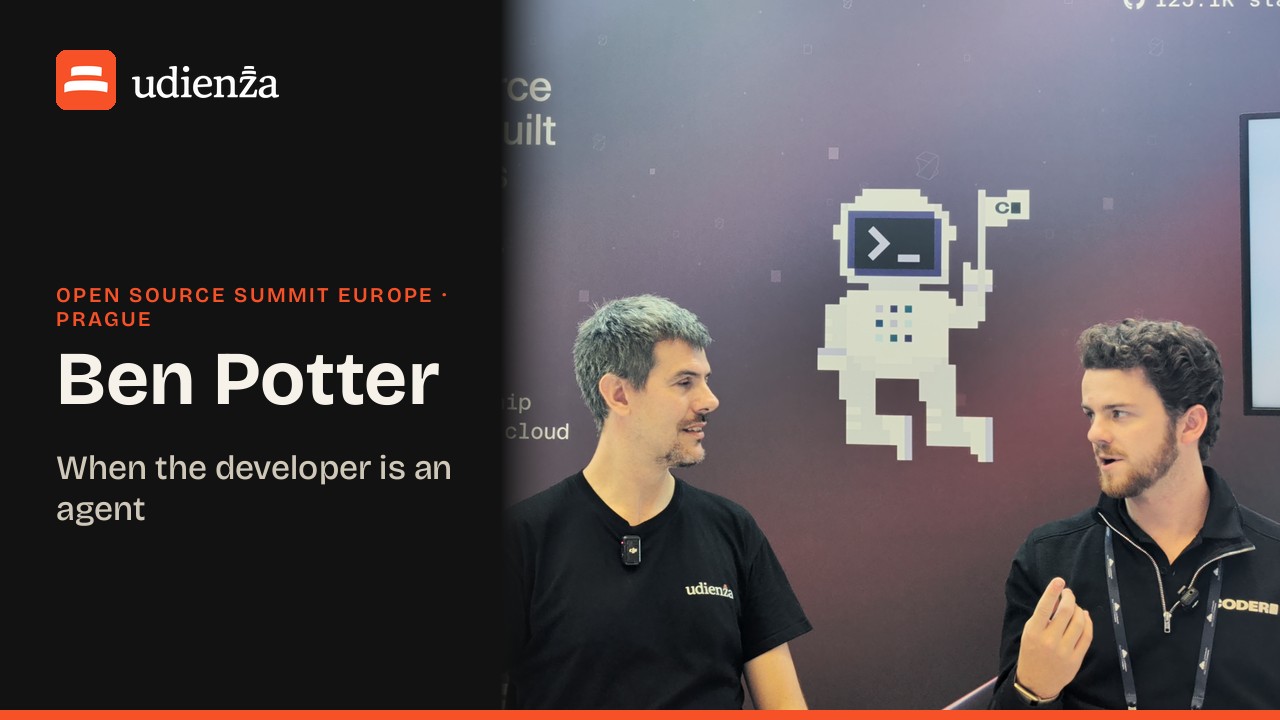
Recorded, coming soon.
Ben Potter works on product, open source and developer relations at Coder, the company behind the open source cloud development environment platform of the same name, where he has been for six years.
Follow the show and the episode arrives the morning it's published.
Why this conversation
Cloud development environments were built for people. Ben Potter opened the show’s Thursday in Prague with the question of what changes when the developer at the keyboard is an AI coding agent, and where that agent should run. Thanks to Cassandra Jowett at Coder for setting it up.
Outgrowing the laptop
Ben is a product manager at Coder, “and I’ve been here for six years.” The host asked what changes when the development environment moves to the cloud. “So for the longest time, people have been doing all of their coding on laptops”, he said, and laptops are great and powerful. “But we’re finding that for a lot of different organizations, they’re outgrowing the laptop”: someone who wants to vibe code an application without being familiar with the CLI, or someone running 10 or 12 different agents, for whom the laptop is no longer productive or secure. So more and more people take the workloads they are used to running on laptops and move them into remote cloud environments.
Six or seven agents at once
His own example is prototyping. “I love to do prototyping as a product manager”, and AI has made it much easier to prototype a new concept: “at any given time, I will have six or seven different agents working”, each coming up with variations of prototypes for things to improve in the product. An A/B test, the host suggested, and Ben agreed: “not just with different prompts, but with different models and even different entire ideas and prototypes.”
That cannot all run on one laptop. “If I shut my laptop or I need to take a meeting or something, the agents will stall”, while on a cloud workspace they keep running without intervention. Then there is security: on his laptop, “the agent could read my email”. On remote sandboxes he has “the peace of mind that they’re properly firewalled off, both on the workspace layer as well as the infrastructure and network layer.”
One click for everyone’s workflow
The host raised the tools agents want to use: the CLI, MCP, WebMCP and the protocols still to come. Coder sees a gap between a power user, who has the right skills, MCP servers and tools, and the next person on the team, who does not know how to build the same workflows. “For example, I do prototyping with six or seven agents, but how do I help other product managers do prototyping like me?” What Coder is building is “a one-click environment that has all of the tools and skills and kind of things that you would need without having each developer having become a power user”. Everyone gets the same workflow: “So you kind of have that reproducibility and consistency.”
Bring your own harness
Coder is building a harness of its own and integrating with others. Subagents have proved useful for evaluators, plans and agent coordination, and people with a strong workflow in another agent should be able to use it inside Coder too. “So you can think of it like you kind of bring your workflow into Coder”, and Coder’s job is to give it “that really strong execution environment.” Choice matters: Anthropic has great models, features and a harness, “but we want to give our customers and our users choice”, depending on the task or on compliance requirements. Coder runs local LLMs itself, “both for a cost reason and also just, it’s fun.”
Sovereignty, fully air-gapped
In Europe sovereignty is a big topic, the host said. “You can run Coder completely air-gapped and you can also run the models completely air-gapped”, so one box can run all of your AI workflows without anything going to the cloud. Coder can point to any model provider, Bedrock, Anthropic or a local one: “We take it all, basically.”
Getting started
The open source version is on GitHub, under Coder, to download and use. Ben runs it in his own home lab, with Raspberry Pis and servers. For enterprises there is a version with governance, cost controls and high availability, on-prem or in a cloud provider, at Coder.com: “It’s pretty easy to find us.”
When it comes out
The episode is recorded and in the edit. Like every episode it goes out on YouTube first, then on Apple Podcasts, Spotify and Amazon Music. The story of the week it was filmed is in Open Source Summit Europe 2026: who we met.
About Ben Potter
Ben Potter works on product, open source and developer relations at Coder, the company behind the open source cloud development environment platform of the same name, where he has been for six years.
Running this in production? Luca Berton helps platform teams take it from prototype to reliable production. See how he works
Built something the rest of us run on? Being a guest is free. Take the other chair
More episodes
All episodes →-
Episode 12 · 19 Oct
Bob Killen and Daniel Krook: How the CNCF judges
-
Episode 14 · 27 Oct
Greg Kroah-Hartman: Inside the stable kernel
-
Episode 04 · 26 May
Luca Galante: Platform Engineering 2.0
-
Episode 28 · Coming
Benjamin Hindman: Coding agents without drift