Coming soon 9:28 Recorded at AGNTCon + MCPCon Europe, Amsterdam
What does a company need in place before employees work with AI agents?
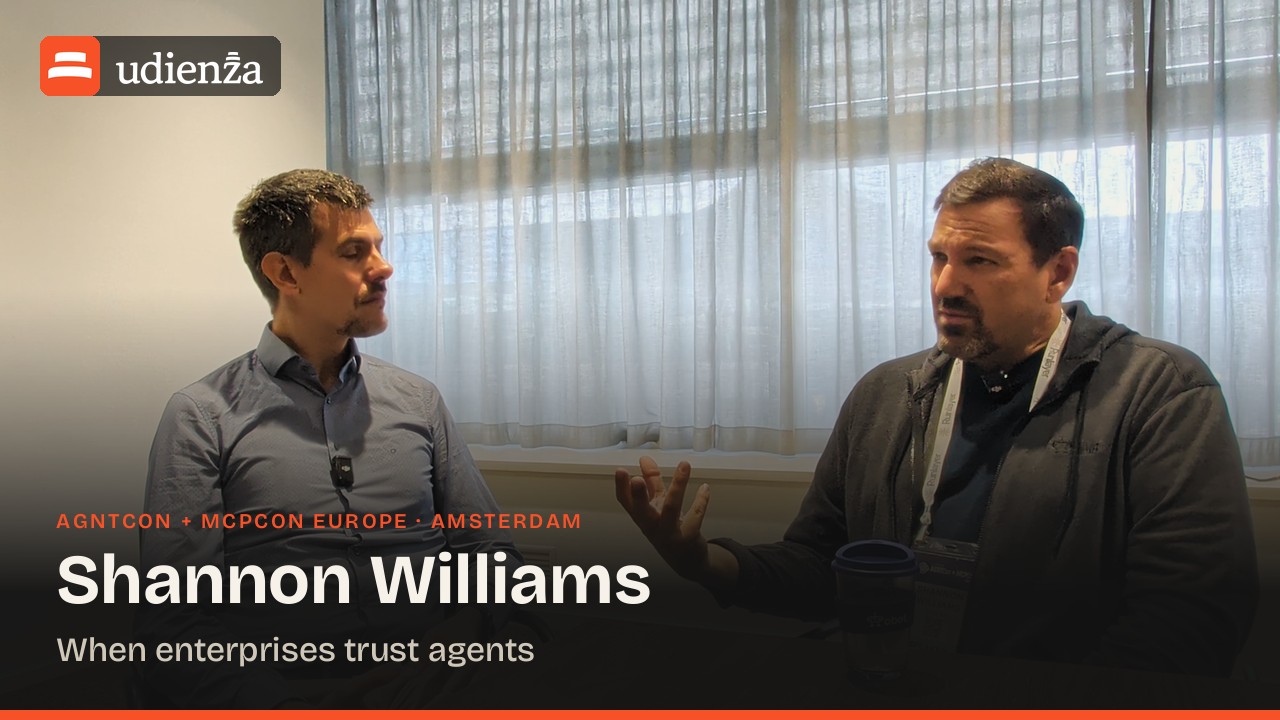
Shannon Williams: When enterprises trust agents
Shannon Williams, President and Co-founder of Obot AI, on an open source control plane for AI agents: gateways, sandboxes, identity, audit and token cost.
Shannon Williams, President and Co-founder,  Obot AI · with
 Luca Berton
Recorded, coming soon.
Shannon Williams is President and Co-founder of Obot AI, which builds Obot, an open source control plane for how AI agents connect to data, systems, models and skills. Before Obot, he and his co-founders started Rancher.
Follow the show and the episode arrives the morning it's published.
In brief
- Obot is an open source control plane for how AI agents connect to data, systems, models and skills, so a company can see what its AI tools do and hold them to its policies.
- It works at three levels: MCP and model gateways, isolated agents hosted in sandboxes on a company's own infrastructure, and controls and audit on users' laptops.
- What coding assistants do locally, calling CLIs, APIs and Bash, becomes visible to the organisation and can have policy applied to it.
- Obot runs on Kubernetes as its compute layer: network control, containers, MCP servers spawned for a single run, and sandboxes with limited network access.
- Assistants such as Microsoft Copilot and enterprise ChatGPT connect through their own catalogs; an agent you build gets an identity, an API key and a URL, and is audited from there.
- He expects most employees to work with agents that take continuous actions on their behalf within the next 12 to 24 months.
- The biggest limits today are the cost of tokens and enough governance to be sure an agent's work adds no risk and is worth what it costs.
- The Obot project is 100% open source on GitHub; the company offers an enterprise version with support for running it at scale.
Chapters
- 0:00 Obot: a control plane for agents
- 1:19 A crowded market, one platform
- 2:22 Kubernetes as the agents' compute
- 4:00 Harnesses, MCP and identity
- 5:12 Agents that take actions
- 6:32 Many frameworks, more complexity
- 7:44 What will agents cost?
- 8:15 Open source paves the way
Why this conversation
Once agents can read a company’s data, call its systems and take actions on their own, someone has to decide what they are allowed to reach, see what they did, and pay for the tokens they use. For a platform team, that is a new layer of infrastructure to run, alongside the models and tools the agents call.
Shannon Williams is President and Co-founder of Obot AI. Before Obot, he and his co-founders started Rancher, so he has been working in the Kubernetes space for a long time. The host spoke with him on the Friday morning of AGNTCon + MCPCon Europe in Amsterdam, the second day of the conference. The story of the week is in AGNTCon + MCPCon Europe 2026: who we met.
A control plane at three levels
He described Obot as “an open source control plane for managing how AI agents connect to data and systems,” and to models and skills as well. It deals with that at a few different levels. At the gateway level, Obot runs MCP gateways and model gateways. At the next level, it creates isolated, hosted agents that run in sandboxes on a company’s own infrastructure. And at the local level, it sets up controls, audit and management for what runs on users’ laptops. The point is to help people put in place the controls they need to see what is happening with their AI tools and to make sure it meets their policies.
The host pointed out that other projects also offer MCP gateways or agent orchestration. It is a very crowded market, Shannon agreed, with a lot of tools and projects. What he says has drawn people to Obot is that it brings those pieces together: the MCP gateway and model gateway, agent orchestration, and what people do with coding assistants on their own machines. When those assistants call CLIs, APIs and Bash, that activity becomes visible to the organisation and can have policy applied to it. It is open source, it runs on Kubernetes, and the aim is that you set it up, turn it on, and manage authorisations and controls wherever agents run.
Kubernetes as the compute layer
When the founders saw the problem, Kubernetes was the natural way to solve it. It gives Obot the ability to control network traffic and to create containers. That matters when Obot needs to spawn an MCP server for a specific run. It matters again for sandboxes: running a harness, attaching it to a model and giving it tools, without giving it full network access, and only allowing certain users into it. Using Kubernetes deeply on the back end makes the system more dynamic than a gateway at the network layer. It takes on the operational questions: where all of this runs, how it is audited and how it is governed.
Identity for agents
Asked how a developer gets started, he split the use cases in two. The first is assistants: coding assistants, Microsoft Copilot, enterprise ChatGPT, tools that reach models and MCP servers through a harness. There, Obot connects to their catalogs and frameworks, so people stay in the tool they want to work in and switch on capabilities, tools and plugins there.
The second is an agent you build yourself. What it needs is an identity combined with a set of access privileges. Obot gives the agent an identity, an API key and a URL to connect to what it needs, whether models or MCP servers. Once it is connected, Obot can apply audit, filtering, guardrails and the other controls that keep the agent within the organisation’s policies.
Agents that act, and what they cost
Most of the organisations he talks to are looking at how to give employees agents with a lot of capabilities, ones that take continuous actions and check things daily, weekly or monthly. Codex and ChatGPT, he noted, offer good versions of that. Over the next 12 to 24 months he expects most employees in most companies to have such agents working with them on a daily basis. One option is to pick a single technology, such as Claude, and stay inside that ecosystem, which keeps complexity down by limiting the number of solutions. Once a company uses multiple frameworks, multiple types of agents and many models from different vendors, tools like Obot that handle heterogeneous models, catalogs and user types become valuable.
For many organisations, the biggest limit today is the cost of tokens, together with enough governance to be confident of two things: that the work does not add risk to the organisation, and that it is worth doing. His example was a simple one: “what did it cost to have the AI agent book a flight for me?” If an agent searched for hours to do something a system once did for almost nothing, the next questions are how token usage is routed to models by price, and where the AI budget is best invested.
Where to find it
Obot is at obot.ai, and the Obot project is 100% open source on GitHub, ready to download and try. The company offers an enterprise version with support for organisations that want to scale it up and use it broadly. He sees open source, as it did with containerisation and cloud computing, paving much of the way for how these problems get solved, before the real opportunities for further innovation become clear.
Mentioned in this episode
About Shannon Williams
Shannon Williams is President and Co-founder of Obot AI, which builds Obot, an open source control plane for how AI agents connect to data, systems, models and skills. Before Obot, he and his co-founders started Rancher.
Running this in production? Luca Berton helps platform teams take it from prototype to reliable production. See how he works
Built something the rest of us run on? Being a guest is free. Take the other chair
More episodes
All episodes →-
Episode 08 · 22 Oct
Theophile Jegou du Laz and Avery Louis: Agent infrastructure at scale
-
Episode 10 · 6 Oct
Guido Laout: A European public cloud
-
Episode 30 · Coming
Sudeep Goswami: Runtime governance for AI agents
-
Episode 38 · Coming
Andrew Lenehan: Governing agents your teams use