
9:26 Recorded at AGNTCon + MCPCon Europe, Amsterdam
Can an AI assistant search science without making up its sources?
Theophile Jegou du Laz and Avery Louis: Agent infrastructure at scale
Theophile Jegou du Laz and Avery Louis of Valency on an MCP server that lets any language model search open-access science, and on where AI takes research.
Theophile Jegou du Laz and Avery Louis, Team member and Founding Research Engineer, Valency · with  Luca Berton
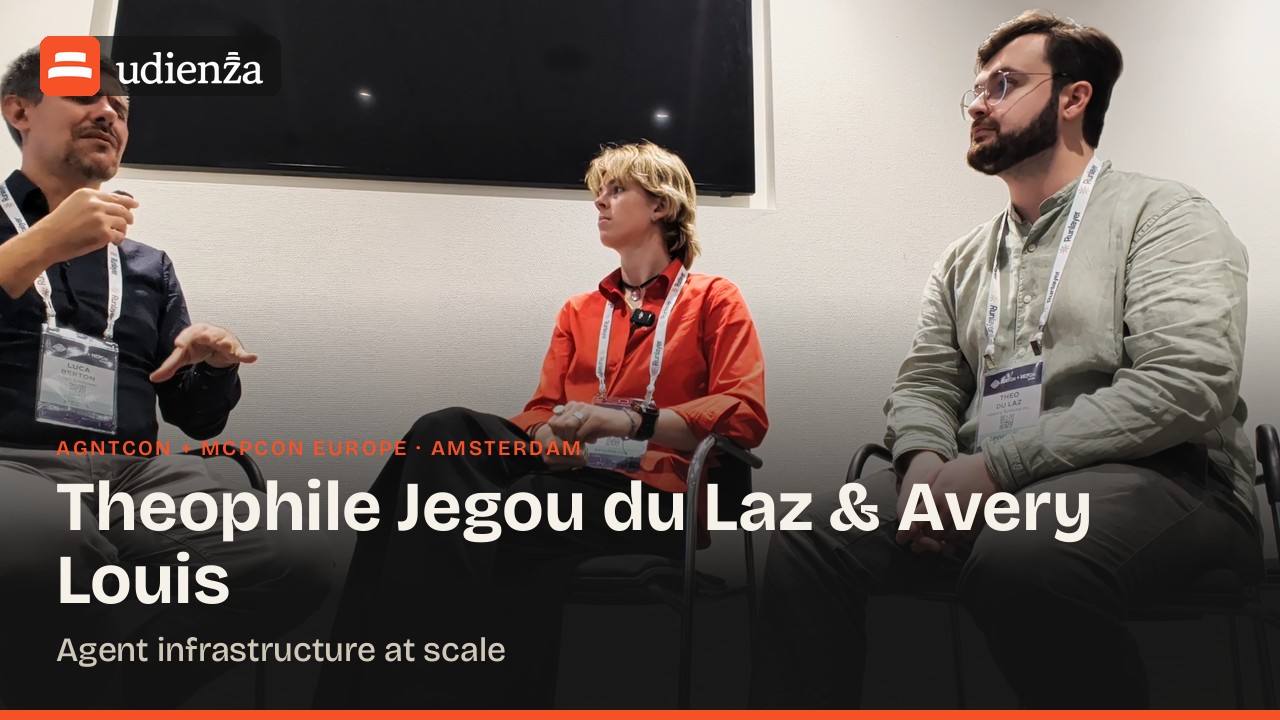
Theophile Jegou du Laz and Avery Louis, Founding Research Engineer, work at Valency, a team of researchers building tools for researchers: an MCP server that connects any language model to open-access scientific research.
Rather just listen?
In brief
- Valency has built an MCP server that plugs into any LLM and lets it search scientific research from almost any open-access platform on the internet.
- Finding papers is easy. Processing them so the data set is normalised across fields, each with its own conventions for writing and citing, is the hard part.
- Without it, an assistant does the equivalent of a web search, pulling in blogs and sometimes hallucinating; with it, the search runs over papers known to exist.
- Valency also scores the quality of individual papers, so the model can sort through them and reason over that as well.
- One of the guests, formerly in time-domain astronomy, found with the tool in a day or two what had taken months of searching for a recent paper.
- Only open-access research is ingested: paywalled papers could not be served anyway, and how much is open differs from field to field.
- The next frontier they see is combining knowledge across dissimilar fields, which suits the breadth-first reasoning of LLMs better than depth-first humans.
- Science should stay people-centric: people drive it and are accountable for what gets published.
Chapters
Why this conversation
Ask a general-purpose AI assistant about the latest research on a topic and it will usually do the equivalent of a web search: blogs and all sorts of other sources, and sometimes a hallucination. For anyone who relies on an answer being traceable to real work, that is the problem to solve before the assistant is useful at all. Connecting the model to a curated source through MCP is one way to solve it.
Theophile Jegou du Laz and Avery Louis, Founding Research Engineer, work at Valency, which they describe as a bunch of researchers building tools for researchers. The host spoke with them on the Thursday afternoon, the first day of AGNTCon + MCPCon Europe in Amsterdam. The story of the week is in AGNTCon + MCPCon Europe 2026: who we met.
Searching papers that exist
Valency has built an MCP server that connects to any LLM and lets it search and surface scientific research from almost any open-access platform on the internet. Finding scientific papers, they said, is easy. Processing them properly so that the data set is normalised is not. There are so many papers, in so many fields, and each field has its own standards for how papers are written, how they are valued and how they are cited. Surfacing them in a meaningful way for someone researching with an AI tool takes knowledge of all those domains.
The host asked how a user can trace where an answer came from and be sure it is real research rather than a hallucination. In use, the MCP plugs into whatever LLM a person already uses. A query about a topic usually starts with semantic search. Without the MCP, Claude, ChatGPT or another assistant does a web search and pulls up all sorts of sources. With it, the guard rail is that the search runs over scientific papers known to exist. Valency also works on scoring those papers, judging the quality of each one, so that a person can sort through them and the model can reason over that as well.
Months of searching in a day
One of the guests came from time-domain astronomy, where researchers look at the sky every night, find many different things, and each care about different ones, so the data has to be processed to give each of them what they need. Shortly before starting at Valency, that guest had published a paper. Trying the tool afterwards, what had taken months to find would have taken a day or two. The foundational papers in a field are easy enough to find. The hard part is finding the newest work, or a paper closely related to a famous one that has something the famous one lacks. Exploring that space is hard without a tool like this.
They put it more broadly too. Research is one of humanity’s oldest activities, and the body of knowledge grows so quickly that it becomes impossible for a researcher to know whether someone has already done something, or whether a claim has been verified. Valency sees its role as the layer that lets people explore that corpus.
Paywalls and open access
The host raised paywalls: institutions finance research and expect some return. Valency only ingests open-access research, anything that can be found and read online for free. It does not ingest research that is closed or behind a paywall, because it could not serve it anyway. They see science moving towards open access, and called the system a little broken, since many authors have to pay for their paper to be open access in a journal. They described it as a virtuous loop: a publicly accessible tool serving publicly accessible papers, in the hope that people use it to add more public research. The catch is that it is not the same in every field. They contrasted machine learning and physics with fields such as the humanities, where more of the research is closed. So there is a bias: what Valency can serve depends on what you work on.
AI and the future of science
Looking five to ten years ahead, Avery expects AI to accelerate science a great deal, through efficiency in doing research and through reasoning over the whole corpus. Much that has not been discovered is knowledge that already exists but has not been combined, such as something invented in physics that turns out to be useful in biology. Humans tend to be depth-first reasoners, while LLMs are native at going breadth-first.
Theo agreed: for him that is the next frontier, looking for answers in fields so different from your own that a person could hardly work through the papers and see how they apply. He also hopes science stays people-centric. That is something Valency cares about: research has to be driven by people first, and people are accountable for the papers they put out. The hope is that AI shortens the path from an idea to an answer, so people can keep exploring, while creativity stays human.
Valency is at valency.io, where anyone can sign up and use the MCP.
Mentioned in this episode
About Theophile Jegou du Laz and Avery Louis
Theophile Jegou du Laz and Avery Louis, Founding Research Engineer, work at Valency, a team of researchers building tools for researchers: an MCP server that connects any language model to open-access scientific research.
Running this in production? Luca Berton helps platform teams take it from prototype to reliable production. See how he works
Built something the rest of us run on? Being a guest is free. Take the other chair
More episodes
All episodes →-
Episode 07 · Coming
Frédéric Barthelet: Alpic, in thirty seconds
-
Episode 09 · Coming
Shannon Williams: When enterprises trust agents
-
Episode 06 · 7 Oct
Manik Surtani: How goose led to the AAIF
-
Episode 11 · Coming
Dilip Lukose: Orkes: APIs, agents and humans
Discussion
Questions for Theophile, or something we got wrong? The conversation continues under the video on YouTube.