Coming soon 5:54 Recorded at Open Source Summit Europe, Prague
Is a container boundary enough once an AI agent is running inside it?
Isolating containers and agents
Kavitha Daula, VP of Engineering at Edera, on giving each container workload its own micro-VM and kernel, the trade-off with performance, and AI-written code.
Kavitha Daula, VP of Engineering,  Edera · with
 Luca Berton
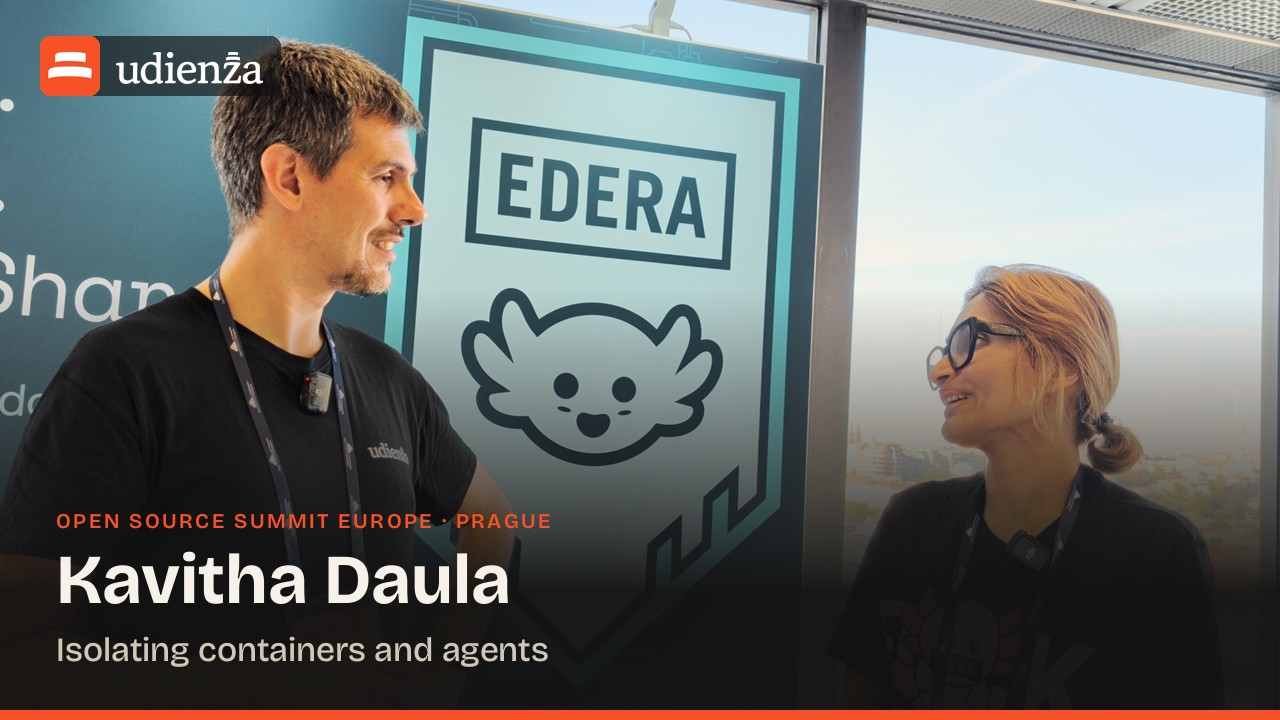
Not filmed yet.
Kavitha Daula is VP of Engineering at Edera, which builds hypervisor-based isolation for containers and AI workloads: a secure micro-VM, with its own guest kernel, for each workload.
Follow the show and the episode arrives the morning it's published.
In brief
- Containers on Kubernetes share one kernel, so a compromised container can reach beyond itself and affect the whole cluster.
- Edera runs each workload in its own micro-VM, which it calls a zone, with its own guest kernel: a breach stays inside that zone.
- Workloads can share a zone or be split across zones; where to draw the line is a choice between security and performance.
- In regulated sectors such as healthcare and banking, zones can keep workloads like CI and databases from running together.
- Isolation is not only a regulated-sector problem: anyone running Kubernetes should take it seriously, more so with AI agents and AI-written code.
- After making Edera work at scale, the team is now taking it beyond Kubernetes; a node can be tried through on.edera.dev.
Chapters
- 0:00 Isolation for containers
- 0:50 Edera: a micro-VM per workload
- 1:45 Security vs performance
- 2:40 Zones for regulated sectors
- 3:29 Isolation for AI-written code
- 4:17 Edera at scale
Why this conversation
Containers running on Kubernetes share one kernel. Anything that can affect that kernel can affect every container on it, and a container that is compromised can be the way into the rest of the cluster. For a platform team that runs code it did not write, and more and more code that an AI agent wrote, that shared kernel is the boundary that matters.
Kavitha Daula, VP of Engineering at Edera, hosted the show at the Edera booth on the Wednesday of Open Source Summit Europe in Prague. Asked what Edera is, she started one step back, with isolation in general, and only then came to the product. The story of the week it was filmed is in Open Source Summit Europe 2026: who we met.
A micro-VM for each workload
Edera builds a secure micro-VM in which each workload gets its own guest kernel. Edera calls these zones. If there is a breach, it happens in one zone and does not move across to the others, so the damage is contained to that one workload.
The host asked what a micro-VM maps to: a tenant or a workload. A workload, she said, but the boundaries are the user’s to draw. Several things can go into the same zone, or different workloads can sit in separate zones, and the zones are put together into whatever secure architecture the team wants.
That choice is where the trade-off sits. Security versus performance always comes up, and the person designing the system has to pick: what runs together in one zone, and what is kept apart.
Where isolation is used
The first use case she named is the highly regulated environment, where multi-tenant workloads should not share a cluster with each other. You do not want CI, a database and everything else running together in the same place; each can have its own zone. Healthcare and banking are the sectors she pointed to.
She does not see it as a problem for regulated sectors only. AI workloads and agents are a second case, and she referred to a recent incident involving AI agents to make the point. “Anybody who’s using Kubernetes should be looking at isolation pretty seriously,” she said, and now almost everybody is using AI in one way or another.
AI-written code adds to it. What would have been written in five lines is now 50, and over time nobody knows everything that is in there, or what it can affect. Isolation limits how far any of it can reach.
What comes next
Last year, the interesting work for her was getting Edera to run at scale in a way that is both performant and secure. Now the team is working to run Edera on more than Kubernetes.
What she enjoys most personally is education: making people aware of the security concerns of running workloads in a vanilla container, and of the challenges with Kubernetes itself. The host added that Kubernetes is not one thing either, given all the flavours on the market.
To try it, she pointed to the website, on.edera.dev, where at least one node of Edera can be set up and spun up.
Mentioned in this episode
About Kavitha Daula
Kavitha Daula is VP of Engineering at Edera, which builds hypervisor-based isolation for containers and AI workloads: a secure micro-VM, with its own guest kernel, for each workload.
Running this in production? Luca Berton helps platform teams take it from prototype to reliable production. See how he works
Built something the rest of us run on? Being a guest is free. Take the other chair
More episodes
All episodes →-
Episode 16 · Coming
Thilo Fromm: Why the host OS still matters
-
Episode 18 · Coming
benny Vasquez: Where AlmaLinux draws its line
-
Episode 09 · Coming
Shannon Williams: When enterprises trust agents
-
Episode 12 · 19 Oct
Bob Killen and Daniel Krook: How the CNCF judges