Coming soon 8:14 Recorded at Open Source Summit Europe, Prague
What does community governance protect a Linux distribution from?
Where AlmaLinux draws its line
benny Vasquez, chair of the AlmaLinux OS Foundation board, on full RHEL compatibility, a non-profit that owns the distribution, and ten years of support.
benny Vasquez, Chair of the board, AlmaLinux OS Foundation · with  Luca Berton
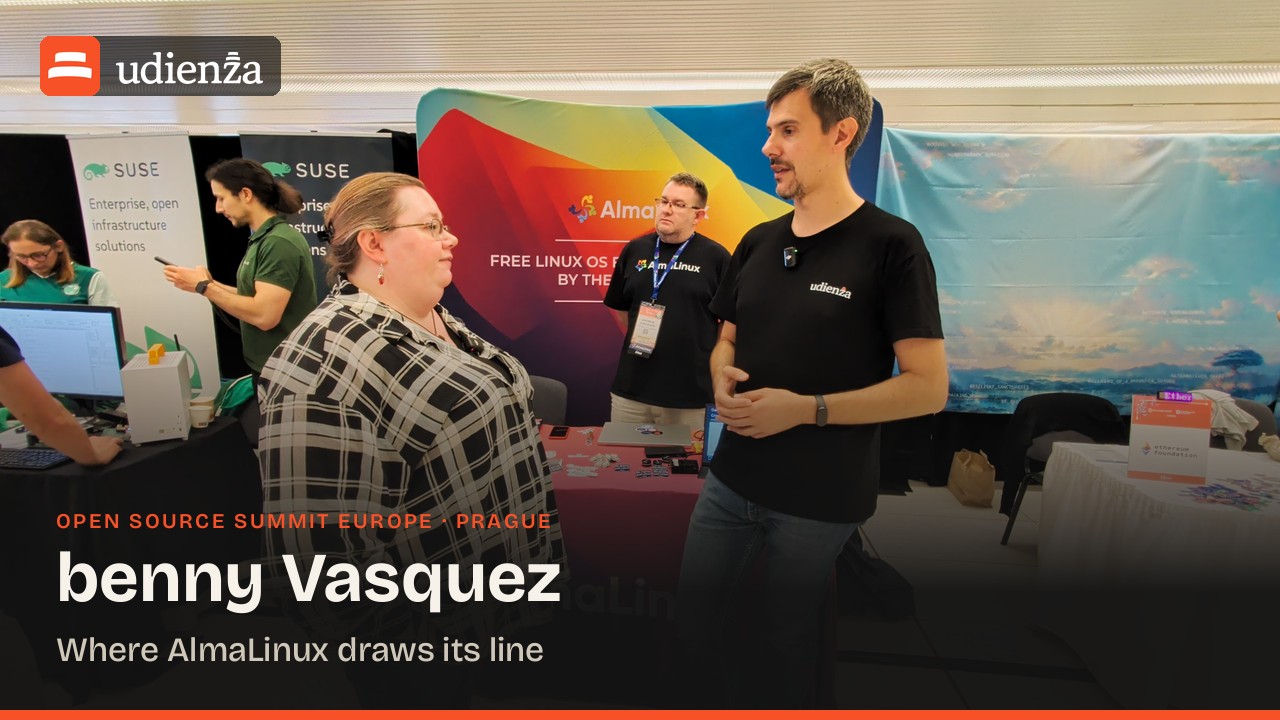
Not filmed yet.
benny Vasquez chairs the board of the AlmaLinux OS Foundation, the non-profit that owns AlmaLinux, the operating system that has taken on the role CentOS Linux used to have.
Follow the show and the episode arrives the morning it's published.
In brief
- CentOS Stream sits ahead of Red Hat Enterprise Linux in the pipeline; AlmaLinux is completely RHEL-compatible and can add features its community needs even when Red Hat does not prioritise them.
- A non-profit foundation owns everything, and nearly 40 sponsors back the project.
- The bylaws allow no more than one person from the same company on the board, and two seats come up for election every year.
- Most packages come from upstream: AlmaLinux follows Red Hat on decisions such as which version of SSH to ship.
- Sponsors give hardware, credits and cloud services; one company shipped about $10,000 of PowerPC hardware after a single conversation at a conference.
- There is a RISC-V build to try today; official support is expected to follow Red Hat with version 11.
- Each major version gets ten years of support; each minor version is supported until the next one is released.
- Individual membership of the foundation is free, so users have a say as well as contributors.
Chapters
- 0:00 AlmaLinux and the board
- 0:57 Why AlmaLinux, not the others
- 2:44 So many packages
- 3:37 How to contribute
- 4:30 Raspberry Pi and RISC-V
- 5:20 Ten years of support
- 6:13 The foundation and its members
- 7:27 Web hosting and beyond
Why this conversation
For anyone who ran CentOS Linux, the last few years have meant choosing again. benny Vasquez describes it as a period of trauma and change in the Red Hat ecosystem, five or six years of motion, and AlmaLinux as the distribution that has taken on the role CentOS Linux used to have. She chairs the board of the AlmaLinux OS Foundation. The host recorded with her at the AlmaLinux booth on the Thursday afternoon of Open Source Summit Europe in Prague; the story of that week is in Open Source Summit Europe 2026: who we met.
The question behind the conversation is where AlmaLinux draws its line: completely compatible with Red Hat Enterprise Linux, but owned and governed by its community.
Compatible, and owned by a foundation
There are several RHEL-compatible choices, the host pointed out: Rocky Linux, CentOS Stream and AlmaLinux. benny starts with the difference from CentOS Stream. In the pipeline, CentOS Stream sits ahead of Red Hat Enterprise Linux: it is not RHEL, it comes just before it. AlmaLinux is completely Red Hat compatible, and it can also add features and benefits its community needs, whether or not Red Hat needs to prioritise them.
The project set up a non-profit to own everything, because the team believes community governance and community ownership of the operating system is what its community needs in the long term. Nearly 40 sponsors now back it. To stop any one sponsor from outweighing the others, the bylaws say that no more than one person who works for the same company can sit on the board. Elections are annual, with two seats up each year, which keeps the board stable while giving new people a way in.
Packages, hardware and RISC-V
Asked how many packages AlmaLinux maintains, benny says she does not know: there are so many. The team is spoiled, she says, because most of it comes from upstream. It does not decide things like which version of SSH to ship; it takes direction from Red Hat, because complete compatibility is what its community needs.
Building for several architectures still takes infrastructure, and that is one of the ways sponsors show up, with hardware, credits and cloud services. Contributing is easy: people simply come to the project. A couple of years ago a large clothing manufacturer met the team at a conference, offered PowerPC hardware it no longer needed, and shipped about $10,000 of it to the project’s data centre for free.
On RISC-V, she sees the industry adopting it much more quickly than it adopted earlier hardware such as the Raspberry Pi. AlmaLinux has a build people can use for RISC-V today, but the project is watching where Red Hat goes, and official support looks set to land with version 11. She expects the next CentOS Stream next year and RHEL 11 around 2028.
Support and membership
AlmaLinux supports each major version for ten years. Each minor version is supported until the next one is released: once 10.3 is out, 10.2 reaches end of life. Red Hat’s longer support for selected minor releases, she says, is a product of being a commercial company that can afford it.
You do not have to be a member of the foundation to be involved, but that is where everyone joins. Organisations come in as sponsor members, at a few different levels, depending on how they want to give back. “If you’re using open source, you need to give back in some way,” is the point she makes to most commercial companies. Individual membership is free, because the foundation wants to include not only the people sending code but also the people using the operating system.
Where it runs
The early adoption came from the web hosting industry, and most people still see AlmaLinux as a server operating system. benny has seen it used on desktops, on HPC clusters and in render farms. The official website is still the same: almalinux.org.
Mentioned in this episode
About benny Vasquez
benny Vasquez chairs the board of the AlmaLinux OS Foundation, the non-profit that owns AlmaLinux, the operating system that has taken on the role CentOS Linux used to have.
Running this in production? Luca Berton helps platform teams take it from prototype to reliable production. See how he works
Built something the rest of us run on? Being a guest is free. Take the other chair
More episodes
All episodes →-
Episode 17 · Coming
Kavitha Daula: Isolating containers and agents
-
Episode 19 · Coming
Erin McKean: Docs that agents read too
-
Episode 21 · Coming
Thierry Carrez: What OpenStack taught Europe
-
Episode 14 · Coming
Greg Kroah-Hartman: Inside the stable kernel