Coming soon 9:51 Recorded at Open Source Summit Europe, Prague
What changes in documentation when the reader is an AI agent?
Erin McKean: Docs that agents read too
Erin McKean of Google's Open Source Programs Office on Docsy, and documentation as an interface read by people and by AI agents.
Erin McKean, Open Source Programs Office, Docsy, Google · with  Luca Berton
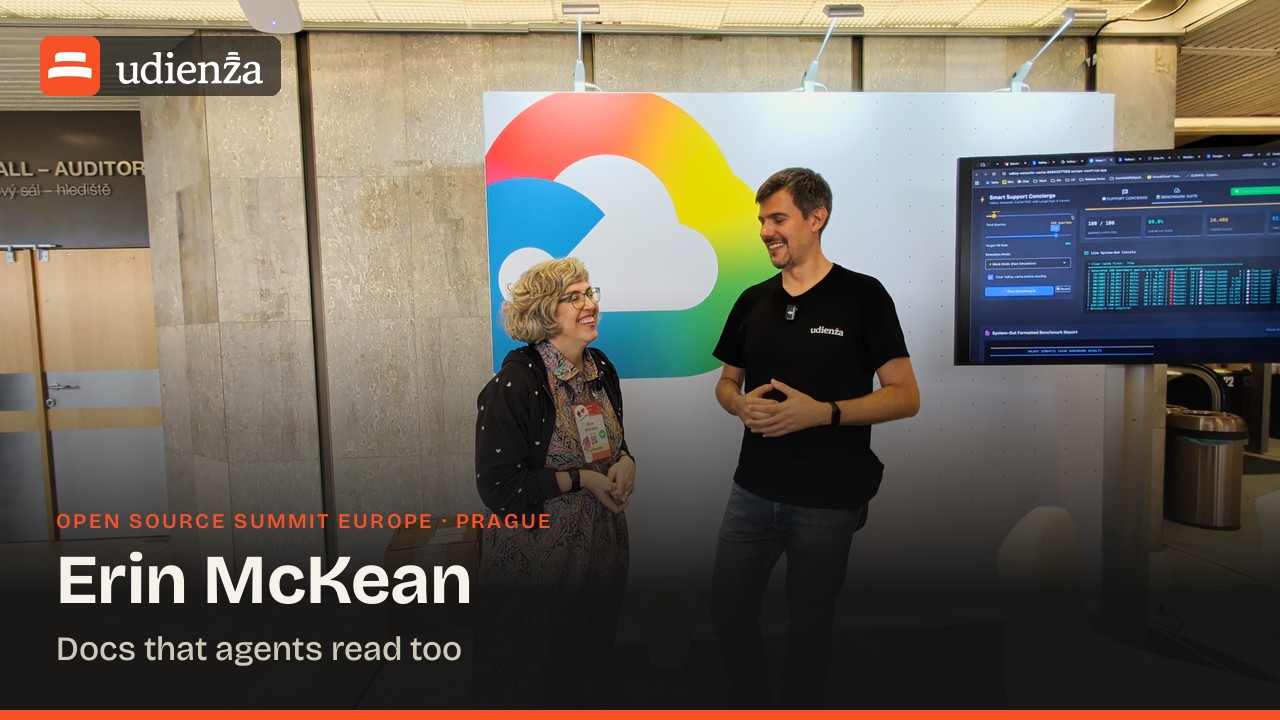
Recorded, coming soon.
Erin McKean works in Google's Open Source Programs Office and on Docsy, the documentation theme used by many open source projects. Her keynote opened Open Source Summit Europe 2026.
Follow the show and the episode arrives the morning it's published.
Chapters
- 0:00 Docsy joins the Linux Foundation
- 1:04 Docs for engineers, not writers
- 1:33 Less time fussing with the tool
- 3:06 Kubernetes runs on Docsy
- 3:47 When the docs fall out of date
- 6:02 A daily log for your future self
- 7:32 Composable, built on Hugo
- 8:28 Docsy 1.18 and new contributors
Why this conversation
Her keynote had opened the summit the day before. At the Google Cloud booth, Erin McKean talked with the show about Docsy and about documentation as an interface read by people and by AI agents. The scope agreed for the episode is open source documentation and Docsy.
Docsy moves to the Linux Foundation
That morning, Erin said, “I was very happy to announce on behalf of Google that Docsy, which is a documentation theme for the Hugo Static Site Generator, the Docsy Project, is moving to the Linux Foundation.” The host uses Hugo a lot, for its speed and its built-in features.
Less surface for fussing
“And the whole point of Docsy is that it should make it very easy for a software engineer who knows a lot about their project, but not a lot about technical writing to produce really good technical documentation for their project.” It comes with templates, the right information architecture and a lot of built-ins. She admitted to a familiar habit: “as kind of a procrastinatory software development technique, I always want to fuss with the tool”. “And Docsy kind of limits your fussing surface area.” You can tweak it, “but because it’s so good out of the box, you don’t have to.” The point is to focus on the content, “and less on, you know, hand crafting your HTML headers.” Videos too? “Yeah, anything you can do on the web, you can do in Docsy”, and it can be extended with regular JavaScript or more Hugo plugins.
Any crazy stories from production? Kubernetes, which is very large scale, uses Docsy. “I think the nice thing about Docsy is it doesn’t really lead to crazy stories, because it just works, right? There’s no drama.” “Like, your docs should be clear and transparent, and your documentation tool should also be clear and transparent and easy to use.”
Sleep in the guest room
What about documentation that falls behind the program, with examples that no longer work when you copy them? Erin told the story of a friend who loves having house guests and sleeps in her own guest room at least twice a year, to make sure it is comfortable. “And as a software developer, you have to do the same thing. You have to pretend as best you can to be a new user.” Every time she gets a new laptop, before customising it, she tries the install instructions of the projects she works on; with containers you can start from a completely clean environment without waiting for a new laptop. “Try to do that at least once a year, even more often if your program has a lot of churn, because otherwise you don’t know what’s slipped because you’re looking at it every day.”
Most software is made for other people to use. A project you are the only user of, “that’s your diary, right?”
Keep a daily log
The host admitted that after three months he sometimes forgets why he took a decision. Her habit: “So I try to keep a daily log when I’m in active software development mode of what I tried, what worked, what didn’t work”. Six months later, updating a dependency, the log says why one tool was chosen over another, and whether it is worth checking that the other one’s blocker still exists. “Like I know it feels weird and like maybe it takes a lot of time, but keeping a daily log of what you’ve done in your development process is a huge time saver.” AI makes it easier: “And now you can just point AI at your like commit history and say, hey, make me a log.”
Getting involved
Because it is based on Hugo, Docsy works with the Hugo ecosystem and standard tools, from Mermaid diagrams to many search options. The site is docsy.dev, and “The documentation for Docsy is written in Docsy.” A new version came out that day, and Erin thanked Patrice, the person behind it. “And we always welcome new contributors to Docsy”: raise an issue, look at the roadmap. The site also points to other people’s Docsy docs, a hall of fame, as the host called it.
When it comes out
The episode is recorded and in the edit. Like every episode it goes out on YouTube first, then on Apple Podcasts, Spotify and Amazon Music. The story of the week it was filmed is in Open Source Summit Europe 2026: who we met.
About Erin McKean
Erin McKean works in Google's Open Source Programs Office and on Docsy, the documentation theme used by many open source projects. Her keynote opened Open Source Summit Europe 2026.
Running this in production? Luca Berton helps platform teams take it from prototype to reliable production. See how he works
Built something the rest of us run on? Being a guest is free. Take the other chair
More episodes
All episodes →-
Episode 18 · Coming
Benny Vasquez: Where AlmaLinux draws its line
-
Episode 20 · Coming
Mario Sánchez Prada: Replacing a foundational API
-
Episode 27 · Coming
Juliette van der Laarse: What engineers can expect
-
Episode 09 · Coming
Shannon Williams: When enterprises trust agents