Coming soon 6:25 Recorded at Open Source Summit Europe, Prague
Why would a mature project replace the API everyone builds on?
Replacing a foundational API
Mario Sánchez Prada of Igalia on WPE WebKit 2.54 and its new platform API, how a WebKit port works, and where to start contributing to WPE.
Mario Sánchez Prada, WPE WebKit,  Igalia · with
 Luca Berton
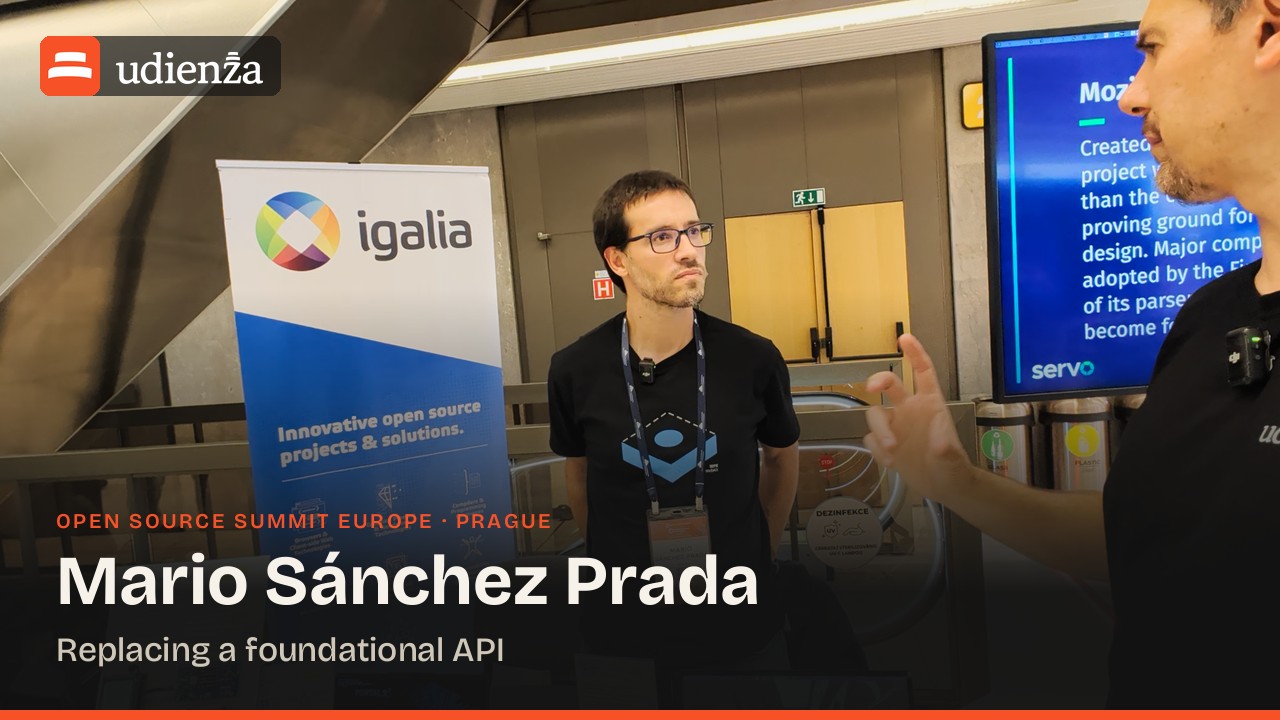
Not filmed yet.
Mario Sánchez Prada is a partner at Igalia, where he has worked for about 15 years and coordinates the team that works on WPE WebKit, the WebKit port for embedded devices.
Follow the show and the episode arrives the morning it's published.
In brief
- WPE 2.54 brings a new API for the platform-related parts, which until now had to be handled through many different libraries and was complex to use.
- His session covered the problems the new API fixes, how they were fixed, and how to migrate an existing installation from the old API.
- WPE is a web engine for embedded devices: the component of a browser that renders web content and handles interaction, not a browser itself.
- WPE is a WebKit port: WebKit needs platform-specific code to run, and that code plus the shared WebKit code makes a port, like the macOS, iOS and GTK ones.
- At the Igalia booth, a game stayed fluid at about 40 FPS while the same machine built a Linux kernel, thanks to a CPU scheduler Igalia wrote for low-latency work.
- wpewebkit.org has documentation, blog posts, tutorials and, since 2.54, FAQs and tutorials on moving to the new API.
- Contributors find the public Matrix room, the public mailing list and Bugzilla linked from the website.
- Igalia turned 25 shortly before the conference and works in small, deeply specialised teams, from Chromium and graphics to kernel and compilers.
Chapters
- 0:00 WPE 2.54 and its new platform API
- 0:54 What a web engine is
- 1:41 WebKit ports and WPE
- 2:48 The demo: a game while building a kernel
- 4:34 Getting involved
- 5:21 Igalia's teams
Why this conversation
An embedded device that shows web content needs an engine underneath to render it, with little in the way of resources and often unusual screens and input devices. The API that engine exposes is what integrators write their code against. When a project changes that API, everyone who builds on it has to decide when and how to move.
The day ended at the Igalia booth, on the second floor of Open Source Summit Europe in Prague, on the Thursday. Mario Sánchez Prada had just come from his session on WPE WebKit, the WebKit port for embedded devices. He is a partner at Igalia, where he has worked for about 15 years, and he coordinates the team that works on WPE. The story of the week it was filmed is in Open Source Summit Europe 2026: who we met.
A new platform API in WPE 2.54
The talk was about a release. WPE 2.54 came out shortly before the conference, and with it a new API for all the platform-related bits. Until then, an integrator dealt with those through many different libraries, and it was, in his words, a bit complex to use. The new API, WPEPlatform, became the default in 2.54 and the old one was deprecated. The aim is to make the platform side simple.
His session walked through the problems the team set out to fix, how they fixed them, and some code. The practical part was for people who already have an installation built on the old API: how to migrate it. The case for the change is the one he gave at the start: one job had been spread across several libraries, and the new API brings it together in one place.
What WPE is, and how a WebKit port works
For anyone who has not met WPE, he started with what a web engine is. It is the component in a web browser that renders web content and lets you interact with it. It is not the browser itself, but the part that does that work underneath. On embedded devices there are usually not enough resources, and there are other situations to deal with: different kinds of screens and different kinds of input devices. WPE is a web engine with a specific focus on embedded devices, flexible enough to adapt to those situations.
WPE is also a port of WebKit. WebKit is a web engine, but to work it needs a connection to a specific platform, and that is what a port is: the platform-specific bits combined with the general WebKit code. WebKit has a port for macOS, one for iOS, WebKitGTK for GTK environments on Linux, and WPE, which works on embedded devices. The new API in 2.54 sits in exactly that platform-specific layer.
A scheduler demo on the side
The Igalia booth had more than WPE on it, and the host asked about a game running on one of the screens. It was not related to WPE. It showed a new CPU scheduler that Igalia developed in the Linux kernel, so that a process that needs low latency gets it, even with a heavy process in the background.
The game ran at about 40 FPS while the same machine was building a Linux kernel in parallel, and it stayed fluid. He then switched back to the default kernel scheduler, and the game became unusable. Cancelling the background kernel build brought it back to its original, smooth state.
Getting involved
WPE is all open source. The website, wpewebkit.org, has links to documentation, blog posts and tutorials. With the 2.54 release the team updated it to explain the new API properly, with FAQs on how to migrate and tutorials to go with them. For people who want to take part, the website links to the public Matrix room, the public mailing list and Bugzilla. There are plenty of ways to contribute and get started with WPE in the open.
Igalia itself turned 25 a few weeks before the conference. It started small and has grown quite a lot. It is organised in teams, each not too big but deeply specialised in one technology: the team that works on WPE, a Chromium team, a graphics team that implemented the Vulkan driver for the Raspberry Pi 4 and 5, a kernel team and a compiler team, among others. That structure, he said, is what lets the company cover a wide range of things, and why the booth showed so many different projects at once.
Mentioned in this episode
About Mario Sánchez Prada
Mario Sánchez Prada is a partner at Igalia, where he has worked for about 15 years and coordinates the team that works on WPE WebKit, the WebKit port for embedded devices.
Running this in production? Luca Berton helps platform teams take it from prototype to reliable production. See how he works
Built something the rest of us run on? Being a guest is free. Take the other chair
More episodes
All episodes →-
Episode 19 · Coming
Erin McKean: Docs that agents read too
-
Episode 21 · Coming
Thierry Carrez: What OpenStack taught Europe
-
Episode 57 · Coming
The openEuler Embedded team: Real time on one chip
-
Episode 18 · Coming
benny Vasquez: Where AlmaLinux draws its line