Coming soon 10:00 Recorded at Open Source Summit Europe, Prague
What do twenty years of open infrastructure teach about sovereignty?
Thierry Carrez: What OpenStack taught Europe
Thierry Carrez, General Manager of Linux Foundation Europe, on what twenty years of open infrastructure teach about neutral governance and sovereignty.
Thierry Carrez, General Manager, Linux Foundation Europe · with  Luca Berton
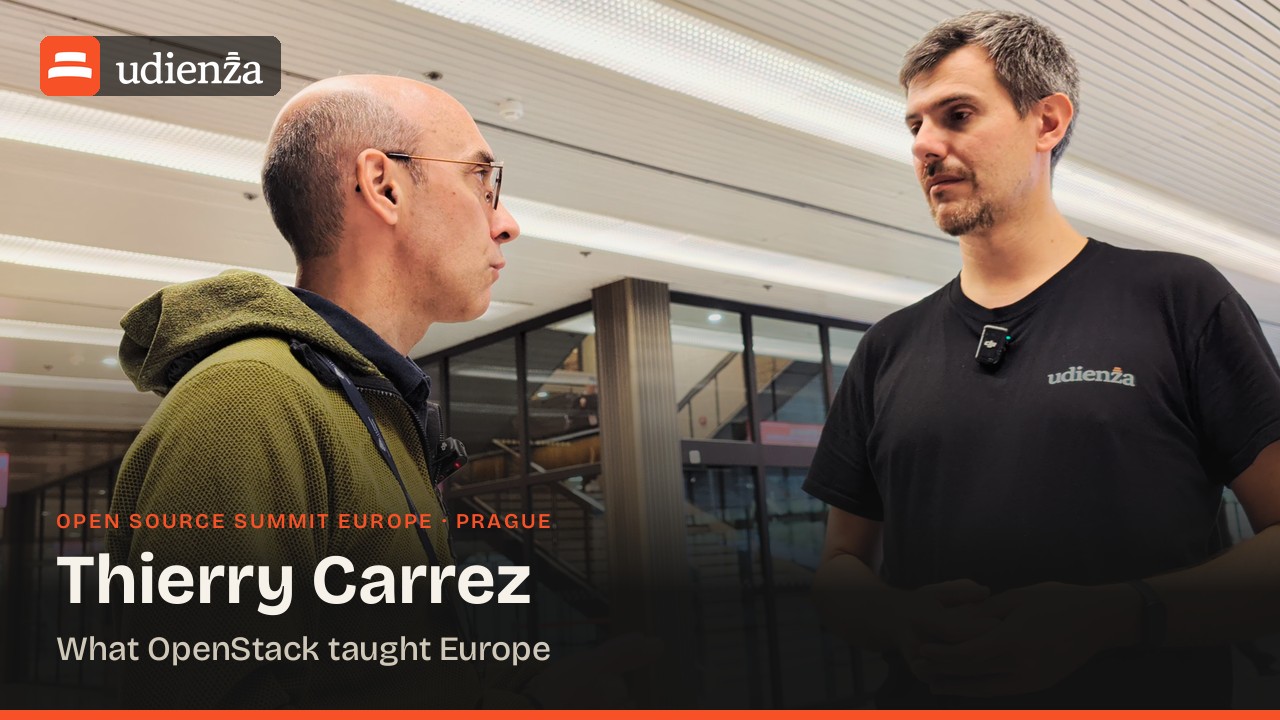
Recorded, coming soon.
Thierry Carrez is General Manager of Linux Foundation Europe. Before that he spent many years at the OpenStack Foundation and the Open Infrastructure Foundation.
Follow the show and the episode arrives the morning it's published.
Why this conversation
Sovereignty was the word of the week in Prague. Thierry Carrez recorded with the show after lunch on the Thursday, on what twenty years of OpenStack and open infrastructure teach about neutral governance and sovereignty.
From OpenStack to Linux Foundation Europe
Thierry helped start the OpenStack project in 2010, and he still does its release management. “I’m now the general manager of the OpenInfra Foundation, which stewards the OpenStack project. And I also just took over, six months ago, Linux Foundation Europe, representing basically the Linux Foundation in Europe.”
Numbers behind the feelings
The host had noticed the many reports and surveys in Thierry’s keynote the day before. “We will have a position on how it goes, but it’s better to back it with research, with numbers, with, like, serious surveys and analysis of data that exactly backs up what we feel is happening.” The work of Linux Foundation Research, which Linux Foundation Europe helps with, provides market insights for the region. “And it’s all public, like, anyone can access it, can download the reports.”
OpenStack at 16
“So the OpenStack project is now 16 years old. You know, we created it back then to have an open source alternative to AWS, to VMware.” Sixteen years on, more and more users are coming in, mostly through the new needs of AI infrastructure. “So NeoClouds are adopting OpenStack a lot because they don’t have to rewrite their own software to manage their hardware.” Digital sovereignty drives new capacity too, in Europe and in regions like Southeast Asia: “So we’re seeing a lot more new users right now than we’ve ever seen during the life of OpenStack.”
Nobody can push code
The governance lesson he chose: giving maintainers direct access to land code “is not a good pattern because it doesn’t guarantee that you’re not introducing regressions”. From the start, OpenStack gave no individual the right to merge. “Nobody can actually push code to OpenStack. It has to go through a machine that’s going to check if you have all the approvals.” At least two people approve each patch, and it has to pass all the tests: “There is no way to bypass the tests.” Most projects reach that lesson later, adding CI on top of maintainers who keep the power to bypass it. The people who founded OpenStack’s development process had strong software engineering practices: “Well, no, if it’s not tested, it’s broken.” The project built its own tooling to enforce it, the CI system it still uses. “And it’s a very good governance pattern, especially in the age of AI, where a lot of things are going to be automated.”
Guardrails for AI-driven development
AI facilitates contribution, he said, “but we need to step it up a bit. It needs to help with the review of the code.” “We need to have ways to undo things that are done by AI. So we need good audit trails. We need good reversibility. All of those things have not been developed yet.” Meanwhile the scarce resources are at the review and maintainer level, and code contribution is now very easy to do. “And so that puts a lot of stress on those central functions, scarce functions.”
His example from the keynote is security vulnerabilities. There used to be a few per year, three on average over the past five years, “and in 2026, we already have 42 of them just on the first three quarters.” “And the teams, they are still the same people.” The few people who work on it “are completely burnt out as a result”. There is a finite number of vulnerabilities in that code, and at some point the projects will probably get past it, as Greg Kroah-Hartman says. “I’m cautiously optimistic.”
Advice for young talent
Events like this one matter for that: “We learn from each other history and mistakes”. For people starting out, he advises against superficial engagement, “because that’s what AI really generates on the fly”. Find a project you are interested in and invest the time to understand how it really works, its context and its architecture, before you contribute. “It can be AI-assisted.” “So take the time to learn about the project you’re contributing to and it’s going to give you a lot easier path to contribute and a lot more value that AI is not going to be able to replace.” And the future? “Right now, it changes so fast, I am not making any predictions.”
When it comes out
The episode is recorded and in the edit. Like every episode it goes out on YouTube first, then on Apple Podcasts, Spotify and Amazon Music. The story of the week it was filmed is in Open Source Summit Europe 2026: who we met.
About Thierry Carrez
Thierry Carrez is General Manager of Linux Foundation Europe. Before that he spent many years at the OpenStack Foundation and the Open Infrastructure Foundation.
Running this in production? Luca Berton helps platform teams take it from prototype to reliable production. See how he works
Built something the rest of us run on? Being a guest is free. Take the other chair
More episodes
All episodes →-
Episode 20 · Coming
Mario Sánchez Prada: Replacing a foundational API
-
Episode 22 · Coming
Franklin Cooper Jr.: Hardware tests, no jumpers
-
Episode 26 · Coming
Paula Grzegorzewska: What makes a good partnership
-
Episode 92 · Coming
Stephen Watt: The right model for the right job