Coming soon 5:04 Recorded at Open Source Summit Europe, Prague
How do you scale embedded hardware tests without someone moving jumper wires?
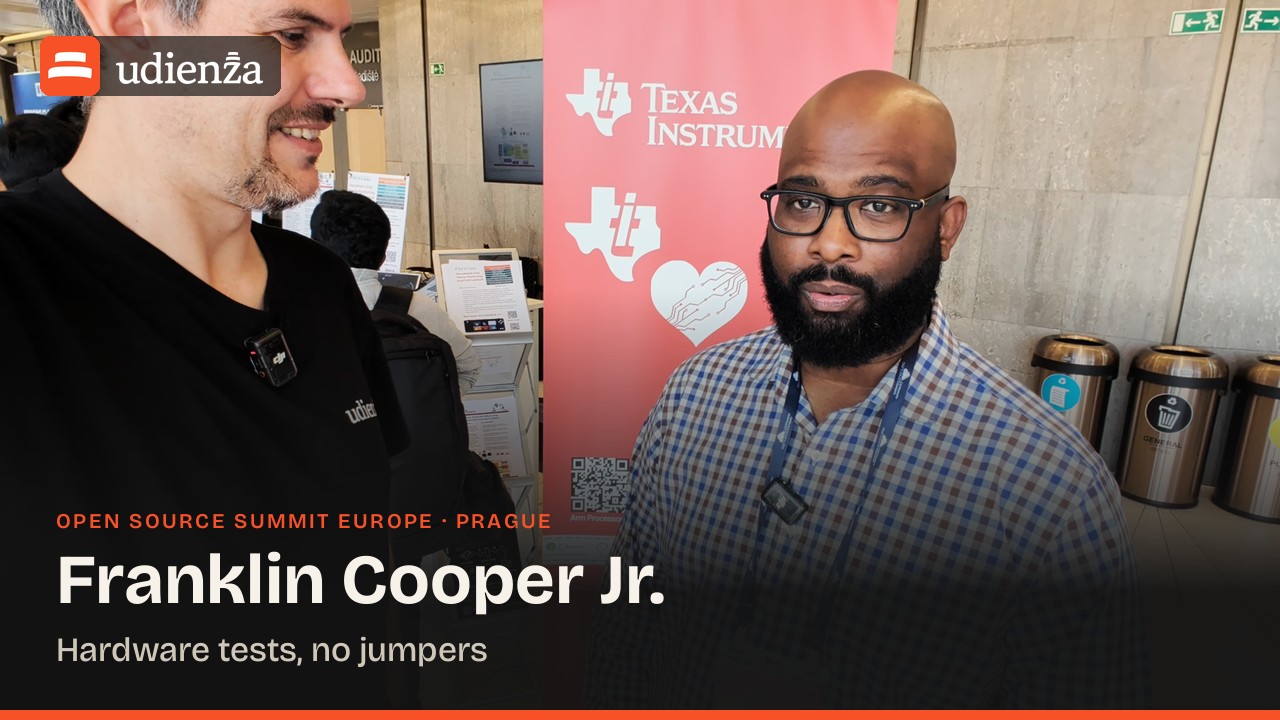
Hardware tests, no jumpers
Franklin Cooper Jr. of Texas Instruments on a cheap FPGA as a programmable routing fabric, so embedded hardware tests scale without jumper wires.
Franklin Cooper Jr., Embedded software engineer,  Texas Instruments · with
 Luca Berton
Not filmed yet.
Franklin Cooper Jr. is an embedded software engineer at Texas Instruments, where he has worked for over 15 years on open source projects from the Linux kernel to U-Boot and Yocto, and is now joining the Zephyr team.
Follow the show and the episode arrives the morning it's published.
In brief
- Testing matters more as teams do more with AI, but it needs a lot of hardware, and cost and space limit how much you can have.
- A board with four instances of a peripheral would need four $400 test tools, or someone rewiring between runs.
- WireWeaver is a Python script and an off-the-shelf FPGA that route signals from each instance on the board to a single tool.
- The approach is hardware-agnostic: it works with whatever microcontroller or processor fits a company's needs, not only TI's.
- You give it a file describing the routing; it fits Zephyr's Twister with pytest, TI's low-level SDK, MCAL or Linux.
- The point is to test exactly the boards you ship, not a custom test board.
- Texas Instruments works upstream first, from Linux to Zephyr.
Chapters
- 0:00 Embedded software at TI
- 0:52 Testing needs a lot of hardware
- 1:44 WireWeaver and an off-the-shelf FPGA
- 2:32 Zephyr, Linux, any software
- 3:22 Test what you ship
- 4:08 TI and open source
Why this conversation
Automated tests are only as good as the hardware they run on, and in embedded work that hardware is expensive and takes up space. Franklin Cooper Jr. has spent over 15 years at Texas Instruments on embedded software, contributing to open source projects from the Linux kernel to U-Boot and Yocto, and is now joining the Zephyr team. The host met him in front of the Texas Instruments booth on the Thursday morning of Open Source Summit Europe in Prague, on the day of his talk about a low-cost FPGA for hardware testing. The rest of that week is in Open Source Summit Europe 2026: who we met.
This is a short conversation, about five minutes, built around one idea.
The problem: hardware is the limit
As people want to do more with AI, Franklin says, the team found that testing is very important. But testing real peripherals needs real equipment, and you are constrained by both cost and space. His example: you may want to test a peripheral with a $400 tool, but if your board has four instances of that peripheral, you are not going to buy four of those tools. The alternatives are to reconfigure the wiring by hand between runs, or to buy far more equipment than the budget or the bench allows.
WireWeaver and an off-the-shelf FPGA
His answer is to let an FPGA do the rewiring. The FPGA routes the signals from whichever instance is under test to the one tool, which saves cost and space and makes testing easier. The solution is a Python script he calls WireWeaver, together with an off-the-shelf FPGA.
Asked which reference hardware a developer should buy, he says he will always recommend TI hardware, but the approach is agnostic. He built it as a contribution to the open source community, and it works with any microcontroller or processor that fits a company’s needs.
It is deliberately small. He did not want a large framework tied to one software stack. You provide a file that describes the routing, and it routes your connections. In Zephyr that means using it with Twister and pytest; it also works with TI’s low-level SDK, with MCAL, or with Linux. It is a building block for whatever test setup you already have.
Test what you ship
The host asked whether this means a developer can start with a development kit and scale up to bigger systems. Franklin’s point is about what gets tested. Software developers do not necessarily want to test on a custom test board; they want to test exactly what is about to ship. Whatever boards you are working on, you can connect them to this setup, so there is a one-to-one connection between what you test and what you ship, with less friction in between.
Upstream first
Franklin closes with Texas Instruments’ approach to open source: an upstream-first mentality, from Linux to Zephyr, contributing to the community first before going back to the downstream work. He is excited about what his team is doing on the Zephyr side.
His conference presentation is public and, he believes, recorded. The code is on GitHub under his account, at github.com/fcooper/wireweaver, alongside his other repositories.
Mentioned in this episode
About Franklin Cooper Jr.
Franklin Cooper Jr. is an embedded software engineer at Texas Instruments, where he has worked for over 15 years on open source projects from the Linux kernel to U-Boot and Yocto, and is now joining the Zephyr team.
Running this in production? Luca Berton helps platform teams take it from prototype to reliable production. See how he works
Built something the rest of us run on? Being a guest is free. Take the other chair
More episodes
All episodes →-
Episode 21 · Coming
Thierry Carrez: What OpenStack taught Europe
-
Episode 23 · Coming
The openKylin team: What AI changes in the OS
-
Episode 20 · Coming
Mario Sánchez Prada: Replacing a foundational API
-
Episode 28 · Coming
Benjamin Hindman: Coding agents without drift