Coming soon 4:55 Recorded at Open Source Summit Europe, Prague
What does an AI-native feature change at the operating-system layer?
The openKylin team: What AI changes in the OS
The openKylin team on openKylin 3.0, the project's roadmap and what AI-native features change at the operating-system layer.
The openKylin team, openKylin 3.0 and the OS roadmap,  openKylin · with
 Luca Berton
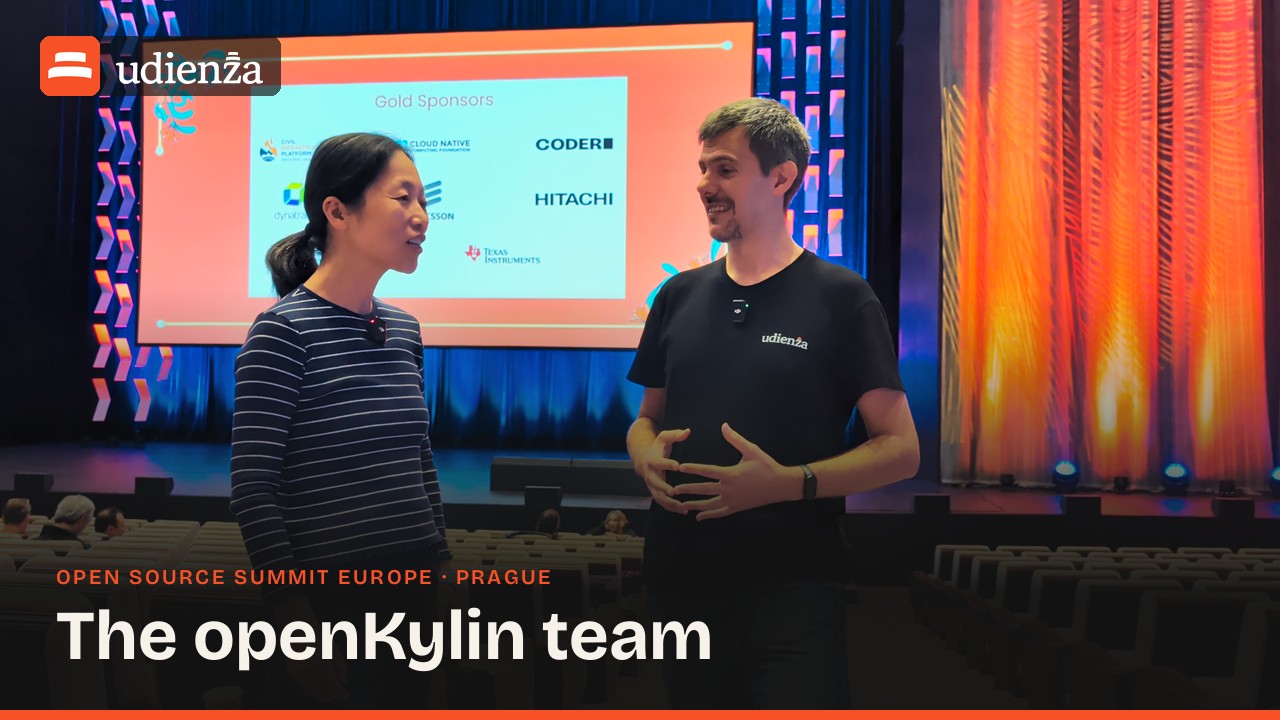
Recorded, coming soon.
openKylin is an open source Linux distribution community. It was a Diamond sponsor of Open Source Summit Europe 2026, with RISC-V hardware on its stand.
Follow the show and the episode arrives the morning it's published.
Chapters
- 0:00 openKylin 3.0, an AI-native OS
- 0:39 Screen reading for accessibility
- 1:00 A small AI agent, run locally
- 1:22 AI and real human connections
- 3:03 Free tokens for contributors
- 3:54 Meetups: Hangzhou, then Bangkok
Why this conversation
Mid-morning on the Thursday, before they flew home, the openKylin team hosted the show at their booth. The conversation, with Jemma of the openKylin team, was about openKylin 3.0, the project’s roadmap and what AI-native features change at the operating-system layer.
A four-year-old project
“It’s just a four-year-old baby, so it’s like relatively very young kid.” For the past several years openKylin has focused mainly on the desktop, and it is now exploring new directions, “like robots and small AI vehicles as well.”
Screen reading, and an agent that runs locally
The latest version, openKylin 3.0, adds screen reading. “So, that can make it more accessible to different kinds of users, including people who can’t really see very well. So, we want to, like, bridge it to them to make the gap, like, smaller for them.” It also brings AI features: “you can run the very small, easy AI agent locally”, and switch to other large language models when you want them.
AI, and real people
“And how do you see the future? How do you see this operating system going?”, the host asked. “I’d say it definitely, because AI is changing everything, you know?” It changes how we work, how we study and how we interact with people. “But I really feel like people are still valuing the connections and relationships between real human beings.” Next to AI, openKylin works on RISC-V and other architectures. And it wants to reach the users who may not know that they can be part of the community: “So, we’re focusing on two parts, and I think that’s basically how we balance between the AI and human beings.”
Free tokens for contributors
The official website has the community documents and a place to submit issues; “You can join us at the user group. We do a lot of local meetups.” “We also have different social media platforms where you can find out our latest news and the events going on as well.” And there is a plan many developers may like: “we’re releasing this plan for the users to get free tokens from us.” “So as long as you register to become our users, we prepare trillions of free tokens.” The host could hardly believe it: “You’re giving away free tokens?” “So you can get like a limited amount at the first, but then you can do like different tasks within the community, like to be a contributor to get more tokens to yourself.” The host’s summary: get involved, and get more tokens for research. The website is openkylin.org.
Next stops: Hangzhou, then Bangkok
The next event is in Hangzhou, in China, where a Chinese open source organisation has invited international organisations and leaders, OpenUK among them. “But for the next year, I think we’re going to stop by in Bangkok, Thailand.” “Yeah, Thailand is really nice.”
When it comes out
The episode is recorded and in the edit. Like every episode it goes out on YouTube first, then on Apple Podcasts, Spotify and Amazon Music. The story of the week it was filmed is in Open Source Summit Europe 2026: who we met.
About The openKylin team
openKylin is an open source Linux distribution community. It was a Diamond sponsor of Open Source Summit Europe 2026, with RISC-V hardware on its stand.
Read more on Udienza
Running this in production? Luca Berton helps platform teams take it from prototype to reliable production. See how he works
Built something the rest of us run on? Being a guest is free. Take the other chair
More episodes
All episodes →-
Episode 22 · Coming
Franklin Cooper Jr.: Hardware tests, no jumpers
-
Episode 24 · Coming
Alastair Turner: Open source databases, in short
-
Episode 25 · 29 Oct
Steve Francis and Anant Yardi: Talos in the AI era
-
Episode 18 · Coming
Benny Vasquez: Where AlmaLinux draws its line