Coming soon 7:36 Recorded at Open Source Summit Europe, Prague
Do AI workloads need a new database, or the relational one you already run?
Open source databases, in short
Alastair Turner, Technical Evangelist at Percona, on twenty years of Percona, the forks that follow licence changes, and why the relational database is staying.
Alastair Turner, Technical Evangelist,  Percona · with
 Luca Berton
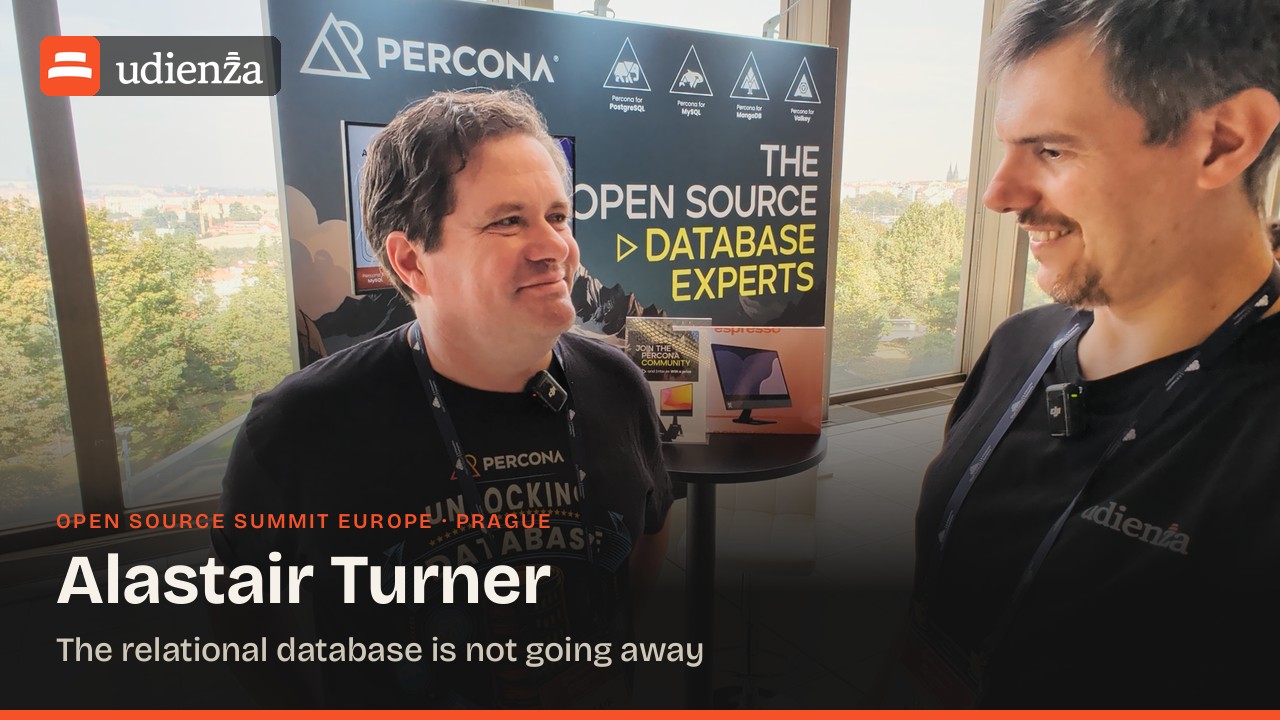
Not filmed yet.
Alastair Turner is Technical Evangelist at Percona, which builds open source tools on top of MySQL, MongoDB and Postgres and offers support for them. He works on the community side of the business.
Follow the show and the episode arrives the morning it's published.
In brief
- Percona turned 20 this year. It began with MySQL performance problems, then built monitoring, management and backup tools for MySQL, later MongoDB and more recently Postgres.
- It builds on the community editions of MySQL and MongoDB to make them more enterprise friendly; all of it is open source, with support for those who want it.
- Percona was involved with AWS, Google, Ericsson and others in forking Valkey after Redis changed its licensing; he expects another wave of forks and licence changes.
- The relational database is not going away: open source Postgres has just marked 30 years, and he sees no reason it will not go another 30.
- Specialist vector and graph databases keep coming back to the big relational engines, where the operational capabilities are: crash safety, known backup and failover processes.
- For most vector applications, the vector capabilities in Postgres, MongoDB or MySQL are good enough.
- Sovereignty raises the cost of complexity: each dedicated database has to be replicated in every territory, which pushes towards mainstream databases.
- percona.community hosts Percona's open source tools and Postgres add-ons such as transparent data encryption and OIDC, with forums and links to the GitHub projects.
Chapters
- 0:00 Percona's open source databases
- 2:02 The relational database stays
- 2:58 Structure, crash safety, backups
- 4:54 Agents still need managed data
- 5:48 Sovereignty and data territories
- 6:43 percona.community
Why this conversation
Every AI feature, from a chatbot to an agent, relies on data that has to be stored, backed up and kept safe somewhere. Each new wave of technology also brings a new kind of specialist database, and a platform team has to decide whether to run one more system or ask more of the database it already has. The answer shapes how much a team has to operate, and where.
Around midday on the Wednesday, the show stopped at the Percona booth, with its view over Prague, for a quick conversation with Alastair Turner, Technical Evangelist, about open source databases: twenty years of Percona, Valkey and the forks that follow licence changes, and why vectors belong in the relational databases people already run. The host also published it as a written interview. The story of the week it was filmed is in Open Source Summit Europe 2026: who we met.
Twenty years, and the forks that follow licence changes
Percona was born just over 20 years ago, around performance problems with MySQL, and had its 20th birthday this year. It began building tools for MySQL, for monitoring, management and backup, and a few years later did the same for MongoDB. It builds on top of the community editions of MySQL and MongoDB to make them more enterprise friendly, and all of it is open source: anyone can get it and run it, and come to Percona when they want support. More recently it added Postgres.
Percona was also involved, with AWS, Google, Ericsson and a few others, in forking Valkey after Redis changed its licensing, about two years before the conversation. Asked about the future, he expects another wave of forks and licence changes. The pressure on VC-funded companies is rising, a lot of them are under greater threat of running out of money, and he expects some strange behaviour as they try to bring more money in.
The relational database is not going away
The other thing he is sure about is that “the relational database is not going away.” People have been telling him for 20 years that relational databases are disappearing, a dinosaur technology. Earlier in the year, at a conference in Vancouver, he joined the celebration of 30 years of open source Postgres. The project is older still, as an academic project, and he sees no reason it will not go another 30.
What keeps bringing people back is structure, and the operational capabilities that come with a proper relational database: crash safety, known backup processes and failover. The same pattern shows up with specialist graph databases and specialist vector databases. A lot of it keeps coming back to the big relational engines, because that is where the operational capabilities are. “You don’t need the world’s best vector database for most vector applications,” he said; the vector capabilities in Postgres, MongoDB and MySQL are good enough. Nobody knows what comes after vectors in AI, but he expects the same path: a few specialists, right for a few niche cases, and the capabilities moving into mainstream relational databases.
Data for agents, and data in territories
The host had walked AGNTCon Europe with a friend who was new to the field and was surprised by how many databases were connected with AI. Alastair agreed that the focus for chatbots has been on text data and embeddings, but there is more to it. A lot of what business applications need is numbers: adding them up and letting people explore them. The agentic model brings some of the same brute force it brings to code generation, but the data still has to be managed. From an operational and complexity point of view, he would not put the embedding data somewhere else. Keep it where the numbers and the inventory information are, all together.
He was speaking first from an application architecture point of view, but sovereignty amplifies the same question, because it makes operational complexity a bigger deal. Instead of one big relational database, one dedicated graph database and one dedicated vector database, a company may have to replicate each of them in every territory it operates in. That pushes further towards using those capabilities inside mainstream databases rather than deploying more specialist technology.
Getting involved
He works on the community side of Percona’s business: getting people to work with Percona on the open source software it builds. The home for that is percona.community. It hosts the tools built on top of MySQL community and MongoDB community, and add-ons for Postgres such as transparent data encryption and OIDC. There are forums around those projects, and links to the GitHub projects for anyone who wants to join in building them.
Mentioned in this episode
About Alastair Turner
Alastair Turner is Technical Evangelist at Percona, which builds open source tools on top of MySQL, MongoDB and Postgres and offers support for them. He works on the community side of the business.
Running this in production? Luca Berton helps platform teams take it from prototype to reliable production. See how he works
Built something the rest of us run on? Being a guest is free. Take the other chair
More episodes
All episodes →-
Episode 23 · Coming
The openKylin team: What AI changes in the OS
-
Episode 25 · Coming
Steve Francis and Anant Yardi: Talos in the AI era
-
Episode 06 · 7 Oct
Manik Surtani: How goose led to the AAIF
-
Episode 21 · Coming
Thierry Carrez: What OpenStack taught Europe