Coming soon 5:23 Recorded at AGNTCon + MCPCon North America, San Jose
How many agents can one pod hold?
A thousand agents, one pod
Michael Levan of Solo.io on agent substrate, Solo.io's sandboxing layer, and kagent v1: a thousand agents in one pod, limited only by the hardware.
Michael Levan, Principal AI Architect, Solo.io · with  Luca Berton
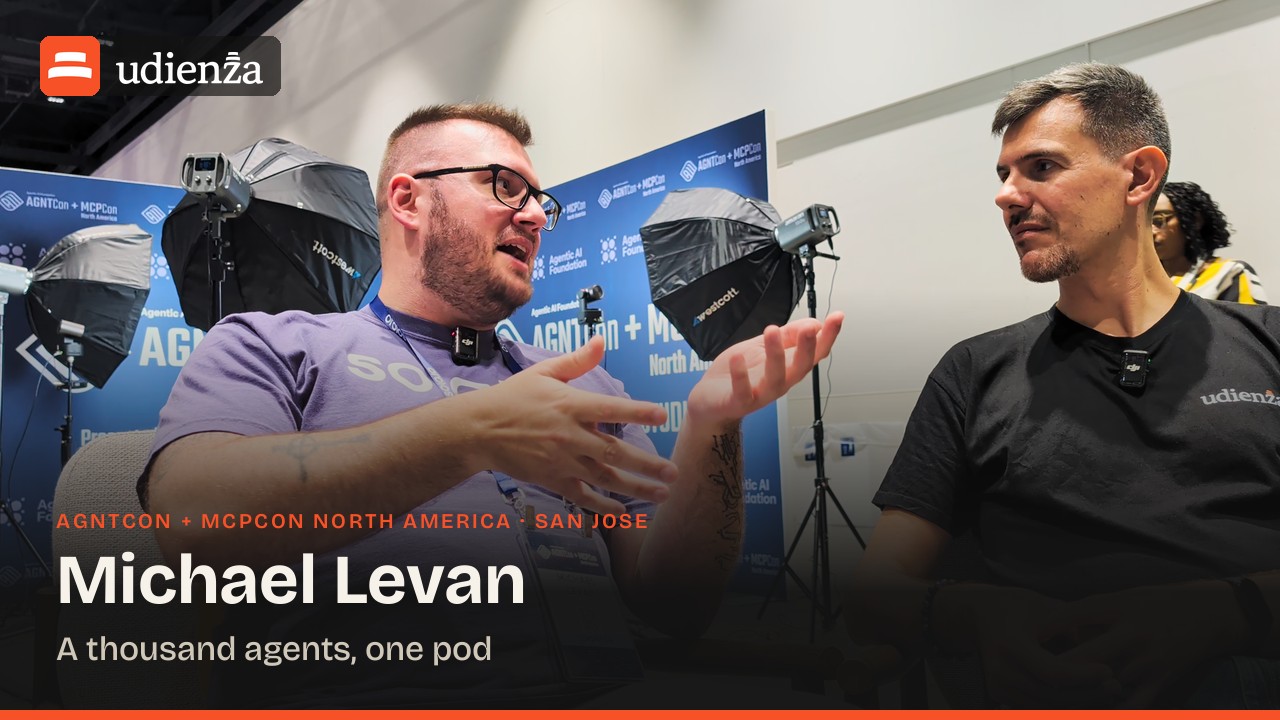
Not filmed yet.
Michael Levan is Principal AI Architect at Solo.io, whose kagent and agent substrate are both open source.
Follow the show and the episode arrives the morning it's published.
In brief
- Solo.io has worked on sandboxing for a long time, he said, while everybody else started talking about it in the past three weeks.
- Agent substrate is the sandboxing layer, with kagent on top of it for the developer experience.
- kagent began as one agent in one pod, like any Kubernetes workload; but a company may have 50 agents or 3,000, in marketing, finance and HR, and has to scale them and keep them from doing whatever they want.
- With kagent v1 and agent substrate underneath, the default is a thousand agents in one pod.
- An agent that is not running goes into a warm state, snapshotted, and its CPU and memory go to an agent that needs them.
- Agents run in an actor, a component of agent substrate; with five pods you can have 5,000 agents, and the only real limit is the hardware in the cluster.
- Both projects are 100% open source and can be deployed on any cluster, GKE included; Solo.io's enterprise version adds security, observability and governance.
Chapters
- 0:00 Agent substrate, sandboxing and kagent
- 0:54 One agent, one pod
- 1:46 kagent v1: a thousand agents, one pod
- 2:25 Warm agents give back CPU and memory
- 3:00 100% open source, on any cluster
- 3:34 The only limit is the hardware
- 3:56 Agents run in actors
Why this conversation
Companies are moving from a handful of agents to thousands, and each one needs somewhere safe to run. Michael Levan is Principal AI Architect at Solo.io, and he came to talk about agent substrate, Solo.io’s sandboxing layer, and kagent on top of it. In this conversation he explained how one pod went from one agent to a thousand. The host recorded with him at the conference’s studio on the show floor in San Jose on 22 October 2026, the first day of AGNTCon + MCPCon North America. The rest of that day is in AGNTCon + MCPCon North America 2026: day one.
Sandboxing, for a long time
Solo.io does a little bit of everything across its agentic stack, he said, but what he wanted to talk about was agent substrate: sandboxing, with kagent sitting on top for the developer experience. “Ironically enough, we’ve been working on it for a very long time, whereas I feel like in the past three weeks now everybody’s talking about sandboxing.”
From one agent per pod to a thousand
When Solo.io created kagent, the idea was one agent running in one pod, like any other workload in Kubernetes: a container in a pod, scaled out. With agents that is not enough: “The problem with that, in the world of AI and agents, is it’s not just, hey, here’s my workload.” A company may have 50 agents or 3,000, in the marketing team, the finance team, the HR team and everywhere else. How do you scale that out, and how do you make sure those agents cannot just go and do whatever they want? With kagent v1 and agent substrate underneath, it is now a thousand agents in one pod. “That’s actually the default,” and you can probably go higher.
Warm agents
Agents come up and go down, and one may be in use only 10% of the time. So the question is whether those resources can be allocated elsewhere when an agent is not running. With agent substrate, the agents that are not running go into a warm state and are snapshotted, and their memory and CPU are given back to another agent that wants to run. That saves a ton of CPU and memory, and makes it much lighter on the infrastructure.
Only the hardware
Agent substrate and kagent are both 100% open source, and you can deploy them right now on any cluster: a GKE cluster, “or even on a kind cluster”. Solo.io’s enterprise version puts security, observability and governance on top. As for limits, the agents run in something called an actor, a component of agent substrate, and a thousand of them can run in one pod if the pod has enough CPU and memory. “So, really, your only limitation at this point is the hardware.” But “when you’re implementing Agent Substrate, that limitation almost goes away in a sense”: with five pods, which is small, you can have 5,000 agents running. “Aside from that, no real constraints.”
When it comes out
The episode is edited and in the release order. Like every episode it goes out on YouTube first, then on Apple Podcasts, Spotify and Amazon Music.
Mentioned in this episode
About Michael Levan
Michael Levan is Principal AI Architect at Solo.io, whose kagent and agent substrate are both open source.
Running this in production? Luca Berton helps platform teams take it from prototype to reliable production. See how he works
Built something the rest of us run on? Being a guest is free. Take the other chair
More episodes
All episodes →-
Episode 92 · Coming
Stephen Watt: The right model for the right job
-
Episode 94 · Coming
Matt DeBergalis: Time to get the architecture right
-
Episode 84 · Coming
Lin Sun: AI agents as microservices, but more
-
Episode 98 · Coming
Kalle Westerling: Rethinking how we do open source