Coming soon 10:10 Recorded at AGNTCon + MCPCon North America, San Jose
How do thousands of agents reach thousands of APIs safely?
Time to get the architecture right
Matt DeBergalis of Apollo GraphQL on agents that must reach a company's APIs, a layer for search and policy, and why the architecture has to be right now.
Matt DeBergalis, CEO & Co-founder, Apollo GraphQL · with  Luca Berton
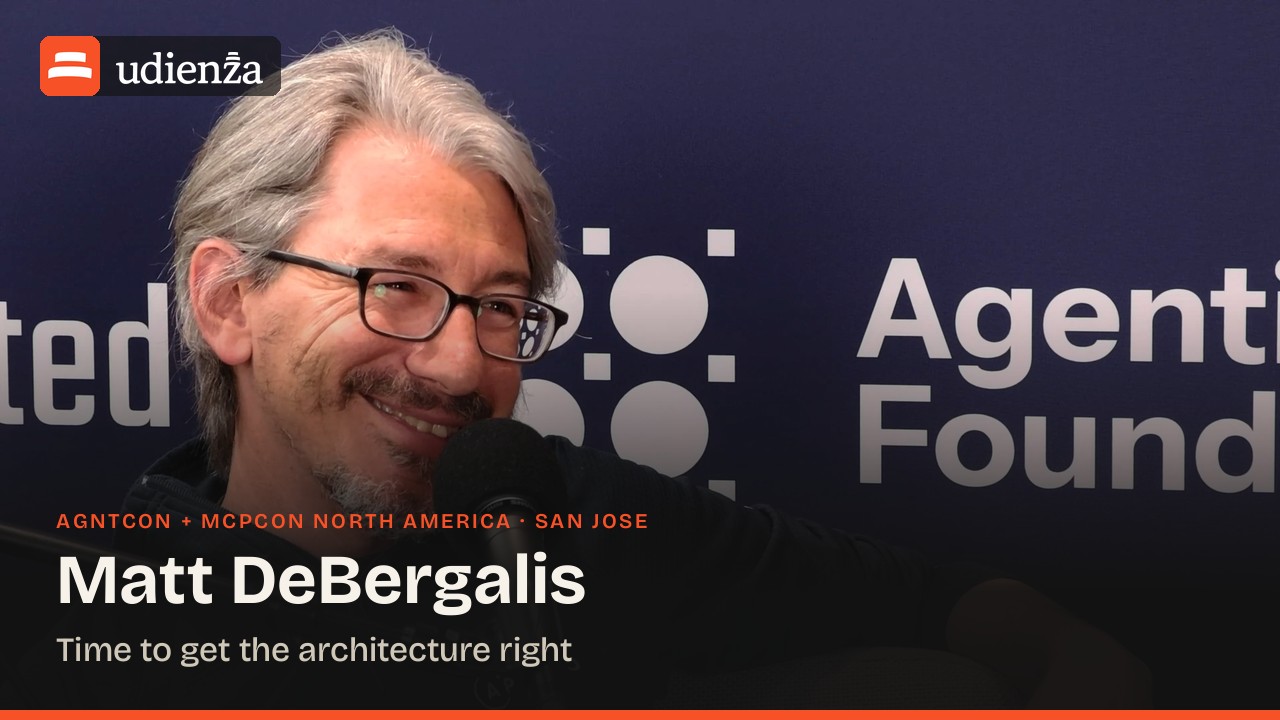
Not filmed yet.
Matt DeBergalis is CEO and co-founder of Apollo GraphQL, which works with large companies that run thousands of systems.
Follow the show and the episode arrives the morning it's published.
In brief
- Agents are past the experimental phase: the question now is what they look like for real, and how quickly companies can get there.
- An agent needs APIs to act and to read real-time or transactional data, and large companies run thousands of systems and will build thousands of agents.
- His answer is a layer that does search and policy enforcement, with semantics that tell the agent what each thing means and its rules of use, enforced deterministically instead of agent by agent.
- A bank shows the squeeze: customers will want to bank through ChatGPT or Claude, and a thousand rules still apply; too slow and you lose, too fast and you end up in trouble.
- He expects a resurgence of deterministic, declarative systems built to scale, as Kubernetes was for the cloud, and welcomes the AAIF's work on standards.
- The trust boundaries, between agents and systems and between agents, are where to solve it: a layer that works like the police force inside your organisation, since no human can approve every call.
- Personal information needs new and stronger primitives, now that people's judgment and code reviews can no longer be the only safeguard.
- Intuit, an Apollo customer, is replacing separate marketing systems with an agent that makes the ad buys and sets the allocation, on a graph with the policy layer under it.
Chapters
- 0:00 Past the experimental phase
- 1:10 Agents need thousands of APIs
- 2:00 Search, policy and semantics
- 2:43 A bank between a rock and a hard place
- 4:04 Declarative, like Kubernetes
- 5:22 Trust boundaries between agents
- 6:16 Personal information needs primitives
- 7:49 A query language and a domain model
- 8:27 A customer's marketing agent
Why this conversation
Every agent worth building has to call the systems a company already runs, and large companies run thousands of them. Matt DeBergalis is CEO and co-founder of Apollo GraphQL, which works with those companies, and in this conversation he explained the layer he thinks agents need between them and their APIs, and why he thinks the next few months decide the architecture. The host recorded with him at the conference’s studio on the show floor in San Jose on 22 October 2026, the first day of AGNTCon + MCPCon North America. The rest of that day is in AGNTCon + MCPCon North America 2026: day one.
Past the experiment
He had been to the conference in New York in the spring, and MCP was then only a year and change old; the scale of this one showed how big a part of the stack it has become. For a year or two, people saw agents as an experimental phase, and most of what they tried never reached production. “We’re past all that.” The topic now is what this looks like for real, and how quickly companies can get there.
Search, policy and semantics
Apollo works with companies that run thousands and thousands of systems. An agent needs to talk to all of it: acting means calling an API, and so does reading real-time or transactional data. Agents are freeform, the more they talk to the more valuable they are, and nobody builds only one. How to do that at scale, sustainably and safely is, for him, the big question for anyone thinking about their AI stack.
His take: “you need a layer that does search and does policy enforcement.” At scale, that takes semantics. Not just a pile of individual APIs, but a way to tell the agent what those things mean, how they are meant to be used and what the rules of use are, captured in standards-based queries with deterministic enforcement, instead of a framework or each team deciding agent by agent.
Between a rock and a hard place
He asked the host to put himself in a bank’s shoes. Customers will want to bank in new ways: a better website or mobile app, but also talking to the bank through ChatGPT or Claude, with partnerships and customer offers folded into the same story. A bank has to do that quickly and at scale, with a thousand rules to follow. If it is too slow, it loses to someone faster; if it goes too fast, without the proper foundation, it ends up in trouble. The choices made in the next few months or year matter for anyone in infrastructure: “if ever there’s a time to get the architecture right, it’s got to be now.”
He expects a huge resurgence of deterministic systems built to scale. Kubernetes gave the cloud a declarative way of describing an environment and how its pieces compose, and AI will need the same in spirit. That is why he is excited about the AAIF and its work on standards: a common language, and a way to prove that things were built in a standard and correct way.
Trust boundaries
Trust is what he thinks about most. Agents are not trusted, and every boundary, between an agent and a system, between two agents, or between two parts of an organisation, is a trust boundary. Solve it there, and you need not worry about what is inside each team’s system or each agent, because the layer between them works like “the police force inside your organization”. Personal information is the example: companies used to rely on their teams, their process and their code reviews to keep it from leaving the building the wrong way. With agents, that needs a new and stronger set of primitives, built into the system, because “we cannot ask a human to approve every single call”. He called it the biggest shift to the stack the industry has ever seen, “way bigger than mobile, way bigger than cloud ever was”, with 18 to 24 months to make it.
Intuit’s marketing
Apollo’s approach is a query language and a semantic model, which it calls a domain model, so that companies can work API by API, system by system or agent by agent, declaratively and at large scale. One customer is Intuit, which is reinventing its marketing. The old way had people watching the ad buys across separate systems and bringing conversion rates together from many places. The new one is an intelligent system that makes the buys and sets the allocation, around the clock, and learns as it goes. To do it quickly and safely, Intuit is rolling out a graph with the layer that sets the policy, and the plan is to take the same idea to bigger and bigger parts of the organisation, one success after another.
When it comes out
The episode is edited and in the release order. Like every episode it goes out on YouTube first, then on Apple Podcasts, Spotify and Amazon Music.
Mentioned in this episode
About Matt DeBergalis
Matt DeBergalis is CEO and co-founder of Apollo GraphQL, which works with large companies that run thousands of systems.
Running this in production? Luca Berton helps platform teams take it from prototype to reliable production. See how he works
Built something the rest of us run on? Being a guest is free. Take the other chair
More episodes
All episodes →-
Episode 93 · Coming
Michael Levan: A thousand agents, one pod
-
Episode 95 · Coming
Benjamin Hindman: A higher level of abstraction
-
Episode 79 · Coming
Angie Jones: The neutral home of the agentic stack
-
Episode 50 · Coming
Erik Wilde: OpenAPI, Arazzo and Overlays for agents