Coming soon 5:08 Recorded at Nordic APIs Platform Summit, Stockholm
When should an agent follow a workflow you wrote, not its own plan?
OpenAPI, Arazzo and Overlays for agents
Erik Wilde of the OpenAPI Initiative on OpenAPI, Arazzo and Overlays, why composable workflows help agents, and why some steps should stay deterministic.
Erik Wilde, OAI Ambassador, OpenAPI Initiative · with  Luca Berton
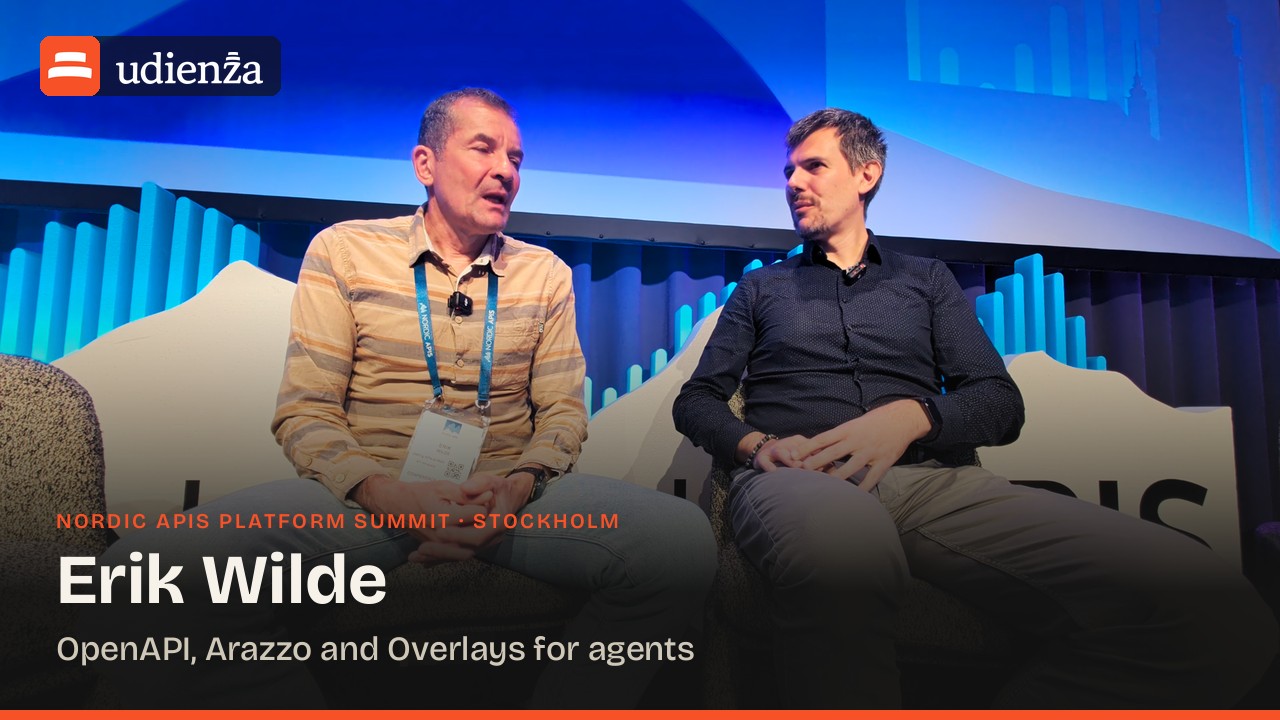
Not filmed yet.
Erik Wilde is an OAI Ambassador at the OpenAPI Initiative, which now publishes the Arazzo workflow standard and the Overlay standard alongside OpenAPI. He spoke at the Nordic APIs Platform Summit 2026 in Stockholm.
Follow the show and the episode arrives the morning it's published.
In brief
- The OpenAPI Initiative used to publish only OpenAPI; it now also has the Arazzo workflow standard and the Overlay standard.
- Interoperability is about choice: thousands of products support OpenAPI in some way.
- Composability is where Arazzo helps: it composes several OpenAPI-described APIs into a workflow, such as booking a ticket.
- Agents sometimes have a hard time stitching APIs together; a written workflow gives them the steps.
- An Arazzo workflow can be reviewed, changed and versioned, so a business knows a task runs in the steps it prescribed.
- Erik's message at the summit: use as little AI as possible, and keep the parts that should be deterministic deterministic.
- The latest OpenAPI release, 3.2, came out about a year ago; upgrading is hard in large companies whose tools lag behind.
- To get involved: openapis.org, openapi.tools for the tools that implement OpenAPI, and the specification Slack channels.
Chapters
- 0:00 OpenAPI, Arazzo and Overlays
- 0:45 Interoperability vs composability
- 1:52 Deterministic workflows for agents
- 3:00 How to get involved
- 3:36 New versions and upgrading
Why this conversation
Most teams that run APIs already describe them with OpenAPI. The question now is what happens when the caller is an agent rather than a developer reading the documentation. Agents can call APIs, but they do not always call them in the same order or in the same way, and a business that depends on a process needs to know which steps will run. The host met Erik Wilde, OAI Ambassador at the OpenAPI Initiative, on the morning of 14 October at the Nordic APIs Platform Summit in Stockholm, the day after Erik’s own talk there. The story of the week is in Nordic APIs 2026: your next customer is an agent.
It is a short conversation, about five minutes, and it covers three things: the new specifications, why written workflows matter for agents, and how to take part in the work.
More than one specification
OpenAPI has been around for about twelve years, and the conversation opened on how widely it is used. For most of that time the OpenAPI Initiative had one specification, OpenAPI itself. It now has two more: Arazzo, a workflow standard, and the Overlay standard. The idea, Erik says, is to give the community more tools to build on, so that products can implement them and work together.
He draws a line between two words that often get mixed up. Interoperability is about choice: if you use OpenAPI, there are literally thousands of products that support it in some way, and you pick the one you want. Composability is different. If you have several APIs described with OpenAPI, Arazzo lets you compose them into a workflow. His example is booking a ticket: the workflow says that to book a ticket you do this step, then this one, then the next. That matters for agents in particular, because agents sometimes have a hard time stitching things together.
Deterministic where it counts
The host raised accountability, a big topic in Europe. Erik’s answer is practical. If a business tells an agent to carry out a task, the agent might do it, but it might also do it differently from one time to the next. It is not deterministic. With Arazzo the workflow is defined: it can be reviewed, changed, versioned and checked by someone else. A team then knows that the task will be done in the steps it prescribed.
That was also the main message of his talk the day before: “use as little AI as possible”. AI is good, he says, but it also has its downsides. Some things should be deterministic, and should be handled that way, rather than throwing every problem at an agent “and just hope for the best”.
Getting involved and keeping up
The starting point is openapis.org, the OpenAPI Initiative’s site (the plural was the only domain available). openapi.tools lists the software components that implement OpenAPI. Those who want to join the technical work will find it mostly on Slack, in active channels for each specification and for other work in the API space.
New versions are always being developed. The last one, OpenAPI 3.2, came out about a year ago, and more will follow. Erik encourages people to join, because standards improve with feedback and with more people doing the work. He is candid about upgrades: in a large company with many tools around, some of those tools may not support the latest version yet, so moving up is hard, as versioning always is. In the long run, he says, it still makes sense to keep asking how to get from where you are to a better place.
Mentioned in this episode
About Erik Wilde
Erik Wilde is an OAI Ambassador at the OpenAPI Initiative, which now publishes the Arazzo workflow standard and the Overlay standard alongside OpenAPI. He spoke at the Nordic APIs Platform Summit 2026 in Stockholm.
Running this in production? Luca Berton helps platform teams take it from prototype to reliable production. See how he works
Built something the rest of us run on? Being a guest is free. Take the other chair
More episodes
All episodes →-
Episode 49 · Coming
Viola Marku: Federation for the agentic era
-
Episode 51 · Coming
Andi Mann: Observability for non-deterministic systems
-
Episode 52 · Coming
Gertrude Chilufya: Reframing the future of work
-
Episode 47 · Coming
Bianca Lewis: OpenSearch as the data layer for AI