Coming soon 14:50 Recorded at Nordic APIs Platform Summit, Stockholm
How do you observe a system that does not do the same thing twice?
Observability for non-deterministic systems
Andi Mann of Apica on observing agentic systems that are non-deterministic, how Apica is growing, and his advice for founders: find a partner for your gaps.
Andi Mann, Chief Product and Technology Officer, Apica · with  Luca Berton
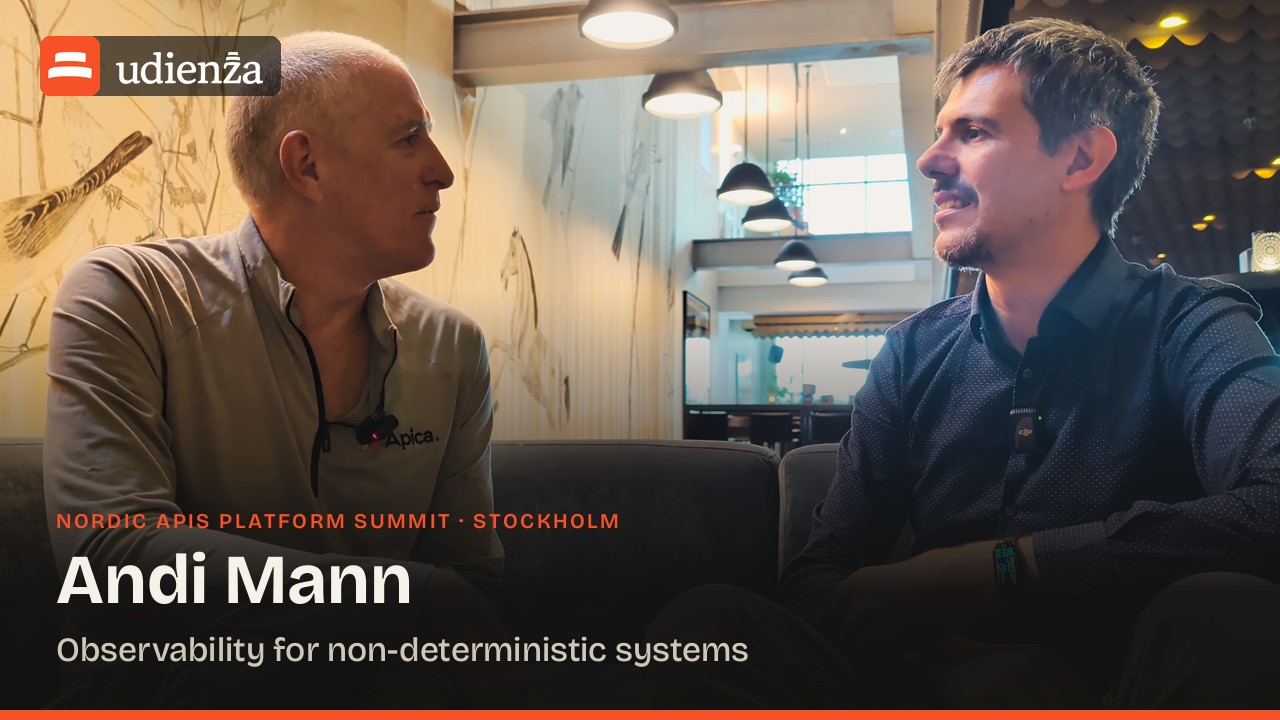
Not filmed yet.
Andi Mann is Chief Product and Technology Officer at Apica. He came out of data centre operations for banks and insurers, worked at BMC Software and CA Technologies, and joined Splunk in its relatively early days.
Follow the show and the episode arrives the morning it's published.
In brief
- A system is observable when you can see inside it; standards such as OpenTelemetry let systems report their own logs, metrics and traces.
- OpenTelemetry SDKs do much of the instrumentation developers used to hand-code, which helps IT operations when things go wrong.
- The main challenge now is the move from deterministic to non-deterministic systems: you cannot tell exactly what an agentic system will do.
- Andi has joined the Agentic AI Foundation's working group on observability and tracing, but says his customers need answers now.
- Apica combines observability, synthetic monitoring for the non-deterministic parts, and a telemetry pipeline to manage data volume, governance and compliance.
- Advice for founders: find people who say 'yes, and', not 'no, because', and do not try to do everything yourself.
- Find a partner who fills your gaps, such as selling, and agree up front who does what and how revenue is shared.
- Start the search with your own network, and be clear about who your services are for.
Chapters
- 0:00 Andi Mann at Apica
- 1:17 What observability means
- 3:24 Non-deterministic agentic systems
- 5:47 Apica's growth
- 7:53 Where to learn more
- 8:56 Advice: find a partner
- 11:07 Know yourself and your gaps
- 13:10 Clarifying your proposition
Why this conversation
Observability was built for systems that do what they are told. Agentic systems do not: give one the same task twice and it may take a different path each time. For the people who run them, that turns a solved problem into an open one. The host met Andi Mann, Chief Product and Technology Officer at Apica, at the Nordic APIs Platform Summit in Stockholm on 14 October, on the day of his talk there. The story of the week is in Nordic APIs 2026: your next customer is an agent, and there is a short profile of Andi in Andi Mann of Apica: the interview.
Andi has worked in observability for a long time. He came out of data centres for banks, insurance companies, travel, logistics and oil and gas, moved to the vendor side with BMC Software and CA Technologies, and joined Splunk in its relatively early days. Cloud, automation, DevOps and observability have been his interests; now it is managing AI systems. He jokes that his “favorite operating system these days is PowerPoint”, but he has written code, contributed to open source projects and run night-shift data centre operations for big banks, and he still likes to understand how the internals work.
What observability means
“A system is observable when you can see inside that system.” Systems used to be black boxes, so teams relied on synthetic monitoring, real user monitoring and end-user monitoring from the outside. Standards such as OpenTelemetry changed that: systems now report what they are doing through logs, metrics and traces. Andi remembers hand-coding specific error logs and trace statements. Now the OpenTelemetry SDKs do much of it for developers, and that makes life easier for the IT operations people who have to work out what went wrong.
When the system is non-deterministic
The hard part now is the move from deterministic to non-deterministic systems. A traditional application or API did what you told it to do. Agentic AI and thinking systems do not, and you cannot say exactly what they will do. Understanding what they actually did, from a monitoring and management point of view, is hard, and observability alone is no longer enough.
Andi has joined the Agentic AI Foundation’s working group on observability and tracing, which is working on open standards and on bringing these ideas into OpenTelemetry. He welcomes the effort, but his customers need it now, so he is already building. Those customers include large banks, insurers, travel companies and one of the top internet companies in the world: large enterprises with mission-critical environments at massive scale. Asked how he sleeps at night, he credits his team.
Where Apica is going
Apica has invested in observability, telemetry pipeline and synthetic monitoring technologies, and the three together were the subject of his talk. Observability shows what happens inside the system. Synthetic transactions create extra monitoring signals, so the non-deterministic behaviour of AI can be understood. And because all this produces far more monitoring data, the pipeline manages the volume and provides governance and compliance. Agentic AI is only at the beginning, he says, and the goal is to give customers confidence, save them money and make sure they do the right things, not just do things quickly.
He is on LinkedIn, and apica.io has videos, documentation and demos. He expected his session to be recorded and planned to post it on LinkedIn.
Advice: find a partner
The second half turns to the host’s own work as an independent consultant, and Andi’s advice applies to anyone building a business. Find good people who support you, and lean on them. He borrows “yes, and” from improvisation: people who take your idea and help make it happen, rather than those who say “no, because”. Don’t try to do everything yourself.
The one thing he wishes he had done as an individual consultant was get a partner who filled his gaps. He is good at marketing and messaging, but not at asking for the deal or the contract. Quoting Sun Tzu, he argues that knowing yourself and the other side is what wins: if you know what you cannot do, find someone who can, and who needs what you can do in return.
Where to start: your network, LinkedIn included. Tell people you are looking to partner with someone, and ask whether they know anyone. Before those conversations, understand your business model: what you will do, what the partner will do, how revenue is shared, and what the costs are. The conversation closes on the proposition itself: mapping the services you offer, and being clear whether they are for a CEO, a CIO or an IT manager.
Mentioned in this episode
About Andi Mann
Andi Mann is Chief Product and Technology Officer at Apica. He came out of data centre operations for banks and insurers, worked at BMC Software and CA Technologies, and joined Splunk in its relatively early days.
Running this in production? Luca Berton helps platform teams take it from prototype to reliable production. See how he works
Built something the rest of us run on? Being a guest is free. Take the other chair
More episodes
All episodes →-
Episode 50 · Coming
Erik Wilde: OpenAPI, Arazzo and Overlays for agents
-
Episode 52 · Coming
Gertrude Chilufya: Reframing the future of work
-
Episode 34 · Coming
Vladimir Vučković: Catching agent failures
-
Episode 47 · Coming
Bianca Lewis: OpenSearch as the data layer for AI