Coming soon 5:56 Recorded at AGNTCon + MCPCon Europe, Amsterdam
How do you find out why an agent in production went wrong?
Catching agent failures
Vladimir Vučković of moyai on catching agent failures in production: statistics and agents on traces, OpenTelemetry-native, and evals on every tool call.
Vladimir Vučković, Founding AI Engineer, moyai · with  Luca Berton
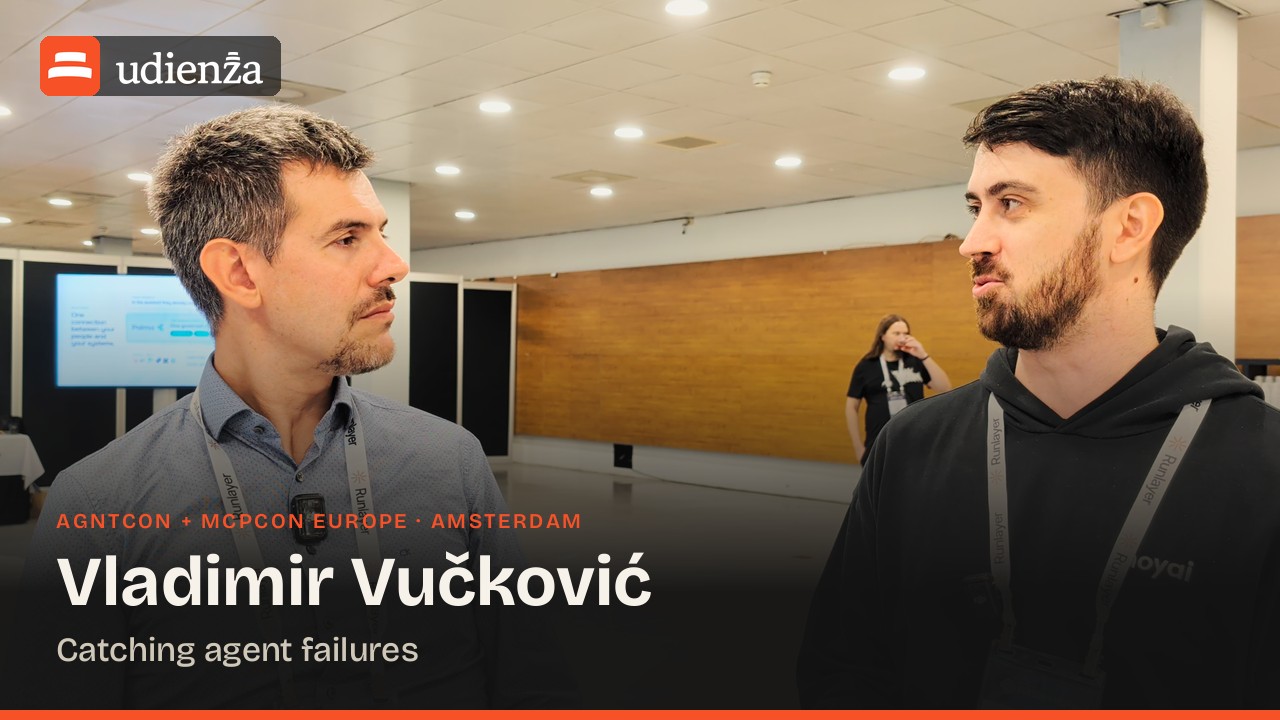
Not filmed yet.
Vladimir Vučković is Founding AI Engineer at moyai, which finds anomalous behaviour in production agents, classifies it and reports what went wrong and how to fix it. He joined the company six to nine months before this conversation.
Follow the show and the episode arrives the morning it's published.
In brief
- moyai looks for anomalous behaviour in production agents: hallucinations, loops and orphan tool calls.
- It does not replace an observability platform; it reads the traces teams already collect and stacks on top.
- Deterministic and statistical analysis of the traces comes first, then a multi-agent system that forms hypotheses and confirms or refutes them.
- The result is a report with the likely cause and the steps to fix it.
- Any agent works, internal or external, with any LLM observability; OpenTelemetry-native traces are preferred.
- Every tool call on every agent in moyai's own system has its own evals, and the platform observes itself.
- The architecture is a macro ReAct loop: each agent is one step of a larger reason-and-act cycle.
Chapters
- 0:00 moyai: catching agent failures
- 1:20 Statistics, then agents on traces
- 3:01 Any agent, OpenTelemetry-native
- 3:44 Evals on every tool call
- 4:20 A macro ReAct loop
- 4:59 How to try it
Why this conversation
An agent in production does not fail like a web service. It does not return a 500 and stop. It takes a wrong turn, calls a tool it should not, or goes round in circles, and the first anyone hears of it is a strange answer. Teams that run agents already collect traces. The open question is what to do with them once there are too many to read.
On the second day of AGNTCon + MCPCon Europe in Amsterdam, the host spoke with Vladimir Vučković, Founding AI Engineer at moyai. He had joined the company six to nine months earlier. moyai describes itself as an AI-native agent company: it catches anomalous behaviour in production agents, classifies it, and gives the team a report of what went wrong in the agentic flow, together with a proposed fix. The rest of the week is in AGNTCon + MCPCon Europe 2026: who we met.
What counts as a failure
An agent with tools moves from point A to point B, calling those tools to find the information it needs on the way. Along that path it can hallucinate, it can get stuck in a loop, and it can make orphan tool calls. Those are the behaviours moyai looks for. Some are generic and show up in almost any agent. Others are specific to the use case, and depend on what the team has built.
Statistics first, then agents
The detection works in two stages, both on traces. moyai does not replace the observability platform a team already runs; in Vladimir’s words, “we just kind of stack on top of it”. The first stage is deterministic and statistical analysis of the traces. The second is non-deterministic: moyai’s own multi-agent system takes the statistical results and digs into the detail. Its agents look for evidence, widen the sample, and search for patterns. They then put forward hypotheses and test them, confirming or refuting each one. Everything is gathered into a report on the platform, with what moyai believes the problem is and the steps to solve it.
The method, he says, came out of many experiments and a lot of iteration, testing on moyai’s own agent and on those of its design partners.
Any agent, any traces
Asked which agent SDKs it supports, Vladimir says the platform is agnostic. Any agent, internal or external, works as long as it has some complex behaviour, such as tool calls, handling context or summarising. On the observability side, any platform built for observing LLMs can be used, and traces are exported into moyai. The preference is for OpenTelemetry-native traces.
Evals on every tool call
The host raised the shift from a deterministic world to a probabilistic one, and the weight now put on evaluations. moyai’s own agents run a layered eval system: code quality evals, and tool evals for every tool call on every agent in the system. The platform as a whole works as a more nuanced, online eval system. moyai also observes itself with it, so the platform feeds back into its own development.
The architecture borrows from the ReAct loop, in which a model alternates between reasoning and acting. Some of moyai’s agents have a single tool, others have complex sets and choose between them based on context. Each agent acts as one step of reasoning and acting, and together they form what he calls “a macro ReAct loop”: the same pattern a chat assistant runs inside a single answer, built out of whole agents.
How to try it
The starting point is moyai.ai. From there, people can book a meeting with the founder or register on the platform. Registration comes with a limited number of scans; anyone who needs more talks to the founder.
Mentioned in this episode
About Vladimir Vučković
Vladimir Vučković is Founding AI Engineer at moyai, which finds anomalous behaviour in production agents, classifies it and reports what went wrong and how to fix it. He joined the company six to nine months before this conversation.
Running this in production? Luca Berton helps platform teams take it from prototype to reliable production. See how he works
Built something the rest of us run on? Being a guest is free. Take the other chair
More episodes
All episodes →-
Episode 33 · Coming
Ugo Pollio: CockroachDB for agentic workloads
-
Episode 35 · Coming
Maisie: Kilo Code joins Anaconda
-
Episode 51 · Coming
Andi Mann: Observability for non-deterministic systems
-
Episode 30 · Coming
Sudeep Goswami: Runtime governance for AI agents