Coming soon 3:39 Recorded at AGNTCon + MCPCon Europe, Amsterdam
Why is Anaconda, known for Python packages, building for AI coding?
Kilo Code joins Anaconda
Maisie of Anaconda on why a Python packaging company came to an agents conference: Kilo Code, 500-plus models, and governance over what teams pull in.
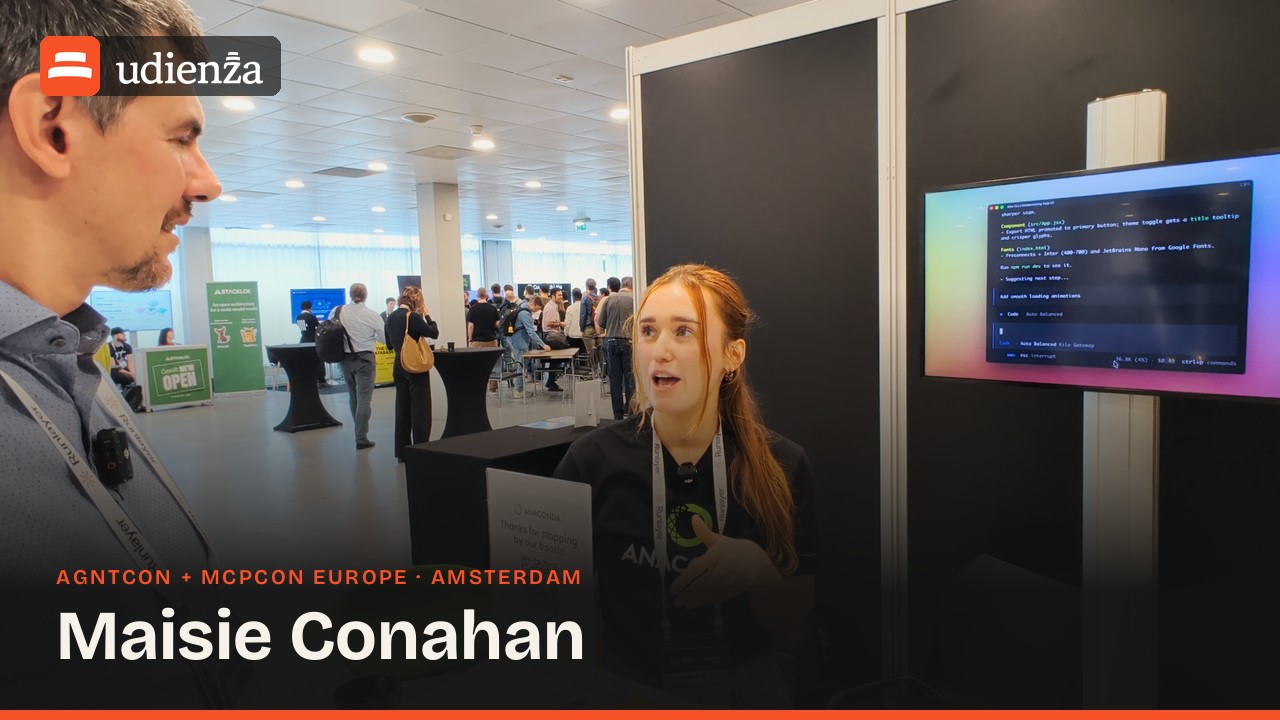
Maisie, EMEA Sales, Anaconda · with  Luca Berton
Not filmed yet.
Maisie works on the EMEA sales team at Anaconda, which has worked in Python package management and its security for about twelve years.
Follow the show and the episode arrives the morning it's published.
In brief
- Anaconda has been in Python package management, and the security around it, for about twelve years.
- It made three acquisitions this year; one is Kilo Code, an AI coding assistant.
- Kilo Code gives access to more than 500 models, open-weight and frontier, with benchmarking, cost optimisation and model routing.
- Developers use it in VS Code, JetBrains or the CLI, and send inference to AWS Bedrock, Azure or on-prem.
- Companies get governance on top: audits of the models pulled in, and role- and team-based restrictions.
- There is a free, open source tier for individuals, and team and enterprise licences.
- Anaconda Desktop was due to integrate with Kilo Code at the end of the month, for local development and testing.
Why this conversation
Most people who write Python have met Anaconda through Conda. So when its booth appeared at AGNTCon + MCPCon Europe in Amsterdam, a conference about agents, visitors kept asking the same question: they knew Conda, but why was Anaconda there? On 18 September the host put that question to Maisie, who works on Anaconda’s EMEA sales team. It was a short conversation at the booth. The rest of the week is in AGNTCon + MCPCon Europe 2026: who we met.
From packages to Kilo Code
Anaconda has been around for about twelve years in the Python space, she says: package management, and the security side of it. This year it made three acquisitions. One of them is Kilo Code, an AI coding assistant.
Kilo Code gives developers access to more than 500 models, open-weight and frontier. They can compare benchmarks, optimise cost based on how a model performs for a given job, and route models and inference to wherever they want: AWS Bedrock, Azure, or on-prem. She describes it as a flexible model harness, used in VS Code, in JetBrains or on the command line.
What Anaconda adds is the view a company needs over all of that: governance and control, audits of the models being pulled in, and role-based and team-based restrictions, for example to restrict certain types of models in line with regulation.
Free tier, licences and local testing
Kilo Code is based in open source, and there is a completely free tier with access to all of the models, which she sees as mainly for individuals. Teams and enterprises that want restrictions, control and visibility over the models in use have team and enterprise licences.
The models run wherever a team chooses to send them. Anaconda Desktop was due to integrate with Kilo Code at the end of the month, so that development and testing can happen locally before deploying to the inference provider of choice. She named AWS and Google, NVIDIA DGX Spark machines, on-prem and air-gapped environments.
Kilo Code and Anaconda now work as one team, and she invited people to get in touch with her or anyone else at Anaconda.
About Maisie
Maisie works on the EMEA sales team at Anaconda, which has worked in Python package management and its security for about twelve years.
Running this in production? Luca Berton helps platform teams take it from prototype to reliable production. See how he works
Built something the rest of us run on? Being a guest is free. Take the other chair
More episodes
All episodes →-
Episode 34 · Coming
Vladimir Vučković: Catching agent failures
-
Episode 36 · Coming
Angela Brown: Why the builders still meet in person
-
Episode 09 · Coming
Shannon Williams: When enterprises trust agents
-
Episode 37 · Coming
Roman Swoszowski: One catalog for every AI system