Coming soon 7:19 Recorded at Nordic APIs Platform Summit, Stockholm
Why is adopting a federated API platform a human problem, not a technical one?
Federation for the agentic era
Viola Marku, Head of Customer Success at WunderGraph, on GraphQL federation for agentic workflows, why adoption is a human problem, and creative space.
Viola Marku, Head of Customer Success, WunderGraph · with  Luca Berton
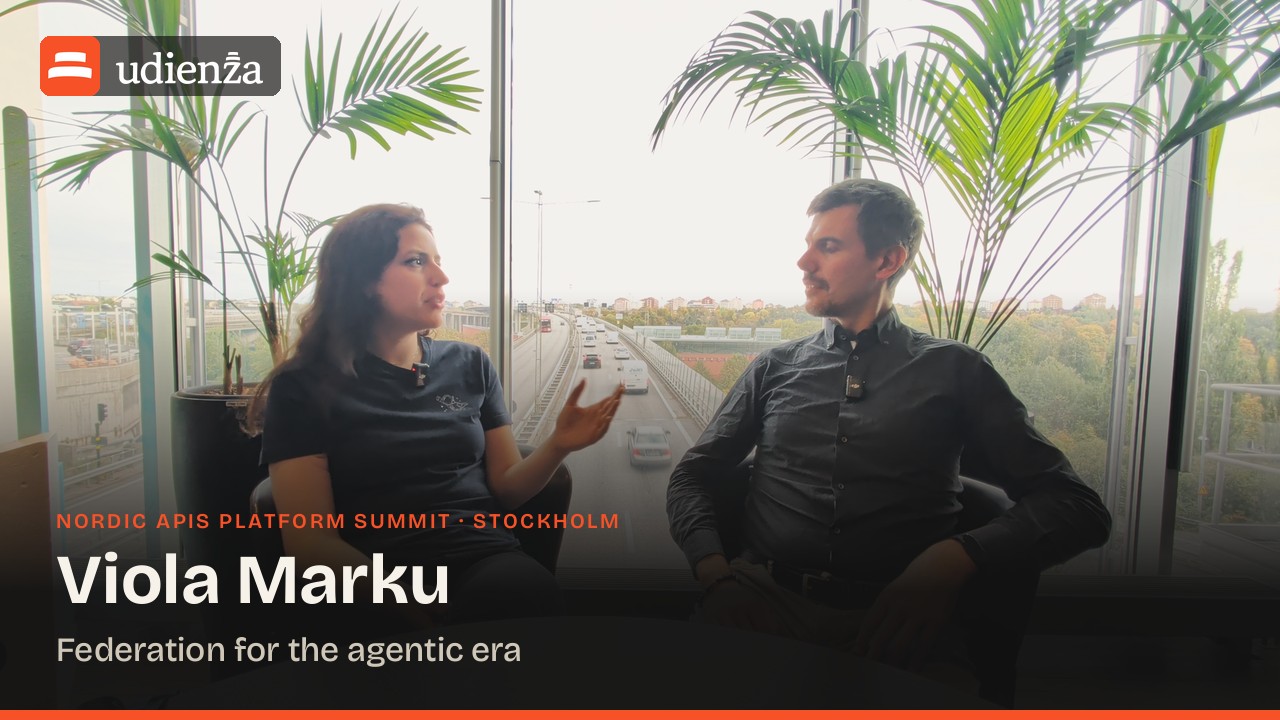
Not filmed yet.
Viola Marku is Head of Customer Success at WunderGraph, a software platform for GraphQL and API management built on federation, where she works with the company's enterprise customers.
Follow the show and the episode arrives the morning it's published.
In brief
- WunderGraph provides GraphQL and API management built on federation, with both open source and commercial offerings.
- Retail giants such as eBay run traffic through its open source components; smaller companies and startups build on federation for agentic use cases.
- The governance that federation brings is being applied to humans and agents working together.
- Adoption across an organisation is often a human problem, not a technology problem: education, best practice and motivation.
- AI should free time to think, not fill it with more repetitive work; protecting that creative space helps avoid burnout and sameness.
- One end-to-end use case covers a car maker from marketing and pre-orders to logistics, delivery and maintenance.
- WunderGraph's architects work with customers on their pain points and best practice.
Chapters
- 0:00 WunderGraph and GraphQL federation
- 1:19 Federation for agentic workflows
- 1:50 Adoption is a human problem
- 2:51 AI and protecting creative space
- 5:42 An automotive use case, end to end
Why this conversation
Large organisations rarely have one API. They have many services owned by many teams, and now agents that want to call them too. GraphQL federation is one way to put a single, governed graph in front of all of them. Whether it works in practice depends as much on people as on software. At the Nordic APIs Platform Summit in Stockholm the host spoke with Viola Marku, Head of Customer Success at WunderGraph, who works with the company’s enterprise customers.
The story of the summit, including a WunderGraph lightning demo on agents exploring a GraphQL schema, is in Nordic APIs 2026: your next customer is an agent.
GraphQL federation, and where agents come in
WunderGraph, she explains, is a software platform for GraphQL and API management built on federation. It offers software both as open source and under different commercial arrangements, so that organisations can use the power of federation.
The use cases vary. Some of the largest retailers in the world, eBay among them, run their traffic through WunderGraph’s open source components. Smaller companies and startups build on federation for agentic workloads. Asked whether this connects to AI, she said yes: the company is exploring more use cases where the governance that federation provides supports a new way of working, with colleagues who are humans and with agentic workflows that are becoming more common every day.
Adoption is a human problem
Her own work is with WunderGraph’s enterprise customers, and the focus is education: how to promote best practice when working with the stack across a whole organisation. Very often, she says, “it’s often a human problem, not a technology problem.” Teams have to work out ways of working, how to promote their choices and drive adoption, and what motivates people to use the best practice available. The technology and the use cases may look different from one customer to the next, but the human problems are the same.
Protecting creative space
Asked about the future, she sees a paradigm shift driven by AI and a stronger push to innovate. The opportunity is to use it for good and be more creative, while keeping our own cognitive abilities. Running seven streams of work in parallel, each with its own context to hold in mind, can be overwhelming. The balance she describes is to take the operational improvements AI brings, and use the time it frees to think, rather than filling it with more repetitive tasks.
Protecting that creative space, she argues, is key to avoiding burnout and avoiding homogenisation across teams, services and companies. Messaging and look and feel already seem very similar from one organisation to the next, which is an opportunity for those that differentiate themselves. Feeling more efficient and productive every day is an attractive line and a dangerous one: without protected time, organisations lose the edge of bringing something new, which sometimes means spending hours on something that is not efficient on paper.
An automotive use case, end to end
Beyond retail, she described an end-to-end deployment for a well-known car manufacturer, from pre-sale to post-sale: marketing, pre-ordering, processing, back-end logistics, delivery and maintenance. Each is a vertical slice of the whole experience. WunderGraph provides the structure to run the services, but customers still decide their own approach; its architects advise on best practice from what they have seen in the industry, with people who have worked in the field for many years. The aim, she says, is to sit down together, understand the pain points and where a customer wants to go, and be partners in that.
To get in touch, she points to wundergraph.com and to LinkedIn.
Mentioned in this episode
About Viola Marku
Viola Marku is Head of Customer Success at WunderGraph, a software platform for GraphQL and API management built on federation, where she works with the company's enterprise customers.
Running this in production? Luca Berton helps platform teams take it from prototype to reliable production. See how he works
Built something the rest of us run on? Being a guest is free. Take the other chair
More episodes
All episodes →-
Episode 48 · Coming
Vidar Seland: Two-second logins with OBOS ID
-
Episode 50 · Coming
Erik Wilde: OpenAPI, Arazzo and Overlays for agents
-
Episode 47 · Coming
Bianca Lewis: OpenSearch as the data layer for AI
-
Episode 36 · Coming
Angela Brown: Why the builders still meet in person