Coming soon 9:22 Recorded at AGNTCon + MCPCon North America, San Jose
Does the agentic world really need another standard?
The neutral home of the agentic stack
The Agentic AI Foundation's VP of Developer Experience, Angie Jones, on the standards agents still lack, testing non-deterministic agents and AGENTS.md.
Angie Jones, VP of Developer Experience, Agentic AI Foundation · with  Luca Berton
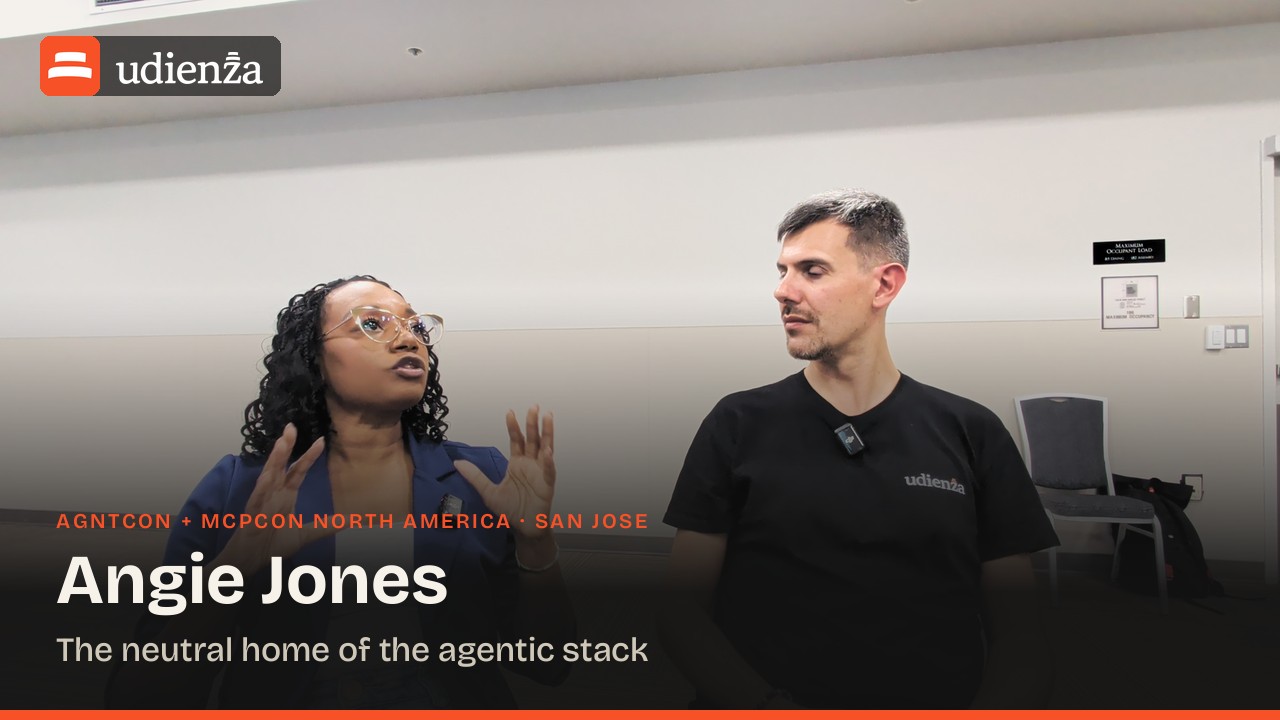
Not filmed yet.
Angie Jones is the Agentic AI Foundation's VP of Developer Experience. The foundation is a neutral home where over 300 member companies work on open source projects and protocols critical to building agents, among them MCP, A2A, AGENTS.md and Agent Skills.
Follow the show and the episode arrives the morning it's published.
In brief
- The foundation is where, in her words, the agentic stack is being built: a neutral home for open source projects and protocols such as MCP, A2A, AGENTS.md and Agent Skills.
- Its more than 300 member companies may compete with what they build, but all of them need an interoperability layer underneath.
- Buying on the web is solved for people but not for an agent buying on your behalf: the merchant has to know the purchase matches the customer's intent, and the agent has to pay without being handed your card details.
- The model at the core of an agent is non-deterministic, so testing takes evals, environments such as OpenEnv from Hugging Face, and guardrails that block undesirable behaviour before it happens.
- Without standards developers build on variations that can change; with AGENTS.md, she says, the Claude team listened to the community and decided to support the standard too.
- Developers can get involved as one of 140 ambassadors, through the foundation's roughly 100 local chapters, or by contributing to its ten open source projects.
- Two flagship AGNTCon + MCPCon events are announced for next year: San Francisco on 28 and 29 April, and London on 15 and 16 September.
Chapters
- 0:00 The neutral home of the agentic stack
- 1:33 Why new standards
- 2:07 An agent that buys for you
- 3:17 Testing non-deterministic agents
- 3:58 OpenEnv and guardrails
- 4:56 Standards and developer experience
- 5:39 The AGENTS.md story
- 6:36 Ambassadors and chapters
- 7:51 Contributing to ten projects
- 8:36 Next year's events
Why this conversation
Many of the protocols that agents depend on now sit in one neutral place, and someone there has to think about the developers who build on them. At the Agentic AI Foundation, that person is Angie Jones, its VP of Developer Experience. The host put two questions to her: what the role means, and how an agent gets from a demo to production. They spoke in San Jose on Friday 23 October, the second day of AGNTCon + MCPCon North America. The other conversations of that Friday are in AGNTCon + MCPCon North America 2026: day two.
A neutral home, and a reason for new standards
The foundation, Angie says, is where the agentic stack is being built. It houses, on neutral ground, the open source projects and protocols that the companies building this agentic world rely on: MCP, A2A, AGENTS.md, Agent Skills and several more. Over 300 member companies meet there to work on those protocols and projects. They may well compete with each other on what they build on top, but they all need an interoperability layer underneath.
The host suggested that a new technology needs new standards. People joke about yet another one, Angie says, but a new space brings a lot of new problems. Take shopping. Buying something on the web is a solved problem for people. “However, if I want my agent to buy something on my behalf on the web, that has not been solved globally.” To work across sites, merchants, payment methods and cards, that may take a standard, or five. The merchant needs some way to know that the purchase matches what the customer meant to buy, and the agent needs a way to pay that does not hand it the customer’s card details.
Testing a system that is not deterministic
The host then raised testing and evaluating autonomous agents. At the core of every agent is a model, and the model is non-deterministic, which makes testing hard. Evals are one part of the answer, and many people are working out how to write efficient ones that cover the scenarios an agent might end up in. OpenEnv, which came from Hugging Face and is one of the newest projects in the foundation, offers another: a place to run an agent through a range of situations and get a better sense of what it might do.
That still does not settle it, because an agent that behaves one way today may behave differently tomorrow. Alongside the tests, Angie says, guardrails have to be in place, so that clearly undesirable behaviour is mitigated or blocked before it happens.
Why developers need the standards
Developer experience, as she describes it, means enabling developers to have a good experience building products and solutions. Without standards, everyone would be developing against different variations that might change, with no way of knowing what to build on top of.
She gives AGENTS.md as a recent case. Most clients had adopted it, but not Claude, whose team used a format of its own, and the community let that team know. A developer who uses Claude for some things and other agents for others says, in her telling: “I just want to put my guidance for my question in one document and I want everyone to support that.” The Claude team listened, she says, and decided to support the standard as well. That is why standards matter to developers: they make their lives easier.
Ambassadors, chapters and ten projects
There are several ways in. Developers can become ambassadors. “So we have 140 ambassadors from every major region of the globe.” These volunteers enjoy helping fellow developers: through blog posts, talks at conferences and local meetups, or videos, they pass on good practices and the lessons they have learned. Others become organizers: the foundation has just about 100 chapters around the world, where local organizers hold regular events in their home towns so that developers can learn and share ideas together.
Then there are the projects themselves. The foundation has ten, and the number is growing; all of them are open source and welcome contributors. Your employer and your country make no difference. Anyone with an idea can bring it to a project’s maintainers on Discord or in its GitHub organization and make a difference that way.
Next year is still being planned, but two flagship events are announced, both under the AGNTCon + MCPCon name: San Francisco on 28 and 29 April, then London on 15 and 16 September.
When it comes out
The episode is edited and in the release order. Like every episode it goes out on YouTube first, then on Apple Podcasts, Spotify and Amazon Music.
Mentioned in this episode
About Angie Jones
Angie Jones is the Agentic AI Foundation's VP of Developer Experience. The foundation is a neutral home where over 300 member companies work on open source projects and protocols critical to building agents, among them MCP, A2A, AGENTS.md and Agent Skills.
Running this in production? Luca Berton helps platform teams take it from prototype to reliable production. See how he works
Built something the rest of us run on? Being a guest is free. Take the other chair
More episodes
All episodes →-
Episode 78 · Coming
Matt Meeboer: Hard-to-reach data for every agent
-
Episode 80 · Coming
San Ramani: From startup to enterprise, with agents
-
Episode 28 · Coming
Benjamin Hindman: Coding agents without drift
-
Episode 50 · Coming
Erik Wilde: OpenAPI, Arazzo and Overlays for agents