Coming soon 5:02 Recorded at AGNTCon + MCPCon North America, San Jose
How does a startup that builds agents reach paying enterprise customers?
From startup to enterprise, with agents
San Ramani, CEO of MobilityeCommerce, on four ways his team helps startups that build agents: enterprise sales, investors, data centres and marketing.
San Ramani, CEO, MobilityeCommerce · with  Luca Berton
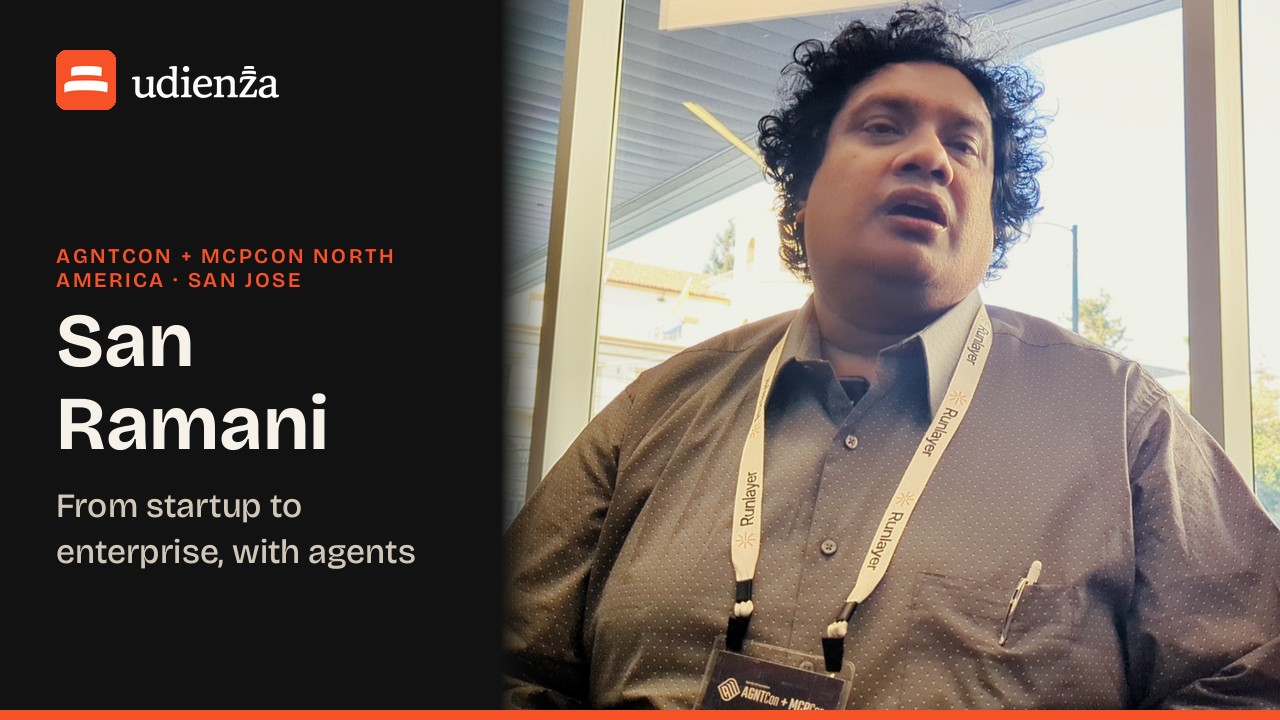
Not filmed yet.
San Ramani is CEO of MobilityeCommerce. His team helps startups that build agents reach enterprise customers and investors, works on data centres for AI, and runs marketing for brands, worldwide.
Follow the show and the episode arrives the morning it's published.
In brief
- His team helps startups in the Bay Area scale and grow as they build agents and agentic commerce, starting with go-to-market: getting into the enterprise, where the paying customers are.
- For that it draws on its ERP experience, with more than 6,000 customers on ERPs such as SAP, Oracle and Microsoft Dynamics.
- Investor Connect helps a startup that has found product-market fit raise funding from top investors worldwide.
- On data centres, it brings investors and end users together: enterprises moving to AI need secure access to power, water and low-cost AI, and AI is so expensive without owning those components that local AI has become their focus.
- For brands, a single channel handles product placement, promotion, pricing and market access autonomously, so a brand can find out what to make before it makes it.
- With about 80 people the company now does more than it did with over 100, and it works worldwide, for tech and physical products alike.
- Its focus now is the role AI can play in all of this, bridging AI companies, finance and accounting companies and investors so that startups can raise what they need to scale.
Chapters
- 0:00 Helping startups reach the enterprise
- 0:40 6,000 ERP customers
- 1:04 Investor connect
- 1:20 Data centres and local AI
- 2:10 Marketing, autonomously
- 3:10 A team of 80, worldwide
- 3:43 AI, finance and investors
- 4:26 Getting in touch
Why this conversation
Building an agent is one problem. Getting it to paying customers, finding the money to grow and running it at a cost that makes sense are others, and those are the problems San Ramani of MobilityeCommerce talks about. The host recorded with him on 23 October 2026, the second day of AGNTCon + MCPCon North America in San Jose. San walked through the four things his team does for young companies and for brands, from enterprise sales and investors to data centres and marketing, and where AI fits into all of it. The day’s other conversations are in the article on day two.
Getting startups into the enterprise
San’s team works with startups in the Bay Area, helping them scale and grow as they build agents and agentic commerce. That work is what brought him to the conference. The first thing the team offers them is go-to-market, and here it leans on its ERP background: it counts more than 6,000 customers across the world’s ERP systems, SAP, Oracle and Microsoft Dynamics among them. That experience is what lets it help new companies that build agents actually execute in an enterprise environment.
The second line of work is called Investor Connect. Once a startup has found product-market fit, the team helps it raise funding from top investors around the world, so that it can keep growing.
Power, water and local AI
The third line is the build-out of data centres, the infrastructure that AI runs on. Here the team brings investors and end users together. Enterprises that are moving to AI, San says, need secure access to power, to water and to low-cost AI, so that they can operate profitably and efficiently as they move their business onto an AI platform. The reason is cost: “Because AI is very, very expensive without you owning much of those components.” That is why, in his view, local AI has become what enterprises focus on, and it is one of the places where his team helps.
Marketing, run autonomously
The fourth line serves brands and covers their whole marketing: product placement, promotion, pricing and market access, all handled through a single channel that can do the work autonomously. The aim is speed. A brand can find out what it should make before it makes it, and whether its ideas are valid. When the product launches, it can scale and go to market through existing connections, from physical stores to online channels and social media, with long-term marketing in mind.
San frames the opportunity in terms of reach, with more than 6 billion people worldwide. “They can solve a small problem, but that is useful for 6 billion people.” If a company can reach everyone who needs what it makes as soon as possible, the time it takes to get to market shrinks.
Eighty people, worldwide
Asked how big the team is, San says about 80 people, and that the company now gets more done with 80 than it used to with more than 100. Its coverage is not limited to the Bay Area. “No, we are worldwide.” It helps companies bring both tech and physical products to market.
What occupies him now is how AI can play a role in every one of these processes. The team works with AI companies on one side and with finance and accounting companies on the other, as well as with investors, and tries to bridge the gap between them. In practice, if an investor is interested in a company, San’s team helps it put its go-to-market, financial and accounting systems in order. With those in place it can raise the money it needs to scale, and its ideas reach the market quickly and efficiently. For anyone who wants to get in touch, San points to LinkedIn.
When it comes out
The episode is edited and in the release order. Like every episode it goes out on YouTube first, then on Apple Podcasts, Spotify and Amazon Music.
About San Ramani
San Ramani is CEO of MobilityeCommerce. His team helps startups that build agents reach enterprise customers and investors, works on data centres for AI, and runs marketing for brands, worldwide.
Running this in production? Luca Berton helps platform teams take it from prototype to reliable production. See how he works
Built something the rest of us run on? Being a guest is free. Take the other chair
More episodes
All episodes →-
Episode 79 · Coming
Angie Jones: The neutral home of the agentic stack
-
Episode 81 · Coming
Katherine Druckman: The human part of AI development
-
Episode 69 · Coming
Jonathan Bryce: PyTorch, vLLM and the brain behind agents
-
Episode 62 · Coming
Siddarth Shekhar: A first con in Silicon Valley