Coming soon 5:46 Recorded at AGNTCon + MCPCon North America, San Jose
If AI writes the code, where does the human go?
The human part of AI development
Katherine Druckman of JetBrains on who answers for the code AI writes, and what the human in the loop needs: tools, resources, support and budgets.
Katherine Druckman, Head of Community and Partnership Engagement, JetBrains · with  Luca Berton
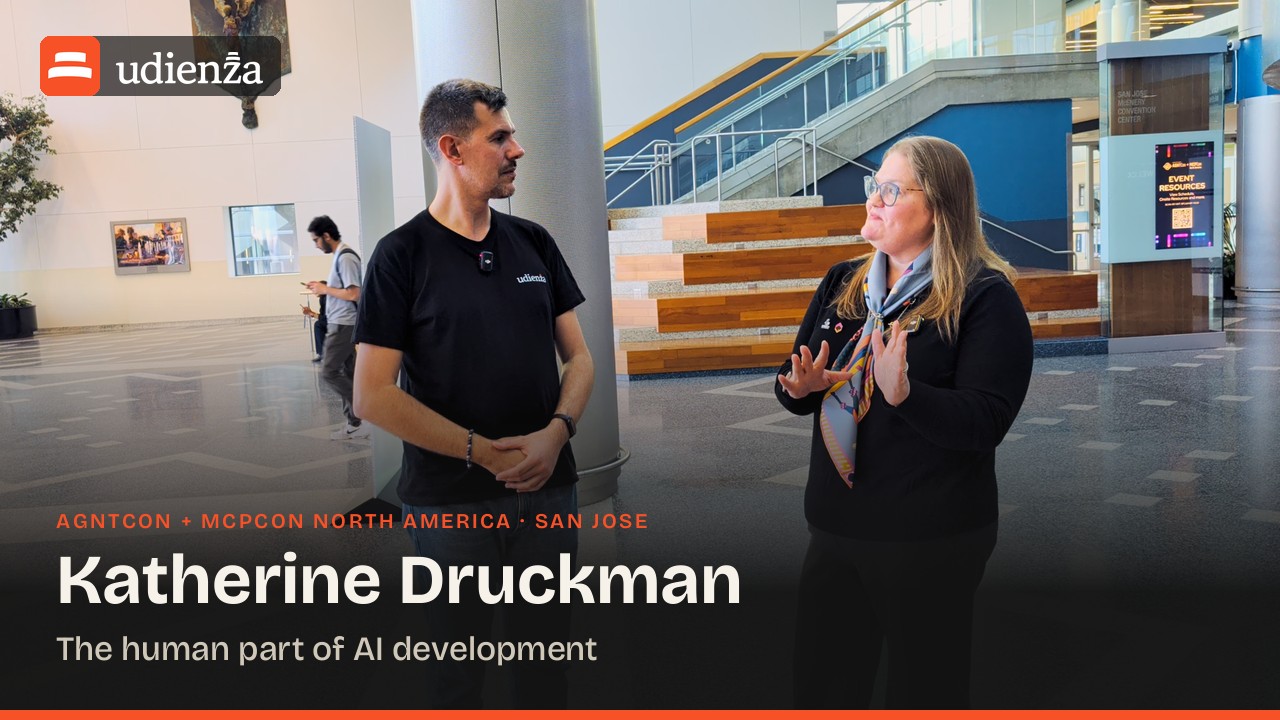
Not filmed yet.
Katherine Druckman is with JetBrains, which supports developers of all kinds and has just launched JetBrains Air. A long-time member of open source communities, she is involved in the Agentic AI Foundation and the OpenSSF.
Follow the show and the episode arrives the morning it's published.
In brief
- She has been in open source communities so long that she no longer counts the years, and takes part in the Agentic AI Foundation and the OpenSSF, both of which JetBrains is a member of.
- JetBrains takes AI development very seriously, for open source communities as well as for developers of all kinds.
- Generating code has become cheap in time, but reviewing it, understanding it and trusting it have not.
- Writing code is less and less the job, yet people remain responsible for what AI generates: they have to know what is in their software and be accountable for it.
- The human in the loop is often talked about as a safety gate, but it is an actual person, who is accountable and needs a reason to change a code base, and to understand the reason behind it.
- That person needs effective tools and, in open source, resources, support and budgets, which can also go toward time: people pitching in.
- JetBrains supports developers who work with AI and those who do not, has just launched JetBrains Air, and showed a tool at the conference that helps developers understand cost, such as the tokens spent on a task.
Chapters
- 0:00 JetBrains and the Agentic AI Foundation
- 0:55 Taking AI development seriously
- 1:16 The cost of trusting AI code
- 2:06 The human part of the work
- 2:41 What human in the loop means
- 3:33 People, budget and time
- 4:08 AI-first developers and the rest
- 4:24 New tools from JetBrains
Why this conversation
AI has made code fast to produce, but someone still has to read it, understand it and answer for it. Katherine Druckman of JetBrains has spent years in open source communities, and at the conference she gave a talk about the human side of this work. She was the host’s last conversation of AGNTCon + MCPCon North America, recorded in San Jose on Friday 23 October, the event’s second day. The rest of that Friday is in AGNTCon + MCPCon North America 2026: day two.
Open source, for a long time
The host opened by noting that she does a lot of things. She agrees. She has been part of open source communities for so long that she would rather not count the years. She takes part in the work of the Agentic AI Foundation, of which JetBrains is a member, and JetBrains also belongs to the OpenSSF, the Open Source Security Foundation, where she has been active for a while. What draws her is the work happening in the open on hard problems. Will it shape the future? She hopes so.
The cost that has not fallen
Asked what JetBrains is doing with AI, she says the company is taking AI development very seriously, for open source communities and for developers of every kind. Generating code now costs little time. Reviewing it does not get cheaper, and neither does understanding it or trusting it, and those costs matter more and more.
That raises the question of where the human goes. Writing code is becoming a smaller part of the job across the industry, yet people remain responsible for the code that AI writes. “We have to know what’s in our software.” Developers must answer for it, trust it and understand it. JetBrains has taken that position, she says, and puts itself behind developers of all kinds, open source or not.
What a human in the loop needs
This is a subject she gets a little soapboxy about, and it was the subject of her talk: the human part of the work, and the support the humans doing it need. One of her slides was about human in the loop, a phrase the industry is fond of. It is often described as a kind of safety gate. For her, it is also, in the end, an actual person, the one who is accountable, who needs to understand the code base, and who needs a reason for each change to it and an understanding of that reason. Defining that person is part of what makes the moment interesting.
“What does that human need in terms of support, resources and tools?” Effective tools, first of all. And, back in open source, resources and support, and, to be honest about it, budgets. Budgets can often be directed to the right place, and at other times they turn into time: people pitching in. In an open source community, she says, people give their own time and understanding, and all of these things go together.
AI-first developers, and everyone else
JetBrains, she says, enables the developers who build with AI, and it also enables those who do not; nobody can take for granted that every developer works that way. The company has just launched JetBrains Air, which she encourages everyone to look at. At the conference it also showed something closer to the cutting edge: a tool meant to help developers understand cost, including how many tokens they spend on particular tasks, and to break down organizational knowledge, so that what a development team learns can be shared across the company. Again, she says, it comes back to understanding what is in the software.
“What a time to be a developer.” For a starting point she suggests jetbrains.com. She also invites people to find her and her JetBrains colleagues on social media.
When it comes out
The episode is edited and in the release order. Like every episode it goes out on YouTube first, then on Apple Podcasts, Spotify and Amazon Music.
Mentioned in this episode
About Katherine Druckman
Katherine Druckman is with JetBrains, which supports developers of all kinds and has just launched JetBrains Air. A long-time member of open source communities, she is involved in the Agentic AI Foundation and the OpenSSF.
Running this in production? Luca Berton helps platform teams take it from prototype to reliable production. See how he works
Built something the rest of us run on? Being a guest is free. Take the other chair
More episodes
All episodes →-
Episode 80 · Coming
San Ramani: From startup to enterprise, with agents
-
Episode 71 · Coming
Jacek Migdał: What agentic coding is really worth
-
Episode 79 · Coming
Angie Jones: The neutral home of the agentic stack
-
Episode 70 · Coming
Andre Elizondo: AURA, an open source SRE agent