23 min read
AGNTCon + MCPCon North America 2026: day one
Day one in San Jose, hour by hour: four new AAIF projects, 305 members, MCP Tasks in Claude Code, Skills over MCP, nine interviews and a maintainer roundtable.
By  Luca Berton
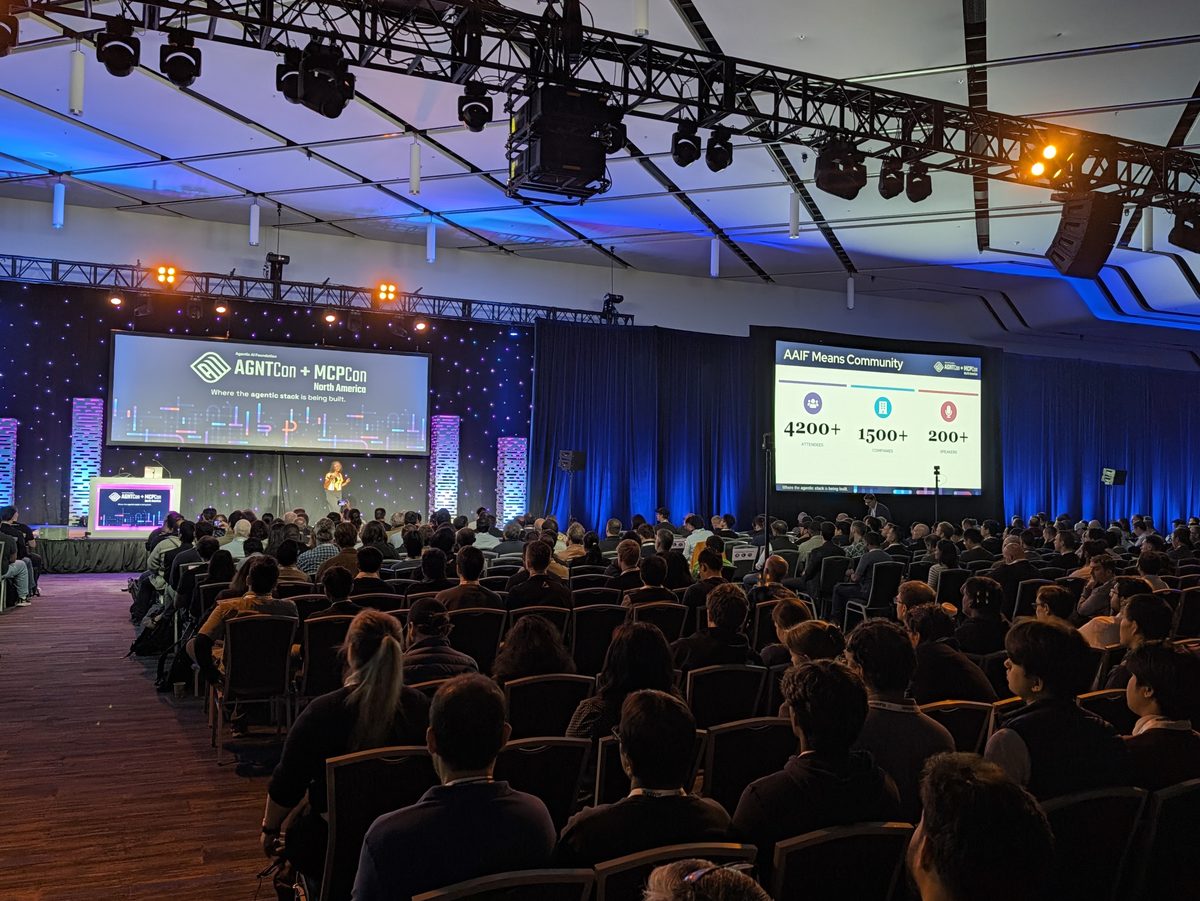
Thursday 22 October 2026, San Jose McEnery Convention Center. Udienza covered AGNTCon + MCPCon North America as an official media partner. It is the Agentic AI Foundation’s conference, a month after the European edition in Amsterdam. The host, Luca Berton, followed the day in his calendar: a gear check at 08:35, the keynote at 09:00, interviews in fifteen-minute slots, the maintainer roundtable at 16:00 and an evening that ended at a comedy show. This is that day, hour by hour, told through the photos, the slides and the recordings. All times are San Jose time.
Day one in numbers
- 305 members, less than a year after the Agentic AI Foundation (AAIF) launched in December 2025.
- 60 new member organisations this quarter, seven of them Gold: Ant Group, Gates Foundation, MongoDB, Nutanix, Royal Bank of Canada, Vercel and Vultr.
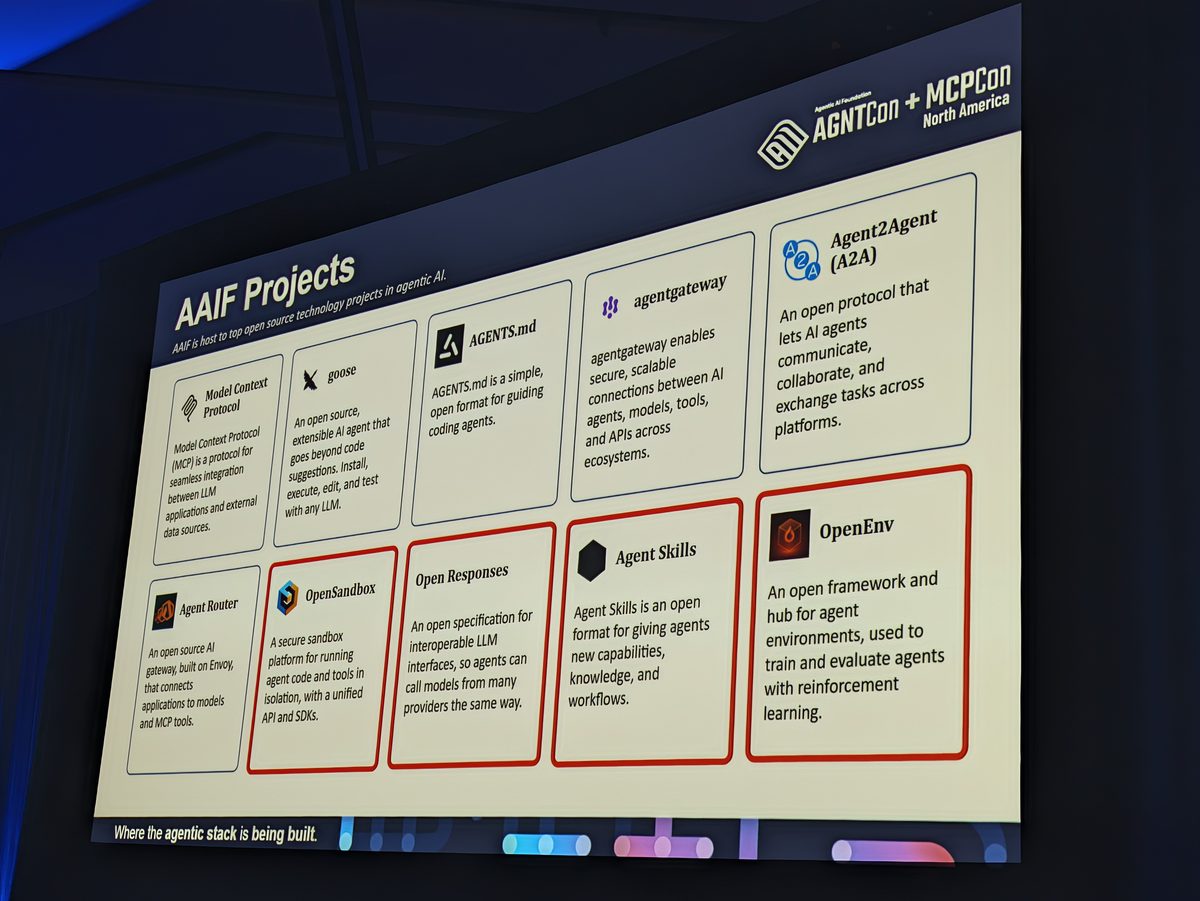
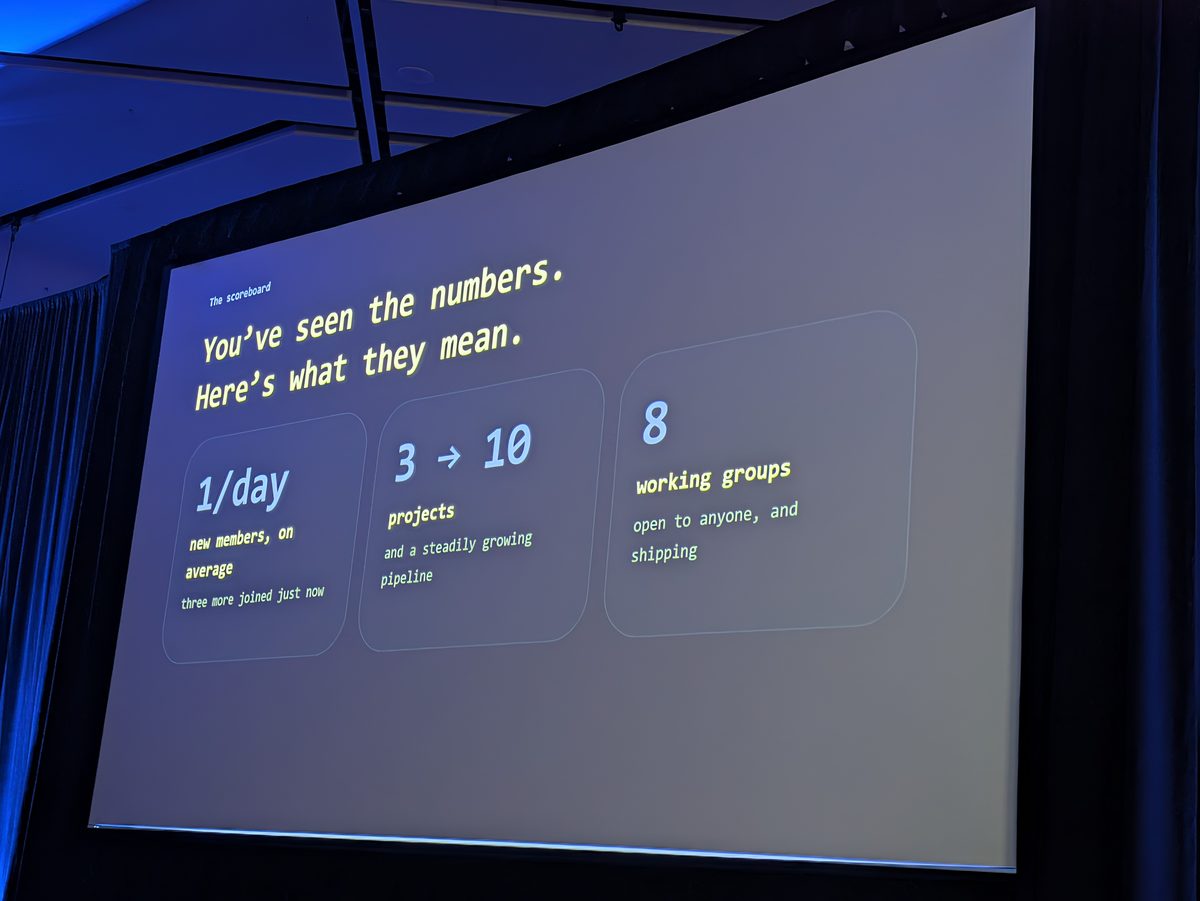
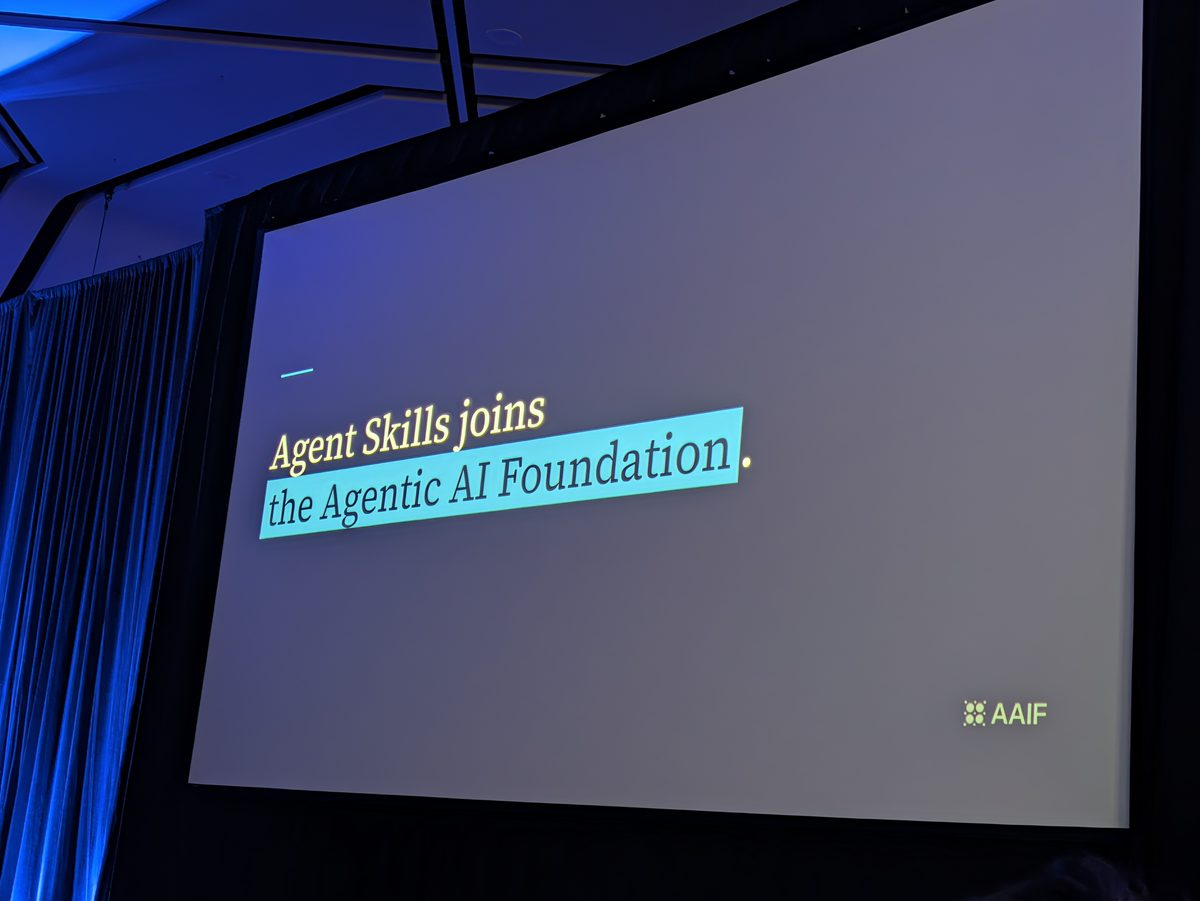
- 10 projects, up from 3 at launch. Four arrived on day one: Agent Skills from Anthropic, Open Responses from OpenAI, OpenEnv from Hugging Face and OpenSandbox from Alibaba.
- 8 working groups, “open to anyone, and shipping”.
- 89% of the members surveyed use or evaluate MCP, and 81% run agentic AI in production today.
The two announcements are public: four new projects and 305 members.
07:51 — Silicon Valley, before the doors open
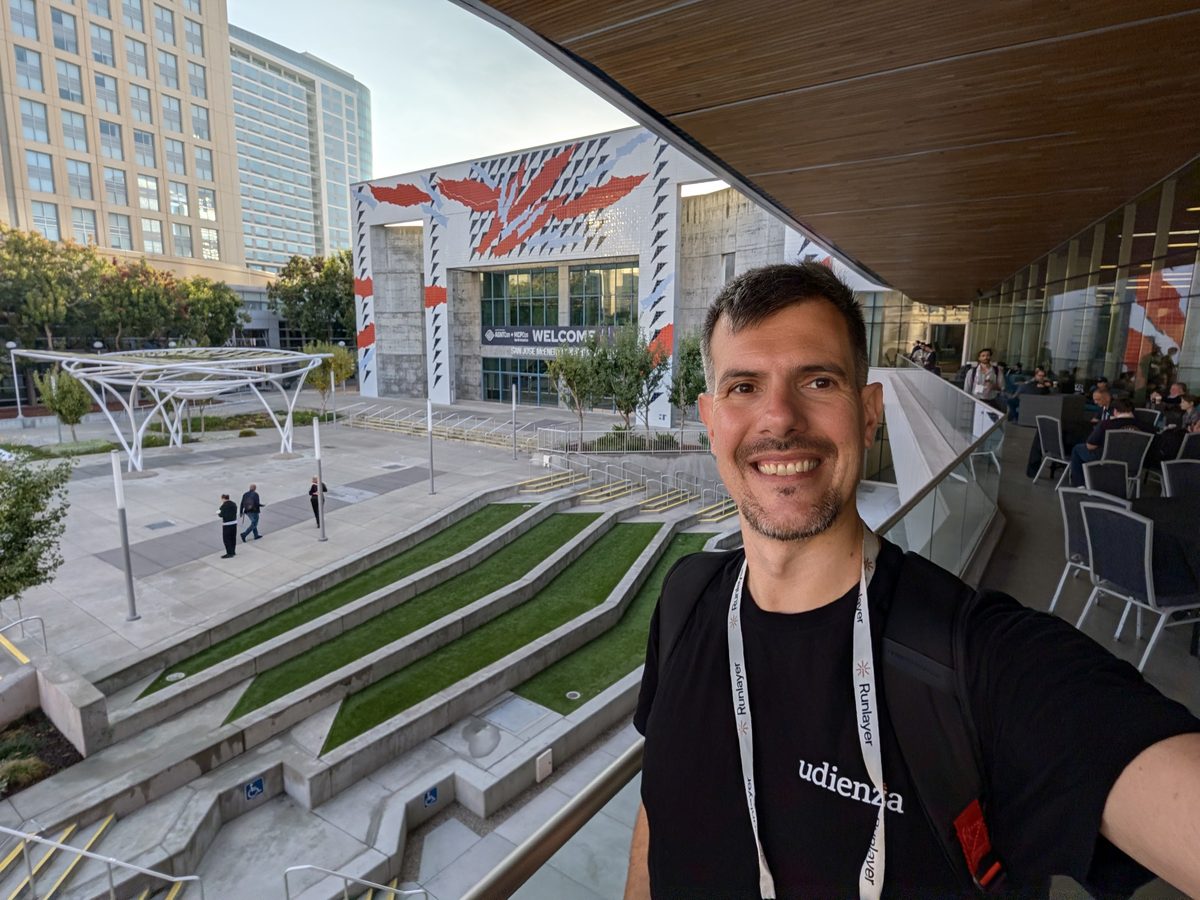
The walk to the convention centre makes the point before any keynote does: every corner has an AI billboard. The first clip of the day was recorded on the street at 07:51, and by 08:17 Luca was on the terrace outside the venue, under the conference banners.
08:29 — The first interview: a first conference
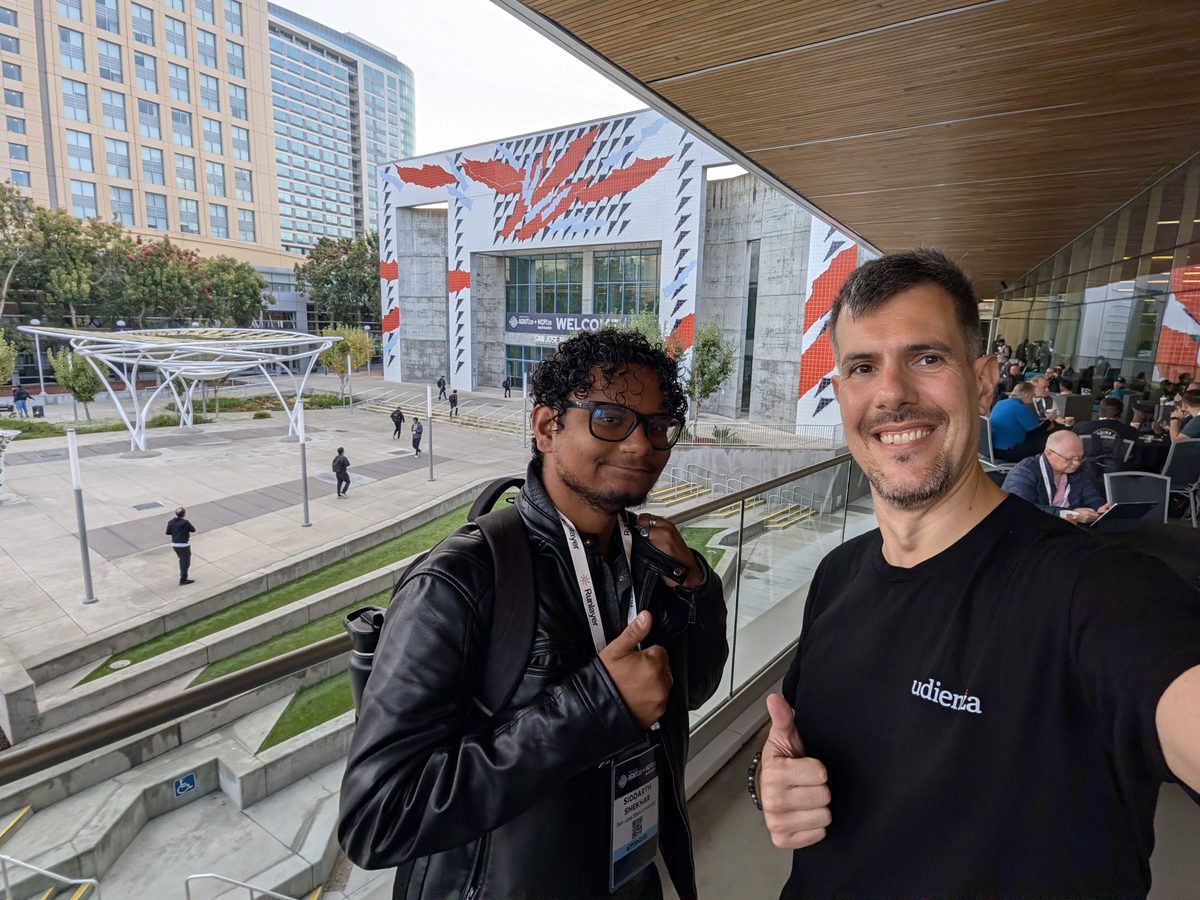
The first conversation of the day was not with a founder. Siddarth Shekhar is a second-year data science student at San Jose State University, born and raised in the Bay Area, and AGNTCon was his first conference. “This is my first ever con, ever in Silicon Valley,” he said. One of his university clubs had offered him the place. “As somebody in data science, this is exactly where I want to be.” He is leaning towards data engineering rather than AI engineering, because “from what I’ve heard from people in the industry, data engineering is a more sought after skill”. He had no session circled in the programme: “I’m just going to see what’s there and hope to learn.”
The gear check followed at 08:35. Two cameras, two wireless microphones and, before every recording, a clap so the cameras and the microphones can be synced afterwards.
09:00 — The keynote
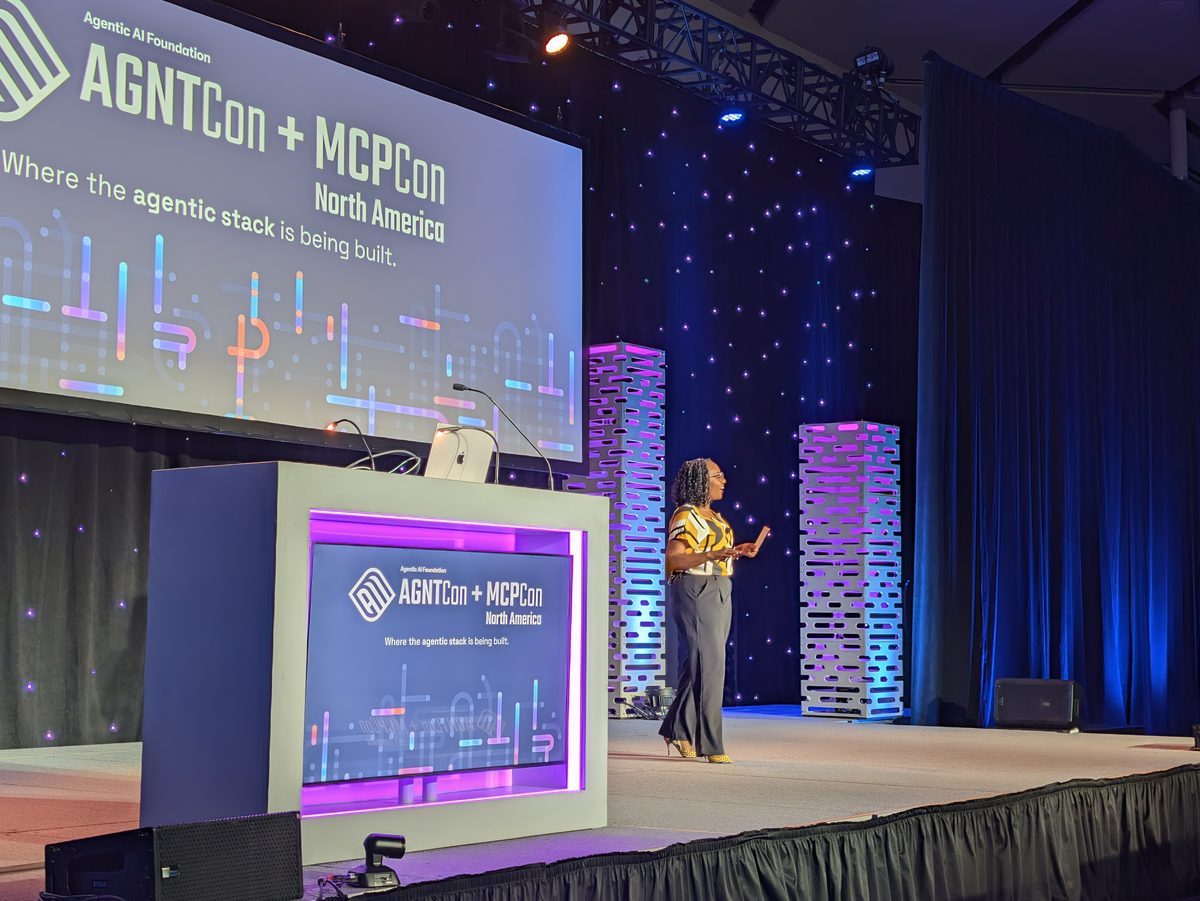
The embargo on the foundation’s news lifted at 09:00, the moment the keynote began. Angie Jones, VP at the Agentic AI Foundation, hosted it. She opened by thanking the Diamond sponsors: Akamai, Anthropic, Auth0, Amazon Web Services, Buzz, Google Cloud, OpenAI, Solo.io, the Tokenomics Foundation and TrueFoundry. Her first piece of news was the first official MCP certification. It is vendor-neutral, was written with people from the AAIF, Anthropic, AWS, Block, GitHub, Hugging Face and Microsoft, and is open now for anyone who wants to become an “MCP Associate”.
Mazin Gilbert: three pillars, ten projects
Mazin Gilbert, the foundation’s Executive Director, called the event “our largest AGNTCon + MCPCon” and gave the foundation’s method in three pillars. The first is “open protocols to enable the internet of agents”. The second is “defining the agentic stack in the open under a neutral governance”. The third is “a global community where every one of you, every company has the opportunity to participate and have their voice heard”.
He then introduced the four new projects:
- OpenSandbox, from Alibaba: a secure place for coding agents to run.
- Open Responses, from OpenAI: an open specification for interoperable, multi-provider LLM interfaces.
- Agent Skills, from Anthropic. “I bet you every one of you is using Agent Skills every day,” he told the room.
- OpenEnv, from Hugging Face: a framework for the environments that train and evaluate agents with reinforcement learning.
Then came the growth. “The fastest-growing foundation in the history of the Linux Foundation. It’s probably the fastest in the history of open source.” Sixty members joined in the quarter, “one member every business day”. The Gates Foundation and the Royal Bank of Canada had been announced in Amsterdam. In the past month Vercel, Nutanix, Vultr, Ant Group and MongoDB joined as Gold members, which he said adds “bench strength” in cloud infrastructure, data analytics and financial services.
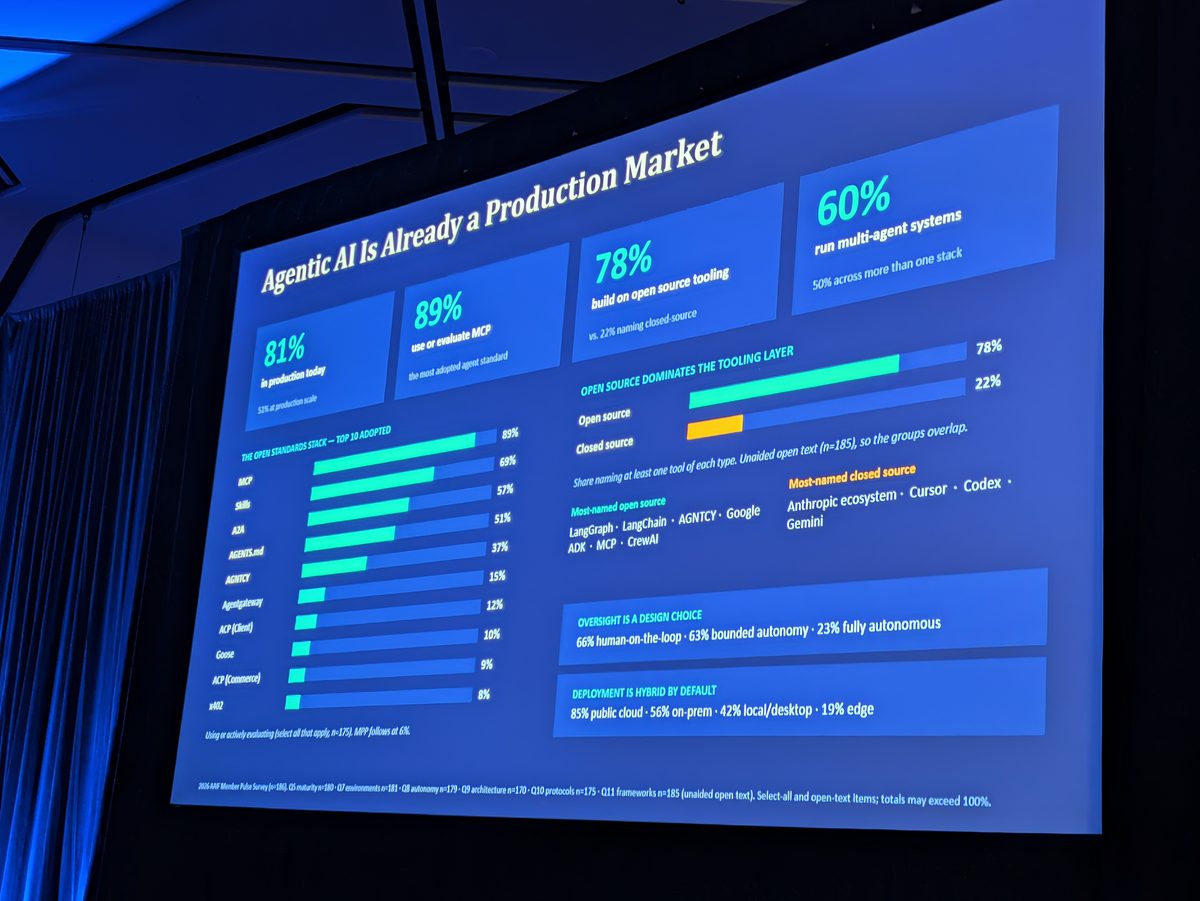
One slide carried the numbers, from the 2026 AAIF Member Pulse Survey of 186 members:
- 81% of members have agentic AI in production today, and 51% at production scale.
- 89% use or evaluate MCP, which makes it the most adopted agent standard. Skills follows at 69%, A2A at 57% and AGENTS.md at 51%.
- 78% build on open source tooling.
- 60% run multi-agent systems.
- On oversight, 66% keep a human on the loop and only 23% run fully autonomous.
- Deployment is hybrid by default: 85% in the public cloud, 56% on-premises and 19% at the edge.
Manik Surtani: who keeps it open?
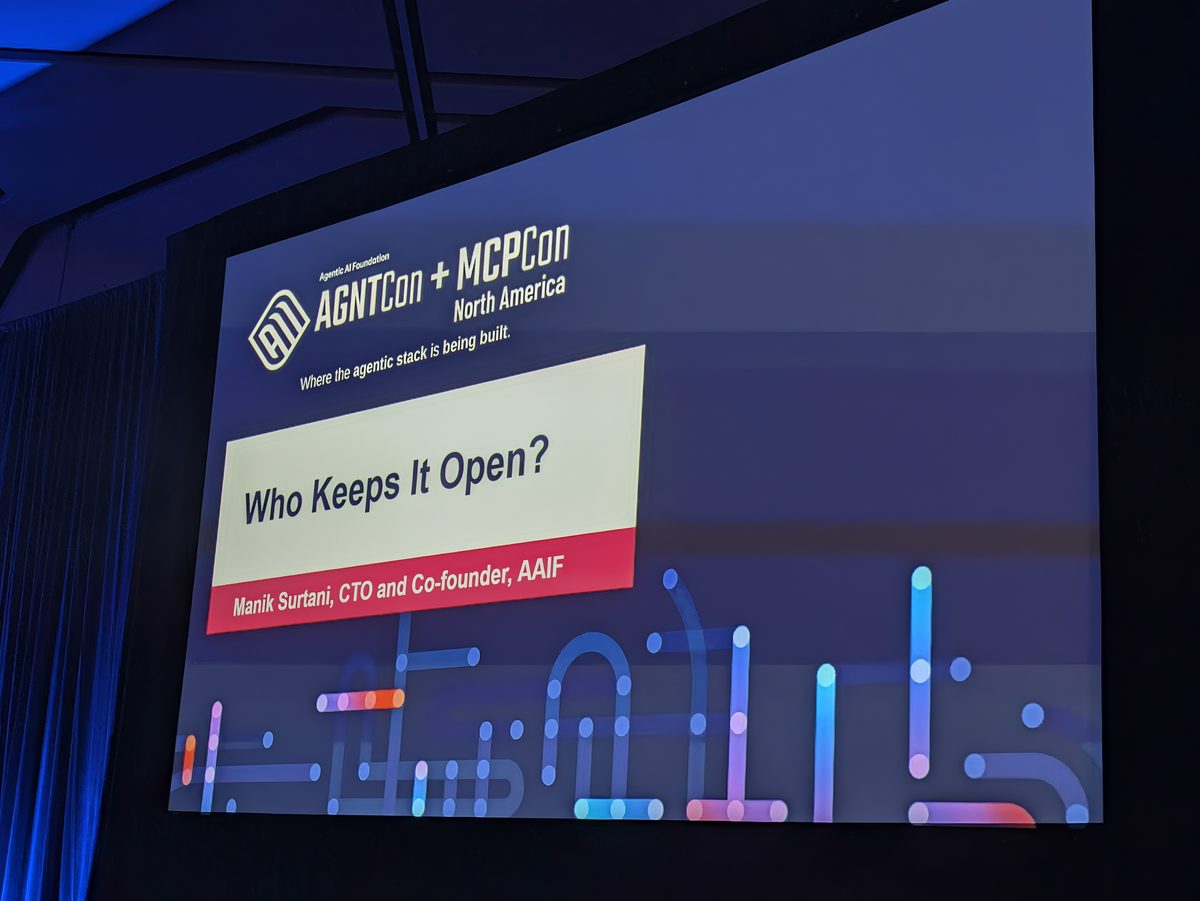
“Mazin got to talk about the Internet of Agents and all that cool stuff, right? I’m going to talk about the plumbing underneath it.” Manik Surtani, CTO and co-founder of the AAIF, told the room that about a year and a half ago he quit a job he loved at Block, “and chose to spend my time arguing with people about protocols instead”.
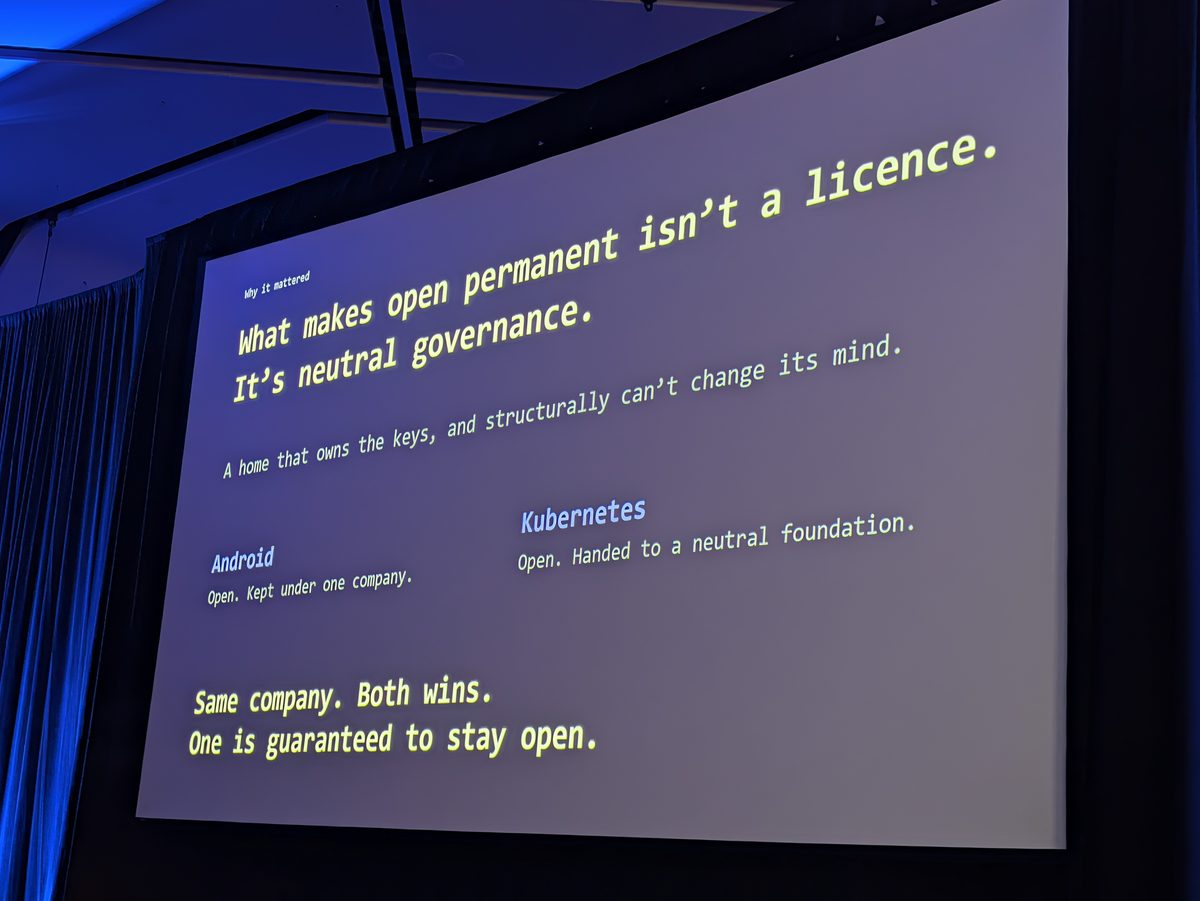
His story started with goose. When the project found its community, the community asked one question: who keeps it open? goose had open code and a permissive licence, but its trademarks and its roadmap still belonged to one company. The answer on his slide was “What makes open permanent isn’t a licence. It’s neutral governance.” He illustrated it with two projects from the same company. Android stayed open under one company; Kubernetes was handed to a neutral foundation. “Same company. Both wins. One is guaranteed to stay open.”
His scoreboard put it in numbers: one new member a day on average (“three more joined just now”), three projects grown to ten, and eight working groups. He closed with three requests to the people in the hall: demand open from every vendor selling an agentic stack, contribute to the commons, and build out in the open.
The Tokenomics Foundation: what are your agents costing you?
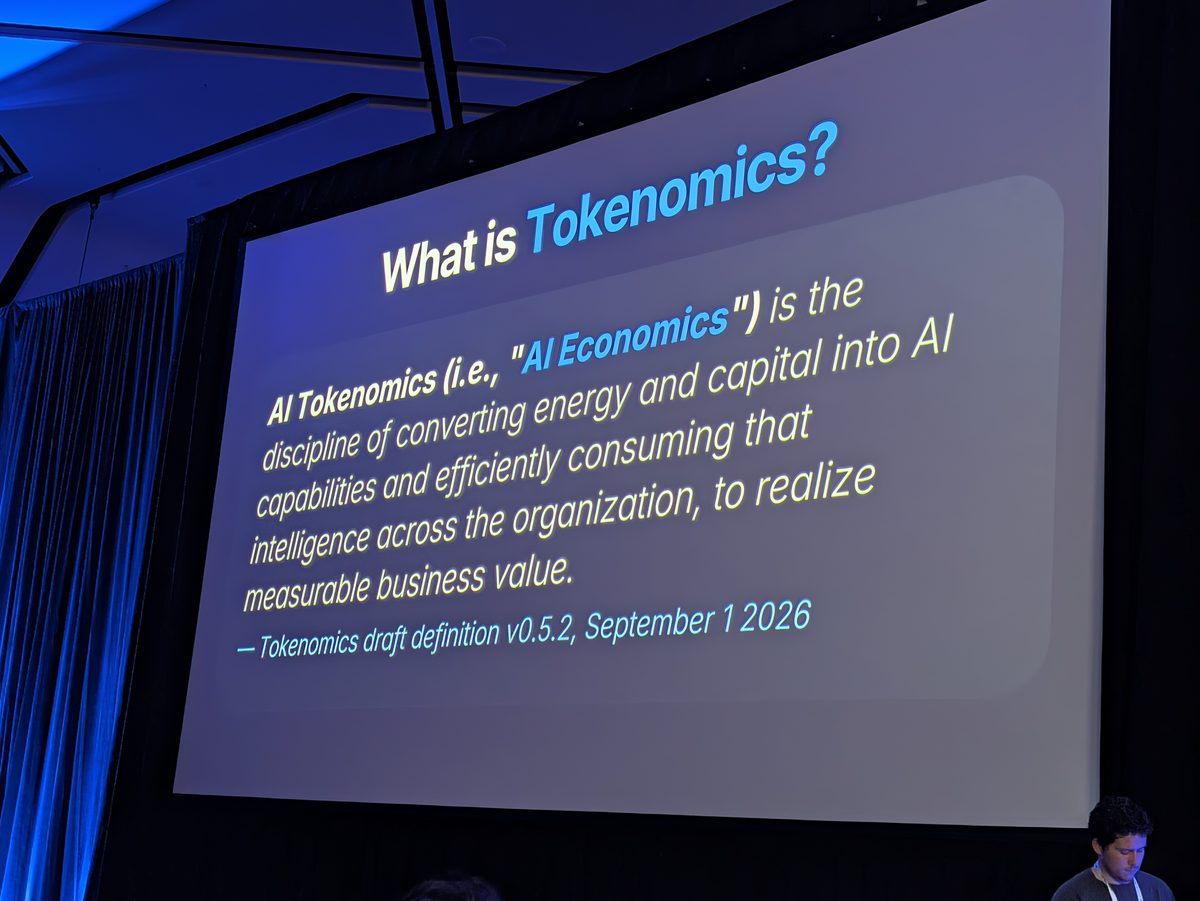
“How many of you know what your agents are costing you right now?” asked J.R. Storment, Executive Director of the Tokenomics Foundation at the Linux Foundation. A few hands went up. “How many of you can tie that back to value and ROI?” One, in the back. The foundation’s draft definition, version 0.5.2, calls AI tokenomics “the discipline of converting energy and capital into AI capabilities and efficiently consuming that intelligence across the organization, to realize measurable business value”. The slide after it read “Don’t count tokens.” Its point was to count the total cost of AI against the value it returns. His last slide announced Tokenomicon and FinOps X: San Diego, 7–10 June 2027.
David Soria Parra: MCP and the era of connectivity
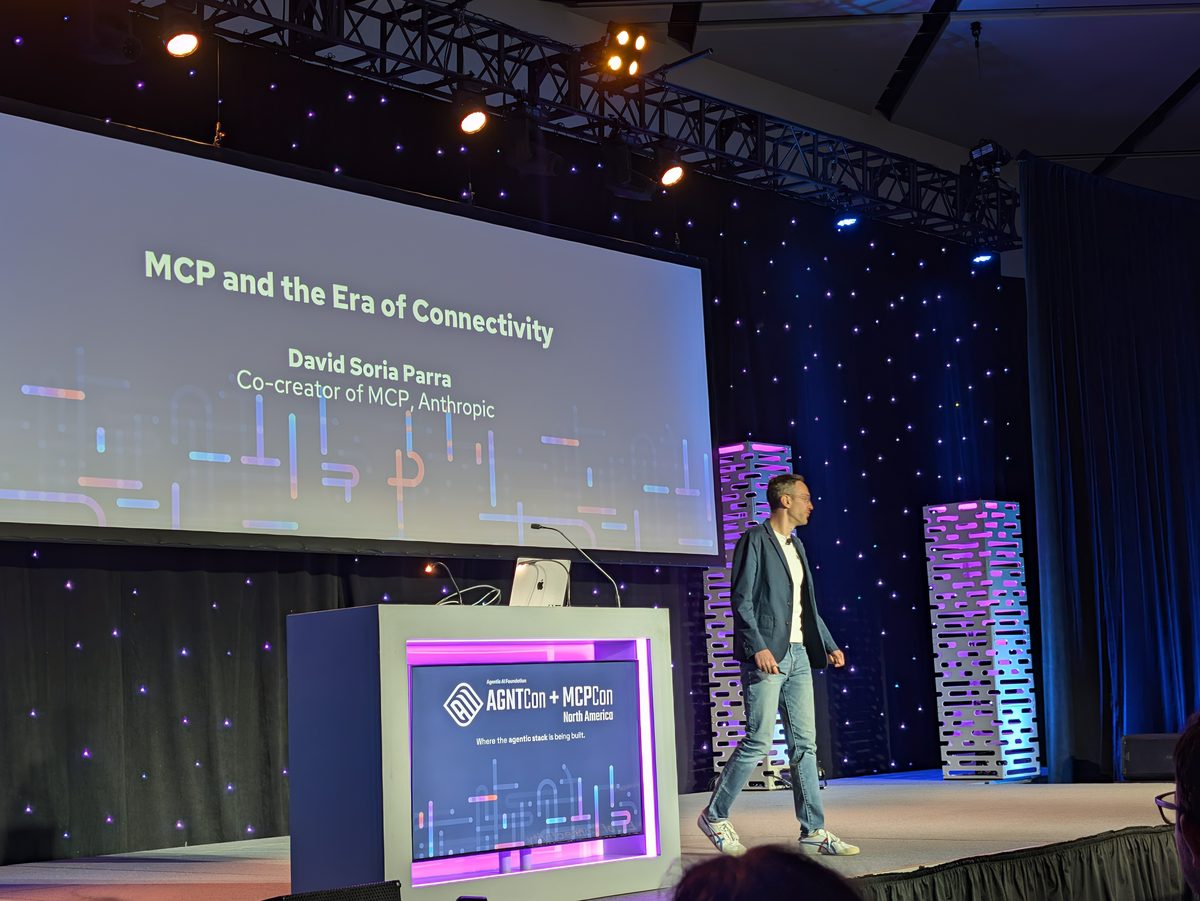
At 09:38 David Soria Parra took the stage. He co-created MCP at Anthropic, is its lead maintainer and also maintains Agent Skills, and he gave the talk of the morning.
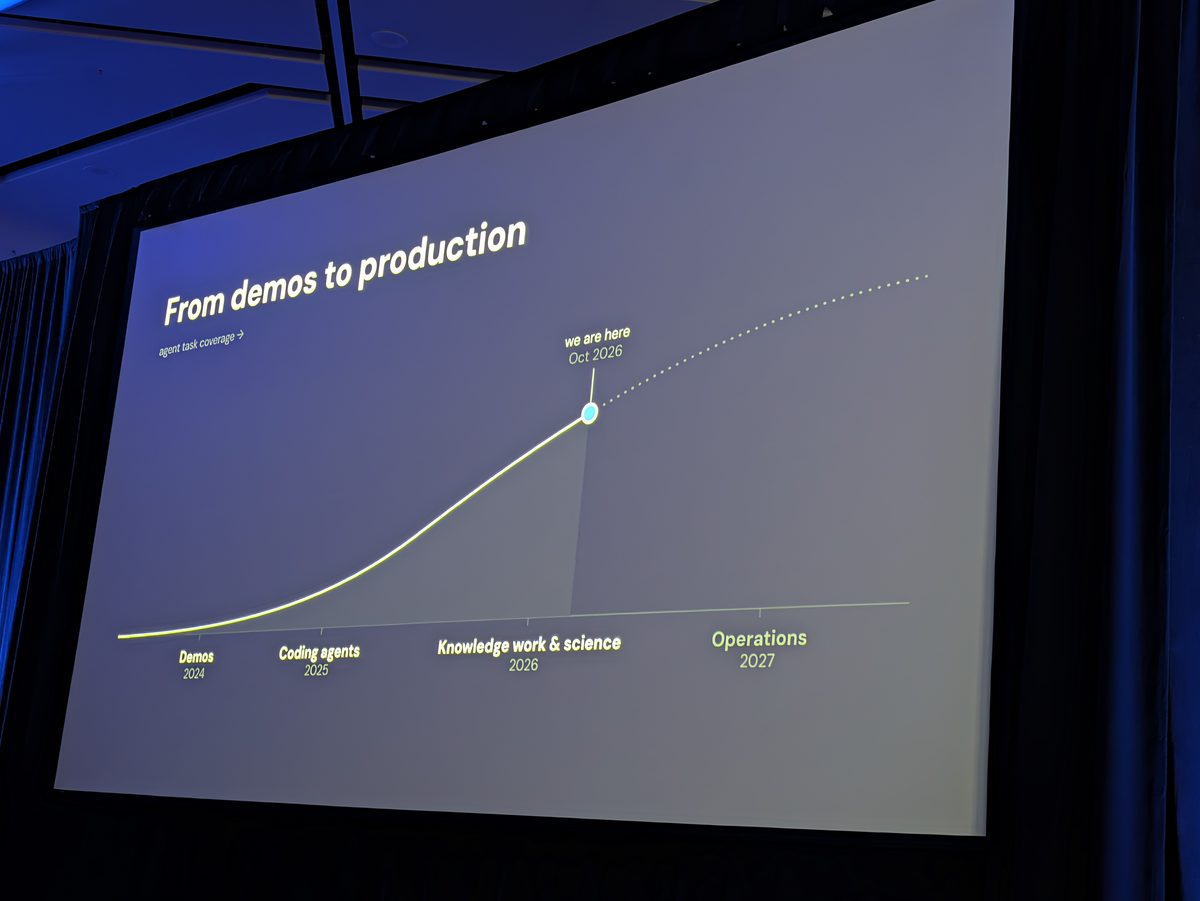
He began with how far models now go on their own. Two years ago, he said, you “really needed to go and help models along the way pretty frequently”. Now models do a month’s worth of human work almost autonomously, and what can be built has changed with them. His timeline ran from demos in 2024 to coding agents in 2025, which work because “coding agents allow you to repeatedly call a compiler, a type checker” to keep the model on track. It then moves to knowledge work and science in 2026, where checking the result is much harder, and to operations in 2027. Those agents “require access to Google Docs, they require access to an internal system, and they don’t just need a compiler or a CLI”. His conclusion was on the slide: “As model capability compounds, the key becomes connecting it.”
The usage numbers came next: 2 billion MCP tool calls in Claude, “and this amount is just growing”, a figure that had been “significantly smaller” a few months earlier. Downloads of the SDKs are growing the same way, and so are MCP tool calls on other platforms and the number of MCP servers being created.
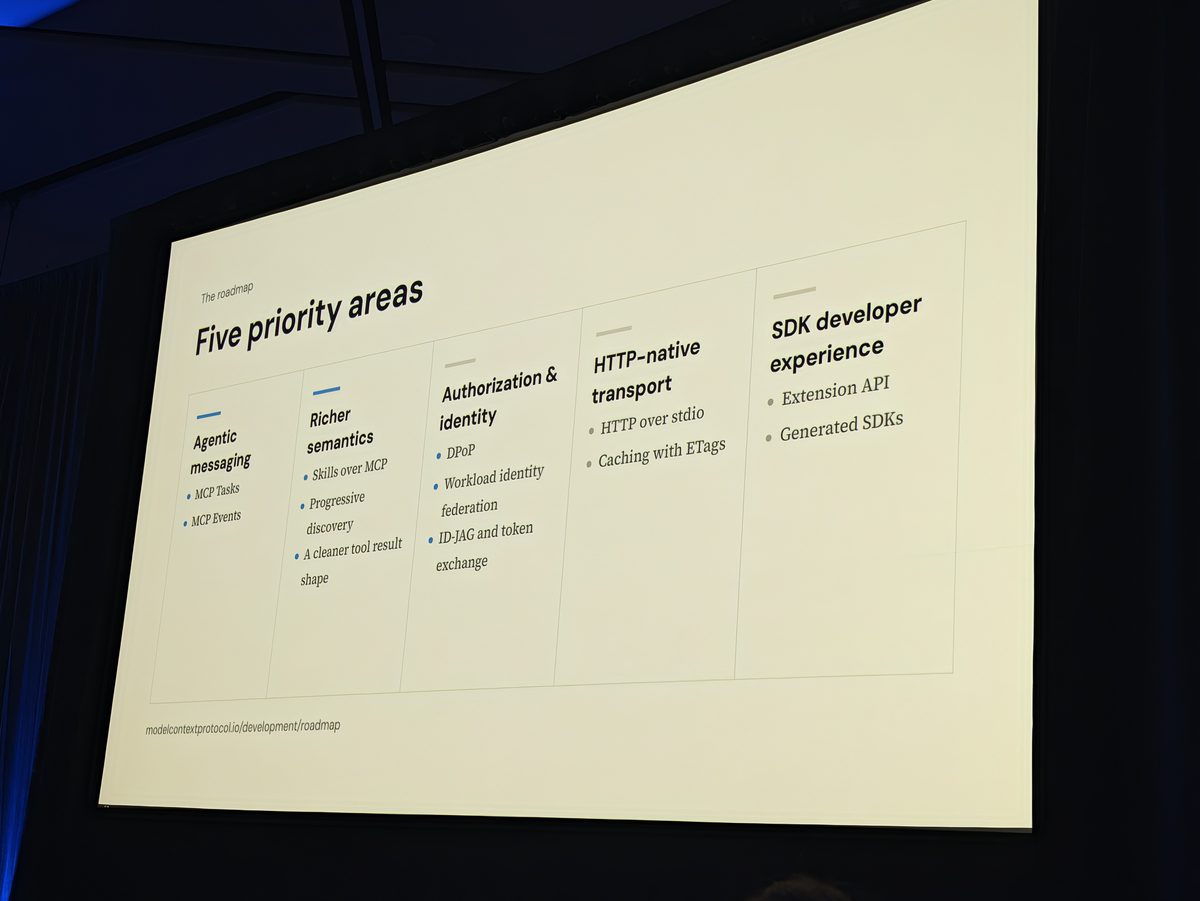
From there he presented the roadmap in five priority areas:
- Agentic messaging: MCP Tasks and MCP Events.
- Richer semantics: Skills over MCP, progressive discovery and a cleaner shape for tool results.
- Authorization and identity: DPoP, workload identity federation, and ID-JAG with token exchange.
- HTTP-native transport: HTTP over stdio and caching with ETags.
- SDK developer experience: an extension API and generated SDKs.
The roadmap is at modelcontextprotocol.io/development/roadmap.
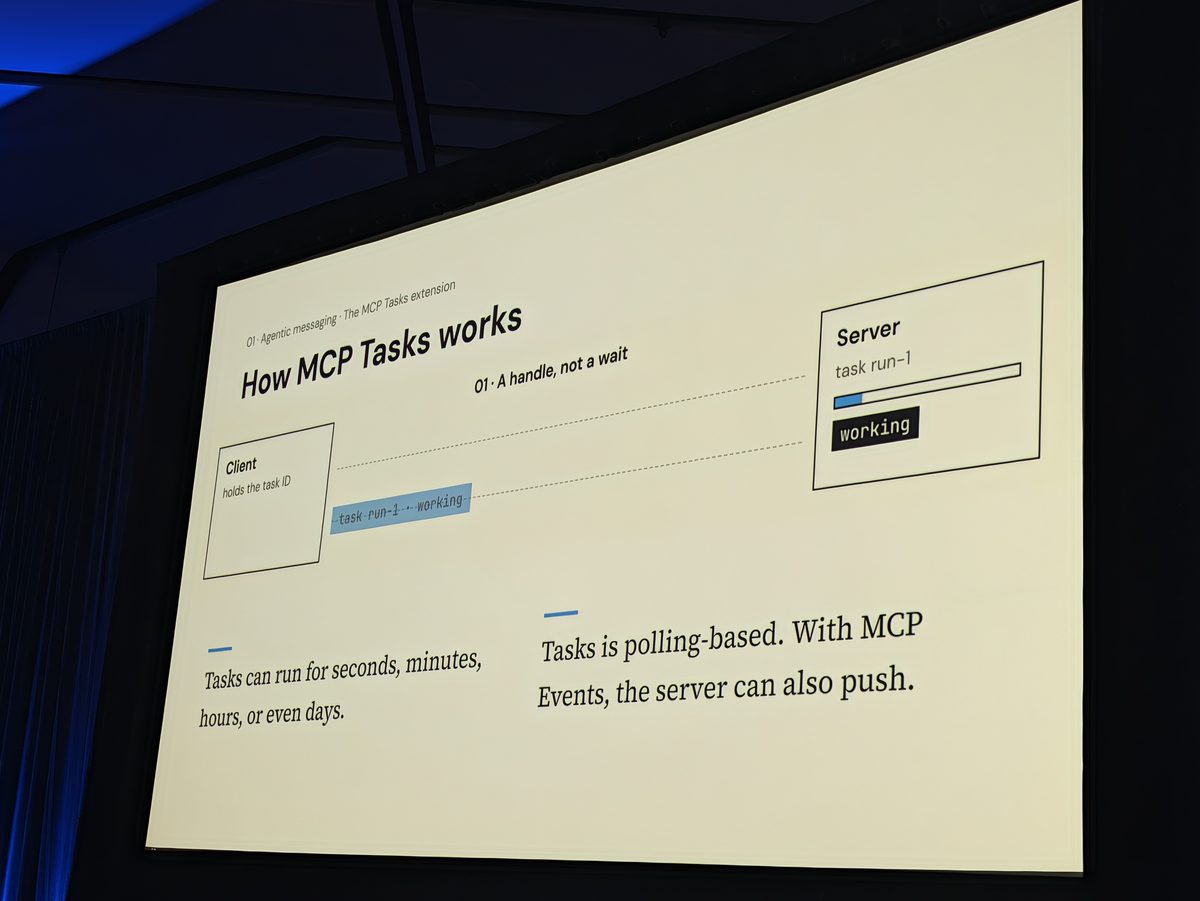
MCP Tasks were the headline. A tool call no longer has to finish inside the 10 to 30 seconds most platforms allow: “you can now run them for minutes, hours, and even days”. His slide called a task “a handle, not a wait”. Tasks are polling-based today, and with MCP Events the server can also push the update. They are live in Claude Code from day one: “You should be able to get home and should be able to run Claude Code against MCP Tasks as of today.” He described what changes for anything long-running, a CI run for instance: “You don’t have to wait on a tool call. You don’t have to limit your tool calls for 30 seconds. You don’t have to make the model use awkward polling tools that you have created. This is all now native.”
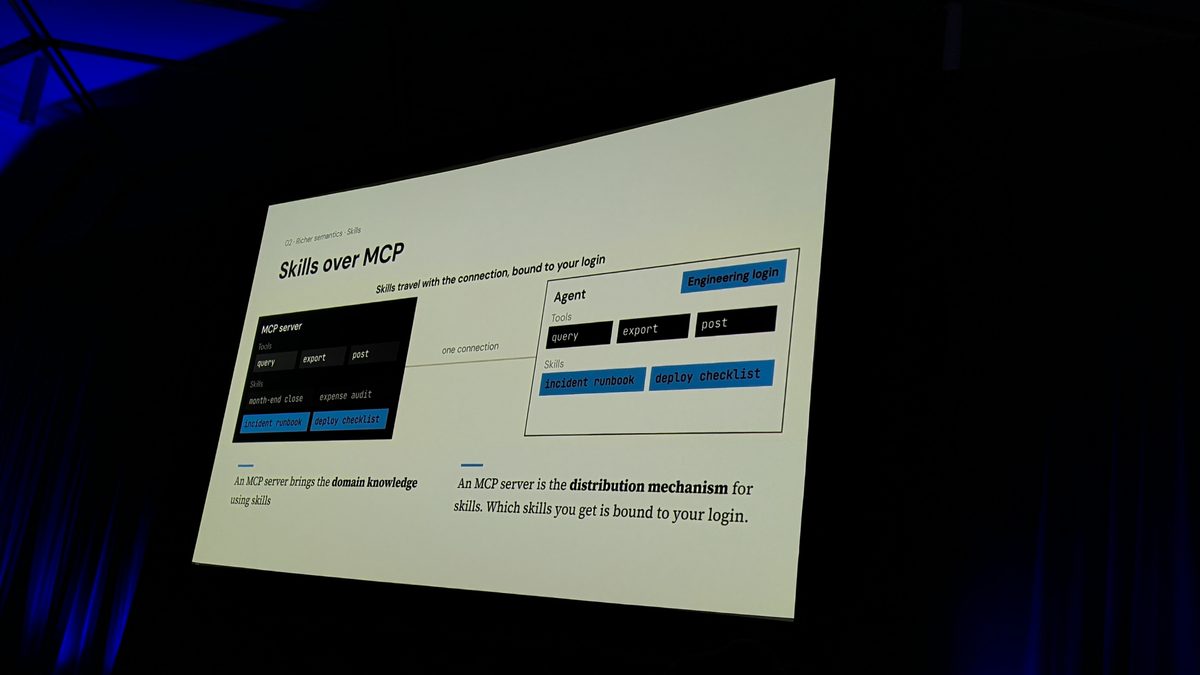
Skills over MCP came second. “Skills currently are files on disk,” he said, “but with a new extension that we’re currently developing within the MCP community, we will start serving skills over MCP.” An MCP server would then bring its domain knowledge as skills, one for a designer and one for an engineer, say. The part he thought most people had missed is that MCP carries authorization, so the skills can be bound to the login: “I’m David, I’m logging into my system, I get the skills that are relevant to me as David, whereas someone else, Mike, would log in and get the skills that are relevant to Mike.” On the slide: “Skills travel with the connection, bound to your login.” He hoped to have it in Claude “very, very soon”. A minute later came the matching announcement, on a slide of its own: Agent Skills joins the Agentic AI Foundation.
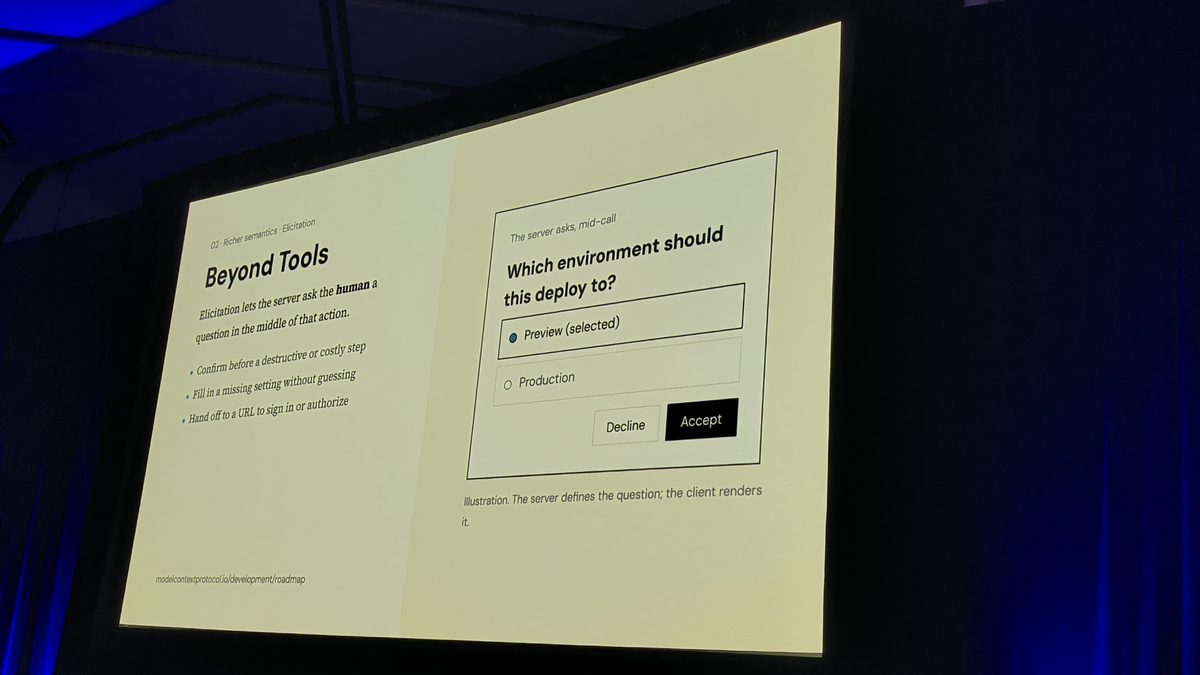
Elicitation went “beyond tools”. It has been in the protocol for a long time and is, in his words, underused: “Who is using elicitations in MCP? Very few. I hope by the end of this week more of you do.” With it, the server can ask the human a question in the middle of an action. It can confirm before a destructive or costly step, fill in a missing setting without guessing, or hand off to a URL to sign in or authorise. The example on screen was a deploy that stops to ask “Which environment should this deploy to?”, with preview or production, decline or accept. The server defines the question and the client renders it, and the human really is the one answering, “without waiting on tool call confirmation that is purely harness dependent”. Claude, he said, would support it “today, latest tomorrow”.
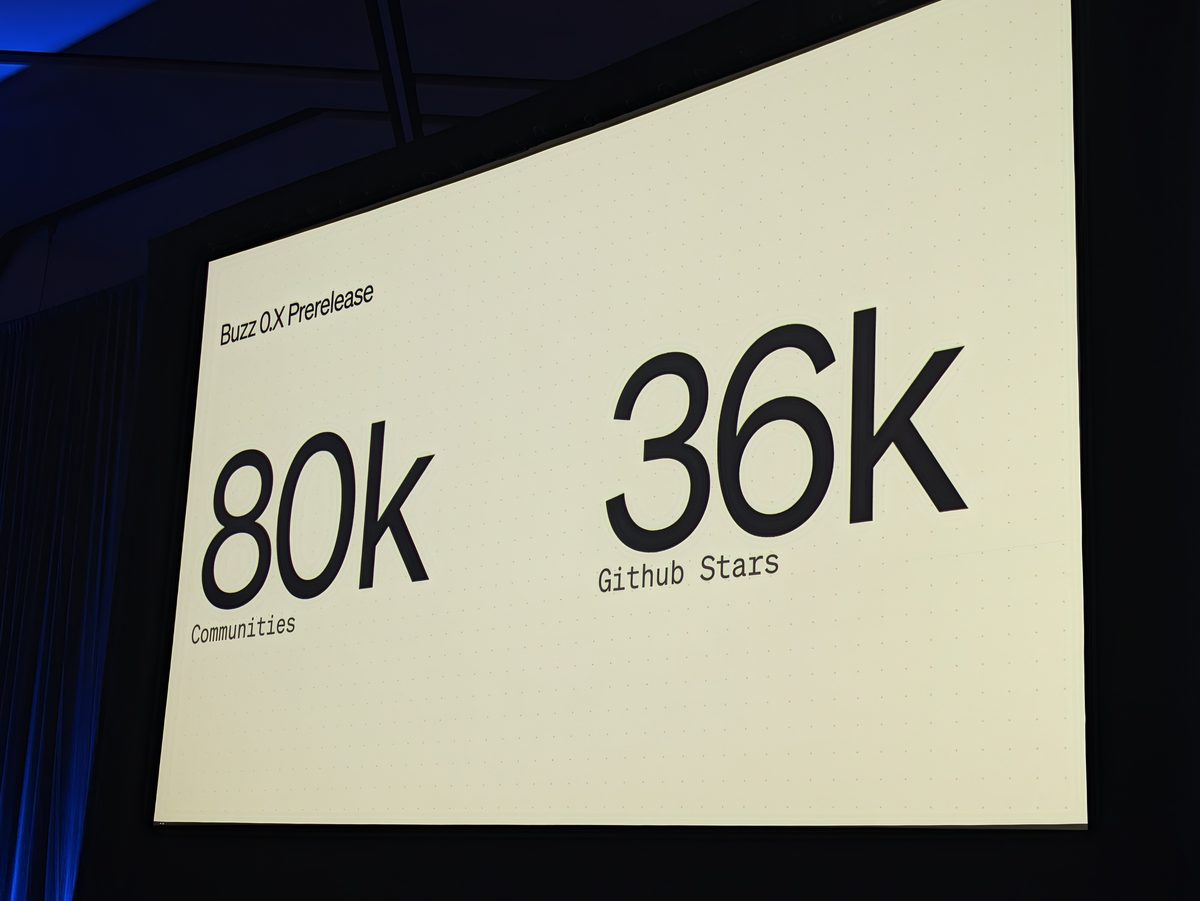
Luca filmed the talk from the audience, and its elicitation demo opens the day’s recap video. Buzz, one of the Diamond sponsors, then demonstrated a pre-release workspace for “your people, your agents, your projects”. Its agents run on goose with any model, each one “the config combination of a model, the harness, and effort level, and the instructions”, and they work in the same channels as the people. An agent is signed by its human and inherits their capabilities, and a long thread can move to a solo chat and back. Angie Jones was back on stage at 10:16 to close the keynote.
10:22 — The podcast room
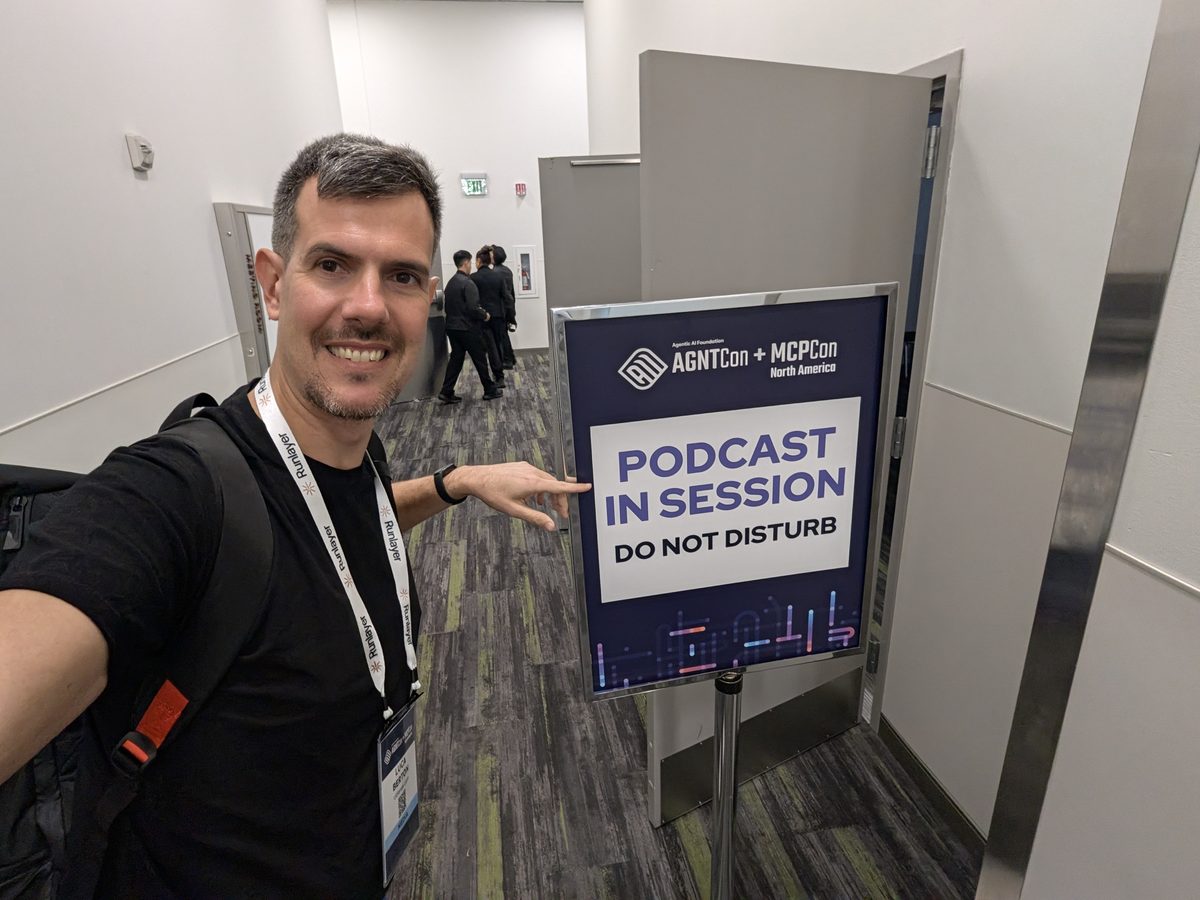
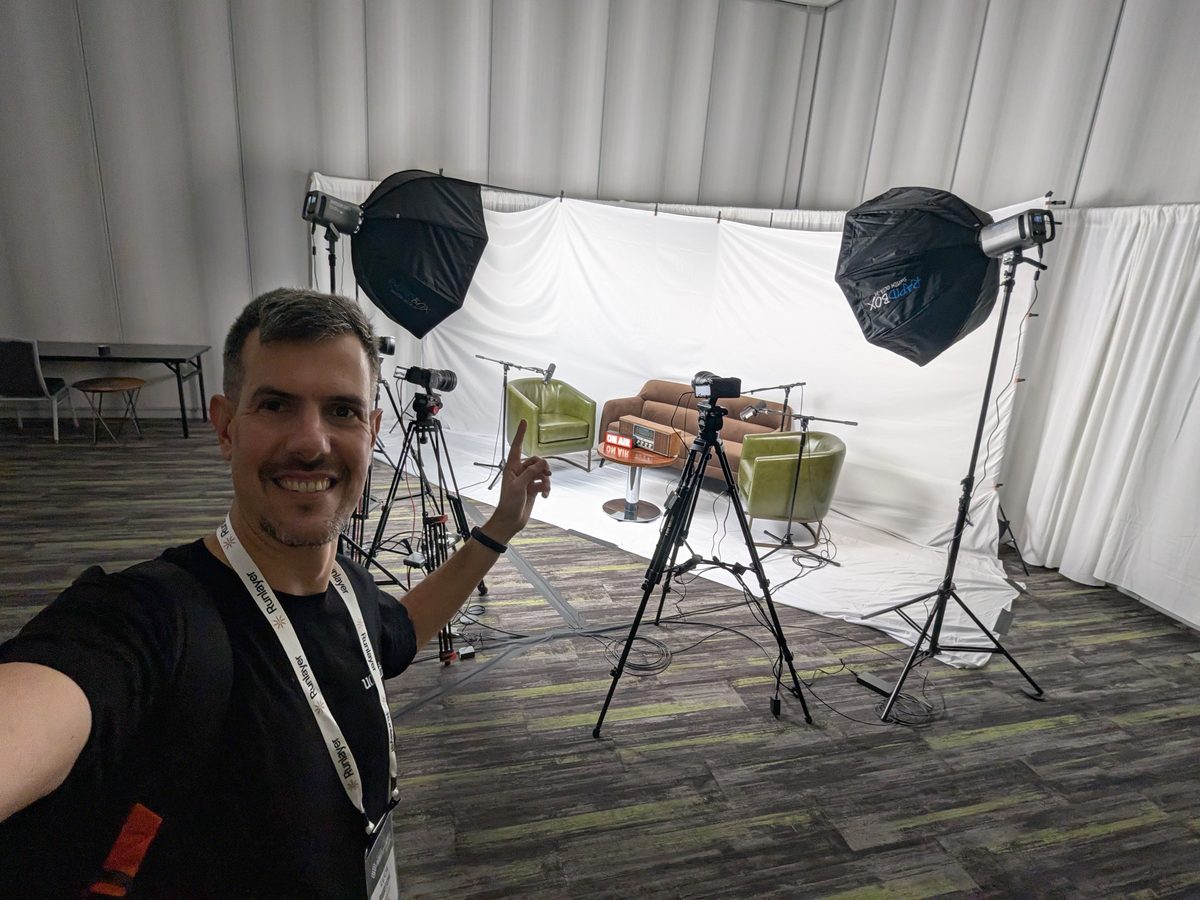
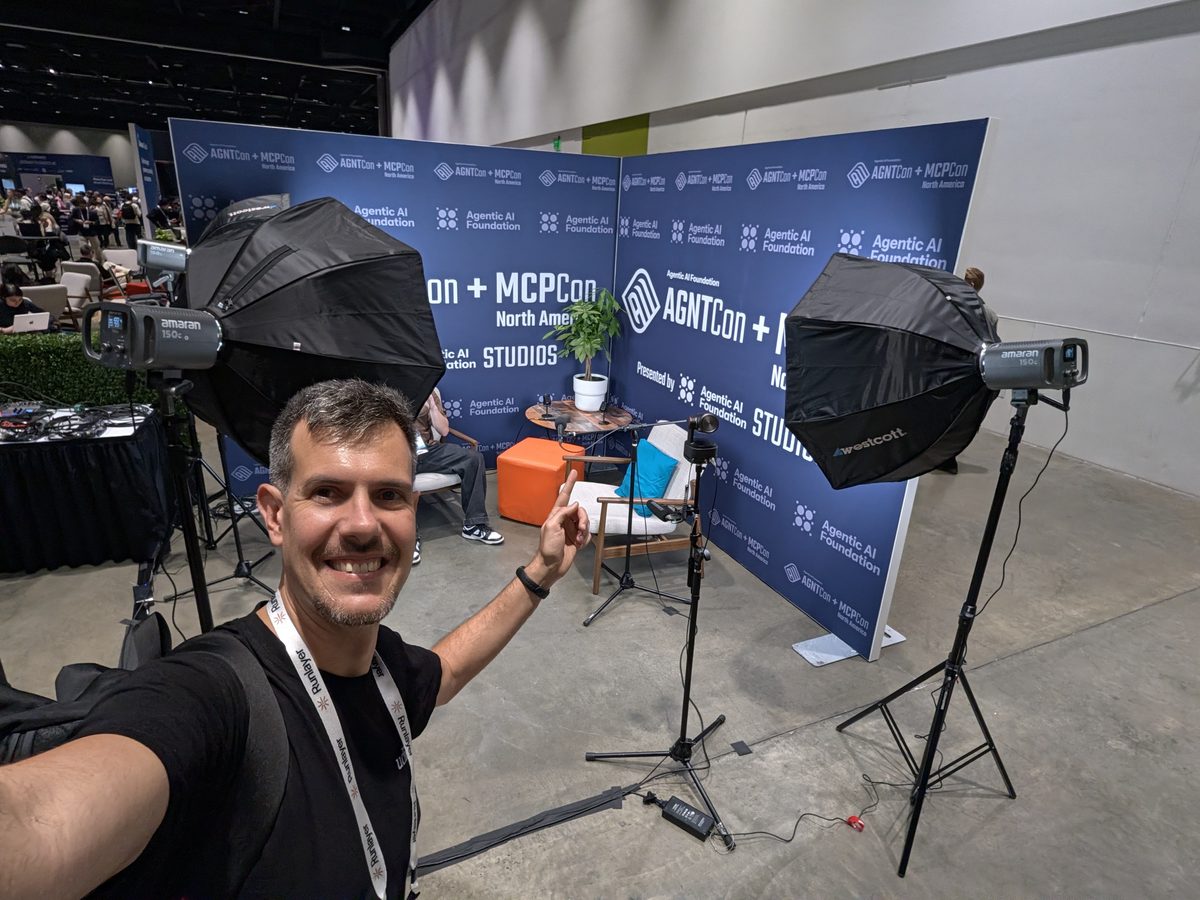
Behind the hall, a door with a sign: podcast in session, do not disturb. The conference ran its own podcast studio, with a white set, two armchairs, softboxes and cameras on tripods, and a second set, the AGNTCon + MCPCon Studios, out on the Solutions Showcase floor.
10:57 — Lena Hall, Akamai: agents at the edge
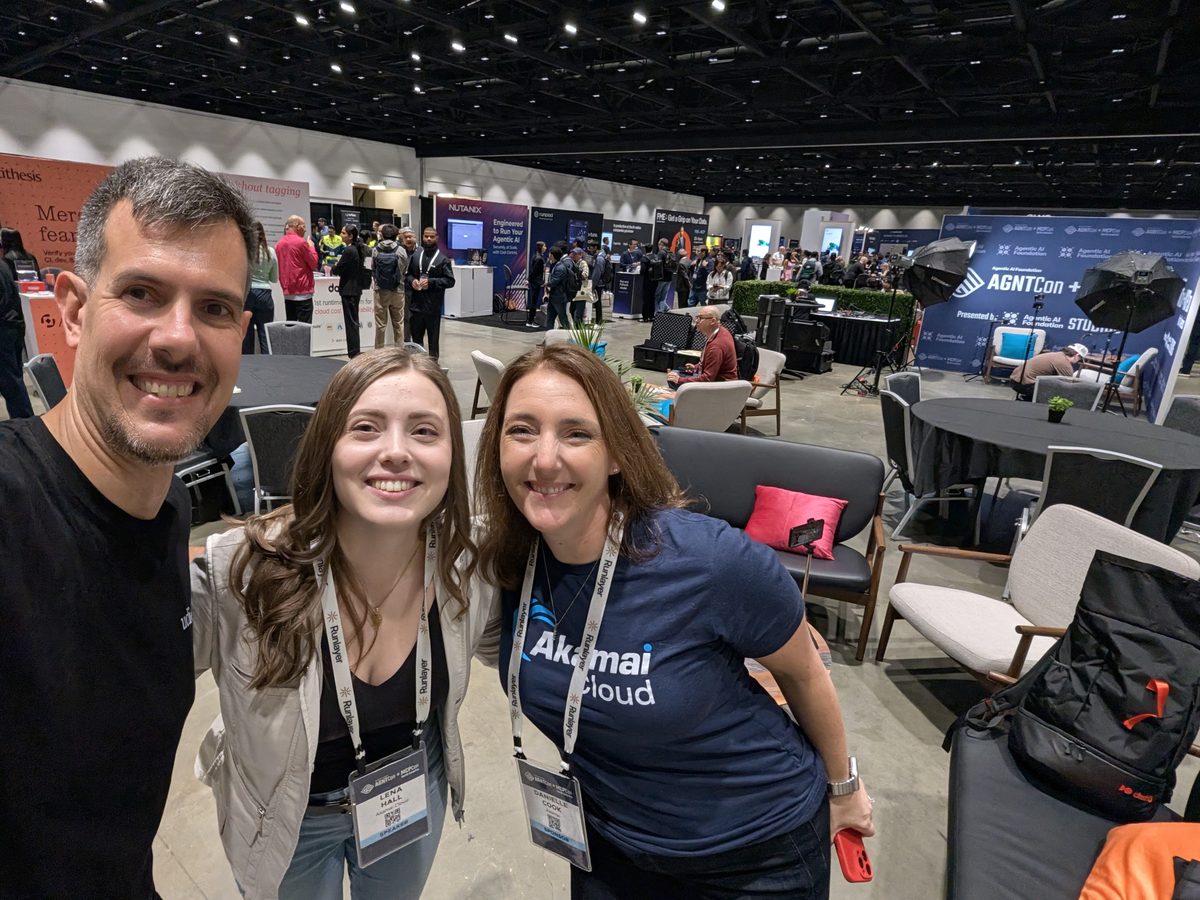
Lena Hall leads developer relations at Akamai Cloud, and her interview gave the clearest answer of the day to the question the keynote had raised: how do you go from a demo to production? “We do see a lot of demos that people build with a Hello World agent,” she said, usually on a frontier model from a centralised provider, and that works for simple scenarios. “For production, you need to account for scale, security, distribution and latency in a way that matters for your customers.” In a voice agent the delay is what people notice: “people are going to lose retention of your product if the delay in speech is going to cause them to just click cancel call.”
Her answer was control, and for her, “control means locality”. Some data cannot leave a site, such as the robot in a warehouse that stores unreleased products. Other requests need to be routed to the compute nearest the user, with open-weight models fine-tuned for that place. Akamai offers NVIDIA GPUs for building and running inference, and functions based on Spin, the CNCF WebAssembly project, which avoid cold starts. Her advice for getting started was github.com/akamai-developers, the Edge Case community on Discord, and one more thing: “make sure you use sandboxing and safe environments”, because agents can perform dangerous operations.
12:00 — Two conversations in the studio
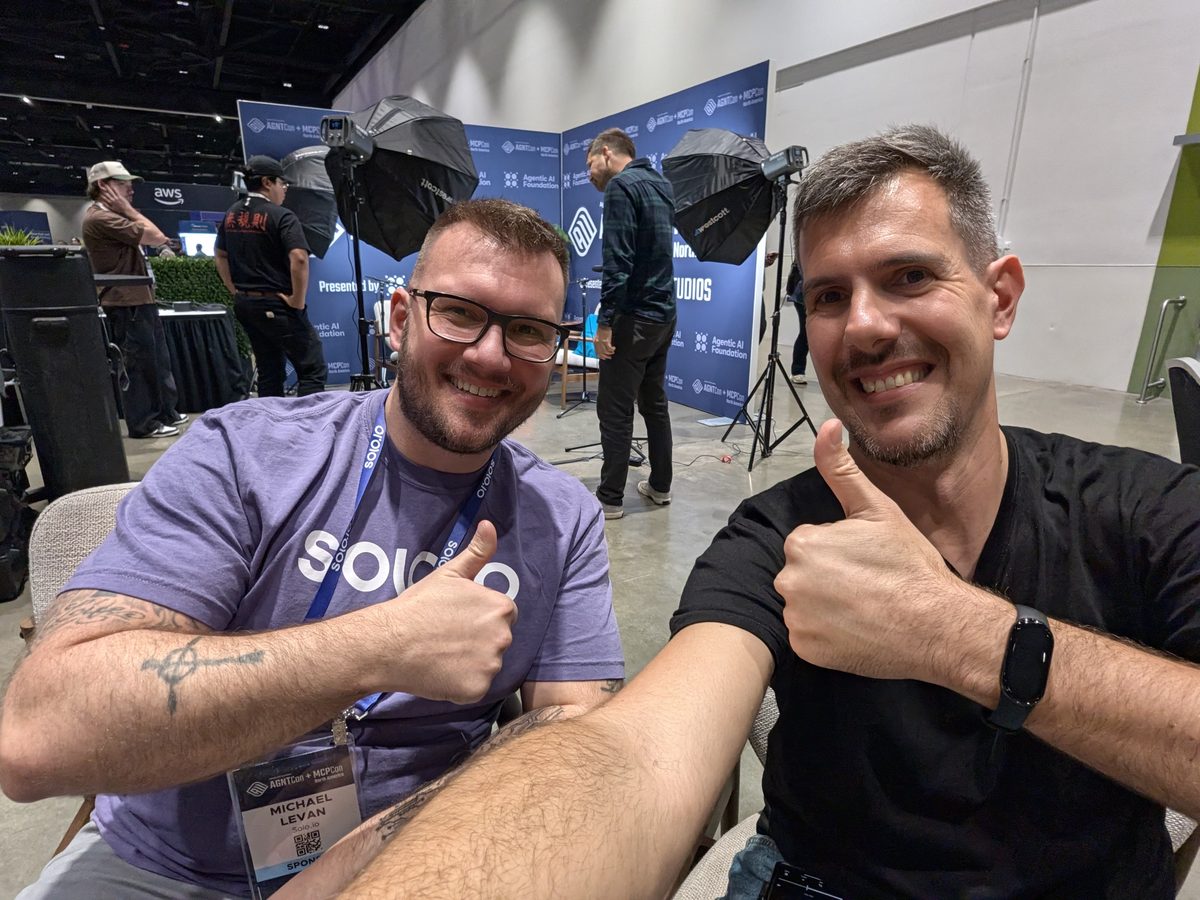
The midday hour was recorded in the conference’s studio. Michael Levan, Principal AI Architect at Solo.io, came at noon, followed by Matt DeBergalis, CEO and co-founder of Apollo GraphQL. The event’s studio edits both recordings itself, and they will be published on Udienza when they arrive.
13:50 — The Solutions Showcase, booth by booth
The afternoon was spent on the showcase floor, one booth and one fifteen-minute conversation after another.
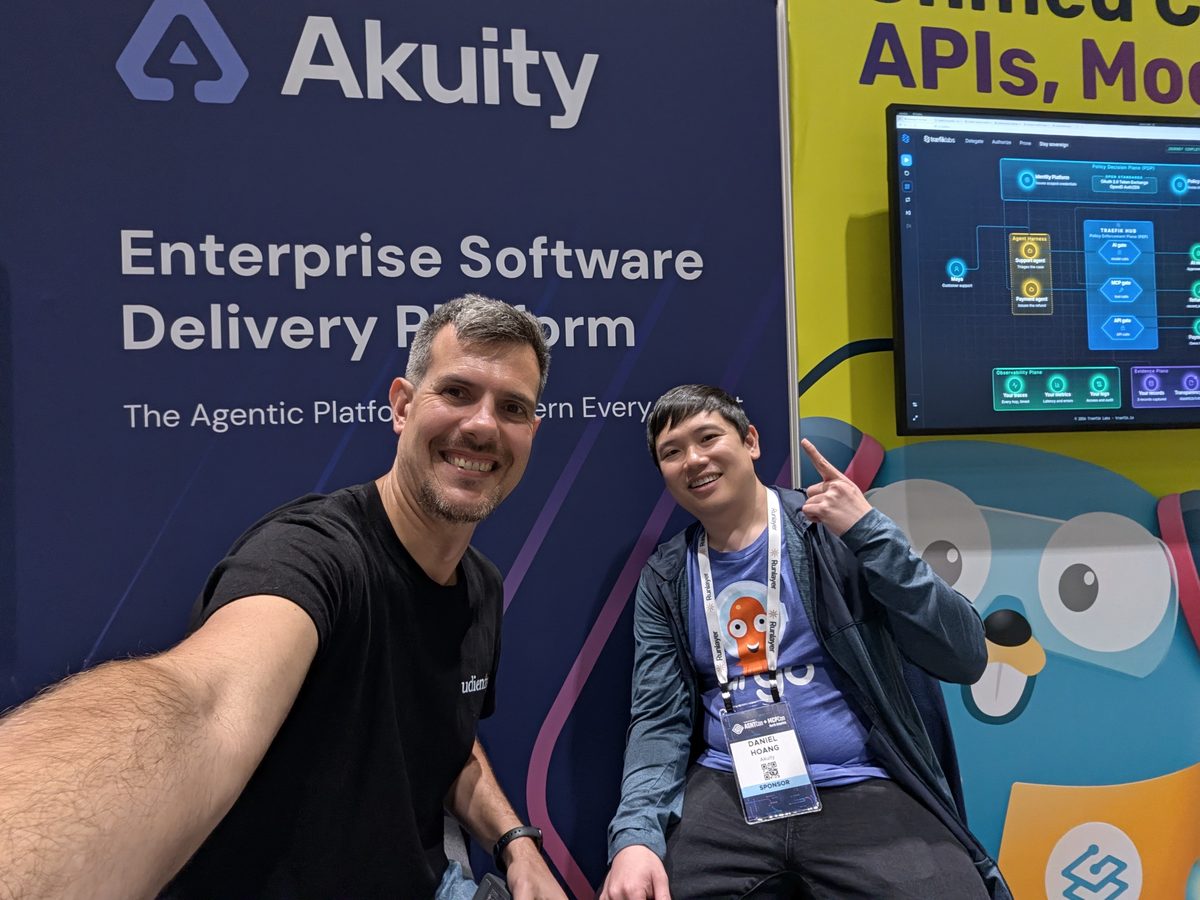
Daniel Hoang, Akuity. “The team that is behind Akuity is the team that built Argo CD,” Daniel said. Their second open source project, Kargo, takes the scripting out of GitOps pipelines: the steps are built in, a UI shows what is deployed where, and deployments are gated between environments. What brought Akuity to AGNTCon is the front end people now prefer: “People just prompt Claude and ask it to build things.” Through Akuity’s MCP tooling, with its permissions gated, an agent such as Claude or Copilot can “build a Kargo pipeline for me with best practice based off of what I have in my Git repositories”. It can also answer which applications are degraded across every environment, not just one. Argo CD and Kargo are open source; the MCP and agent layer is part of Akuity Enterprise.
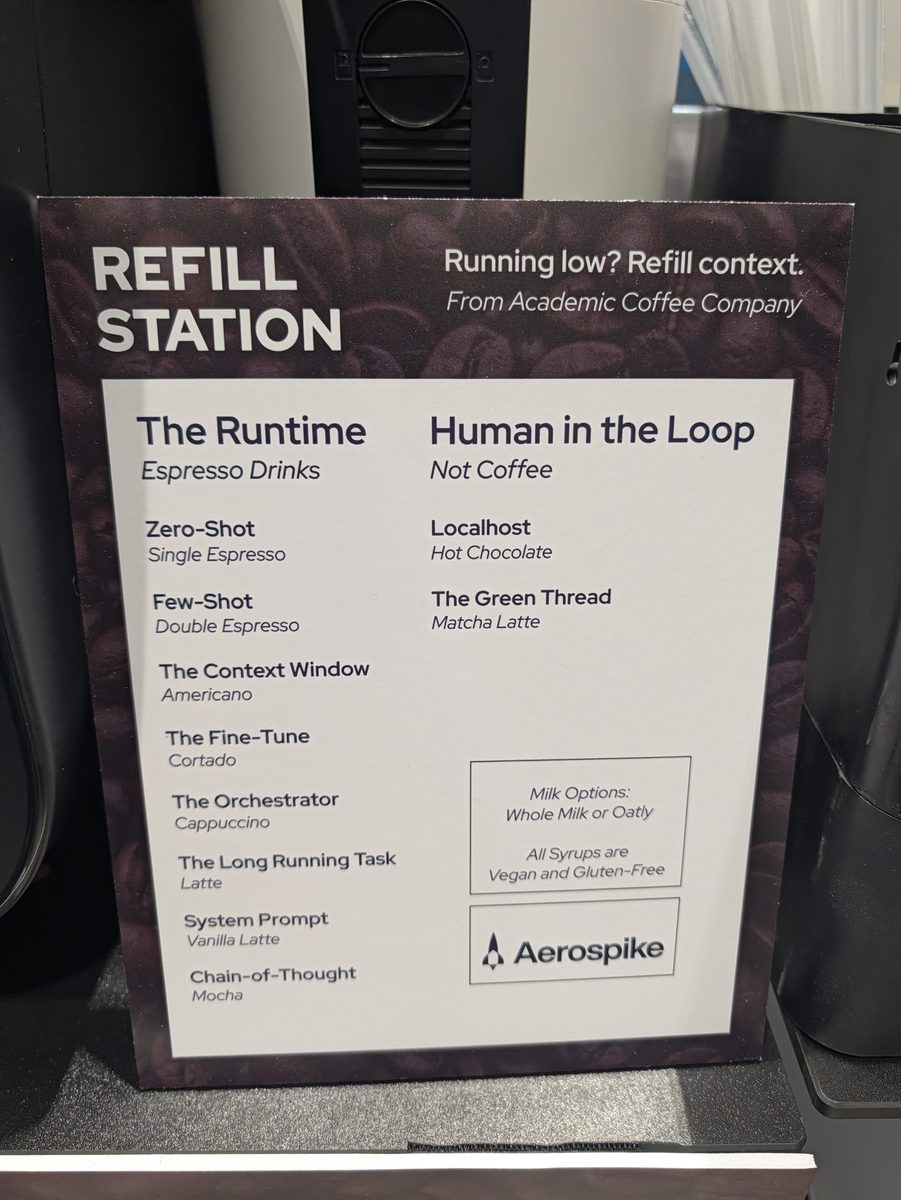
The coffee bar had its own menu. It was sponsored by Aerospike and labelled “Running low? Refill context”: a single espresso was a Zero-Shot, a double a Few-Shot, an Americano The Context Window, a latte The Long Running Task. Hot chocolate, listed under Human in the Loop, was Localhost.
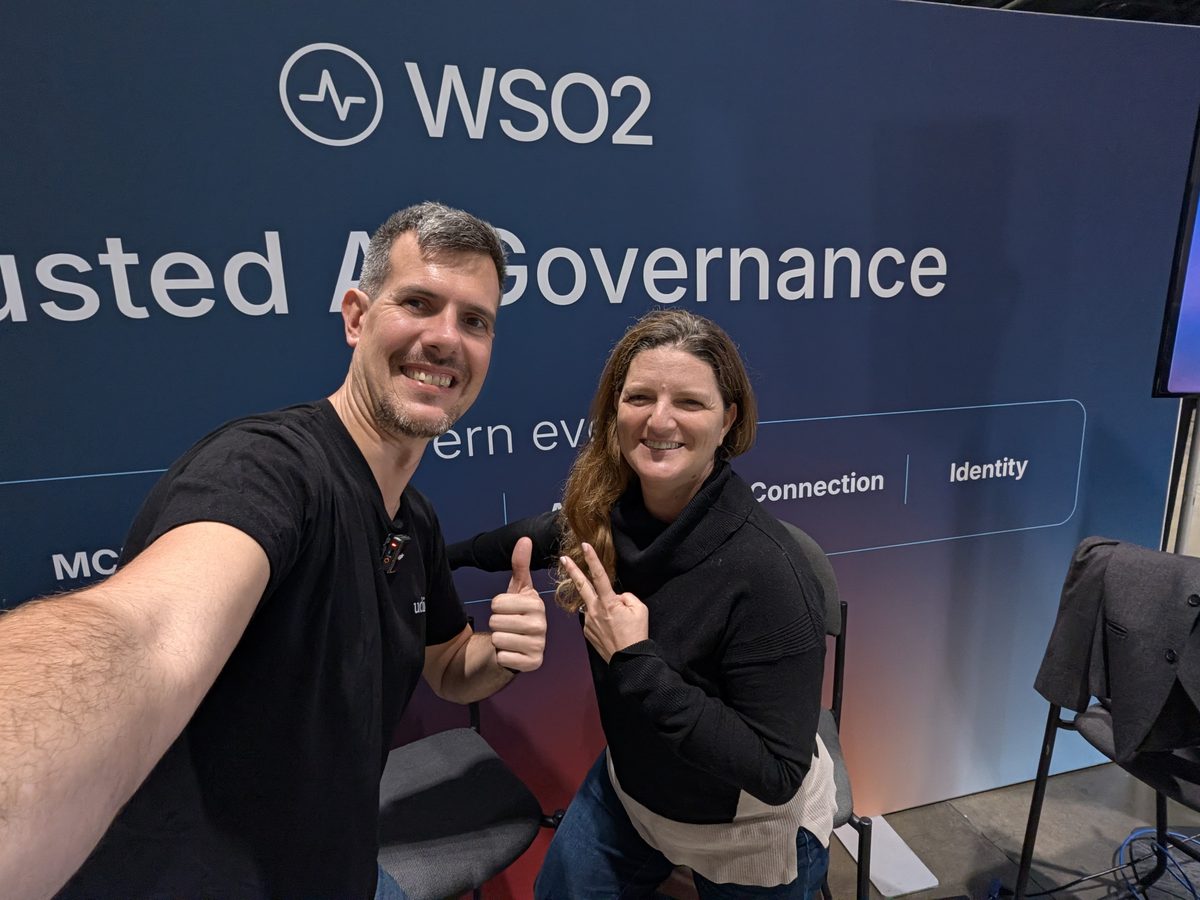
Rania Khalaf, WSO2. Rania Khalaf is Chief AI Officer at WSO2, which joined the AAIF as a Silver member this quarter. WSO2’s booth was about trusted AI governance.
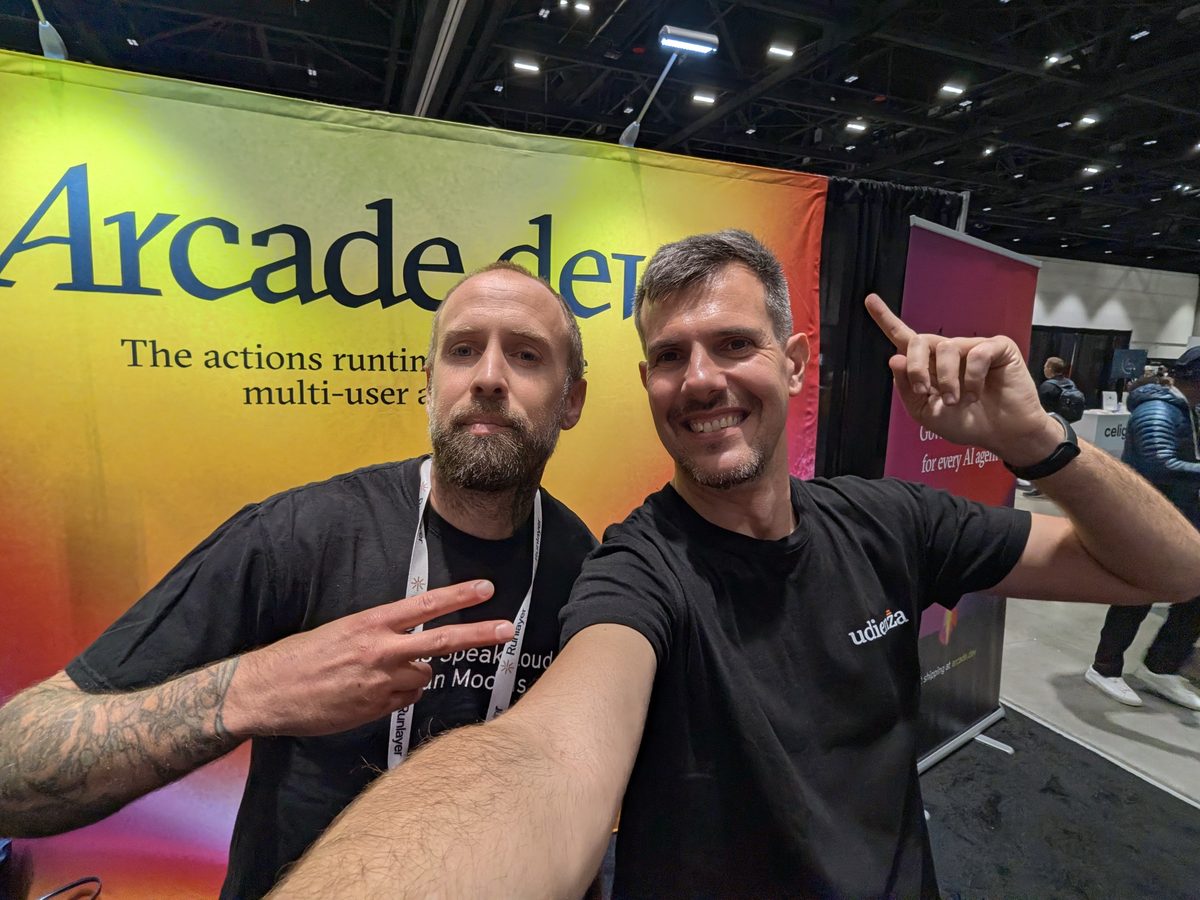
Nathan Slavik, Arcade.dev. “Arcade.dev makes agents actually work” was how the conversation started. In the words of its banner, Arcade.dev is the actions runtime for multi-user agents.
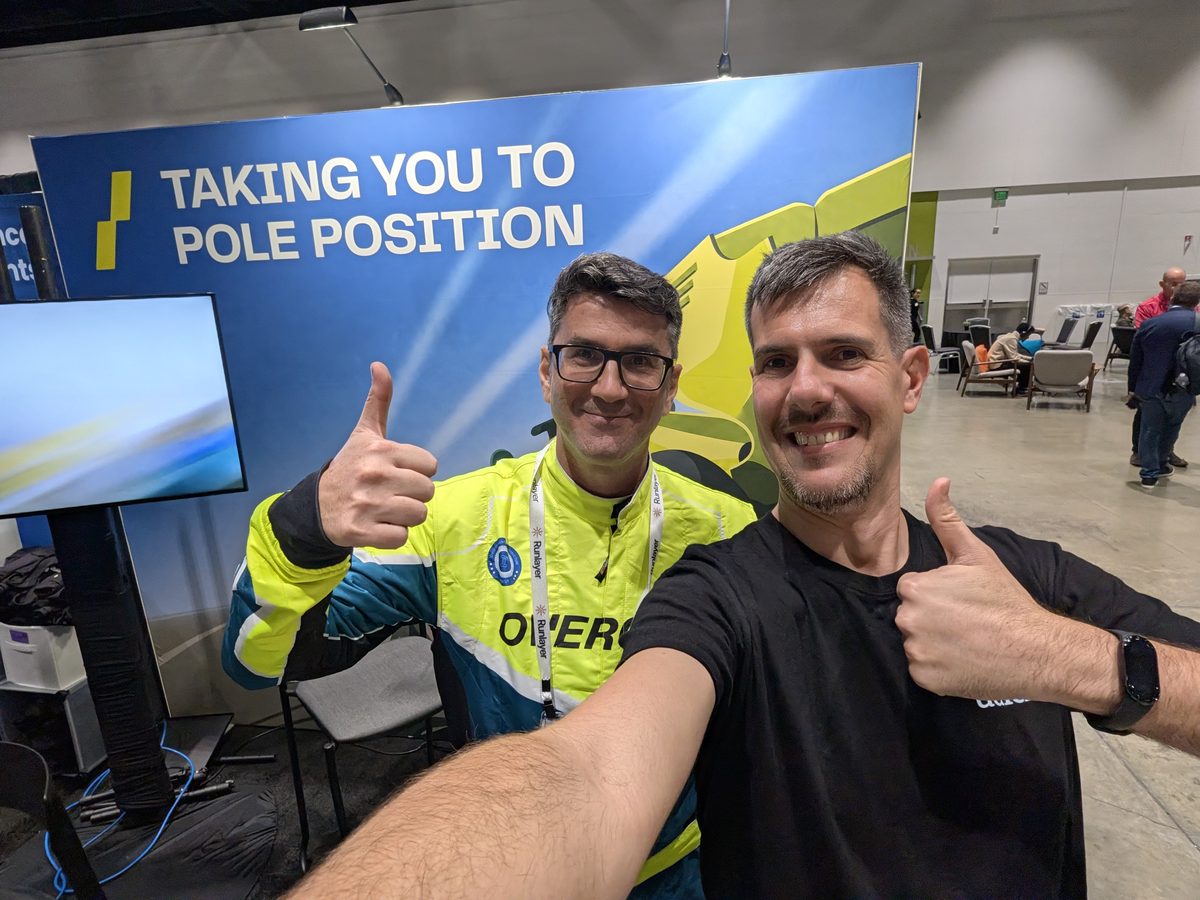
Yuval Hazaz, Overcut. The co-founder and CEO of Overcut came dressed for it: a racing suit at a booth whose banner promised to take you to pole position.
16:00 — The maintainer roundtable
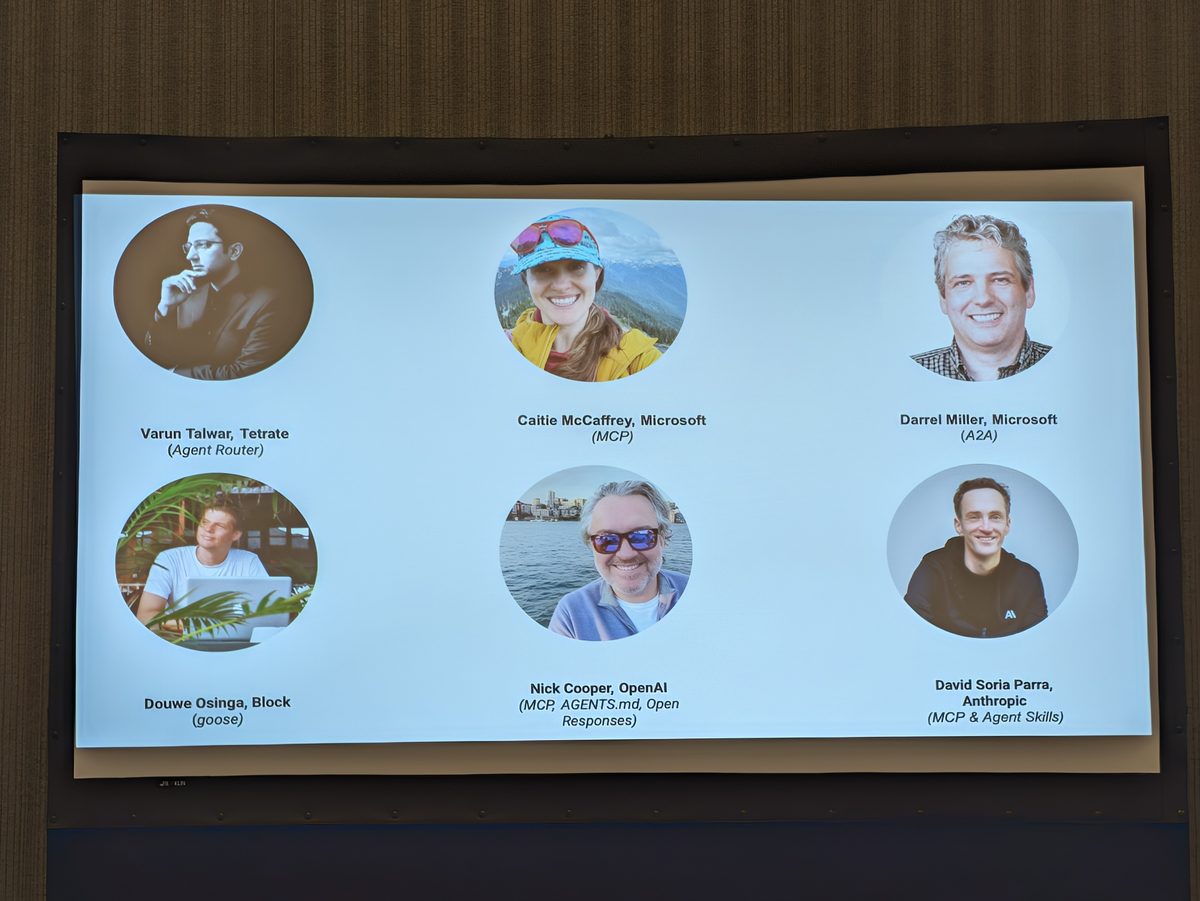
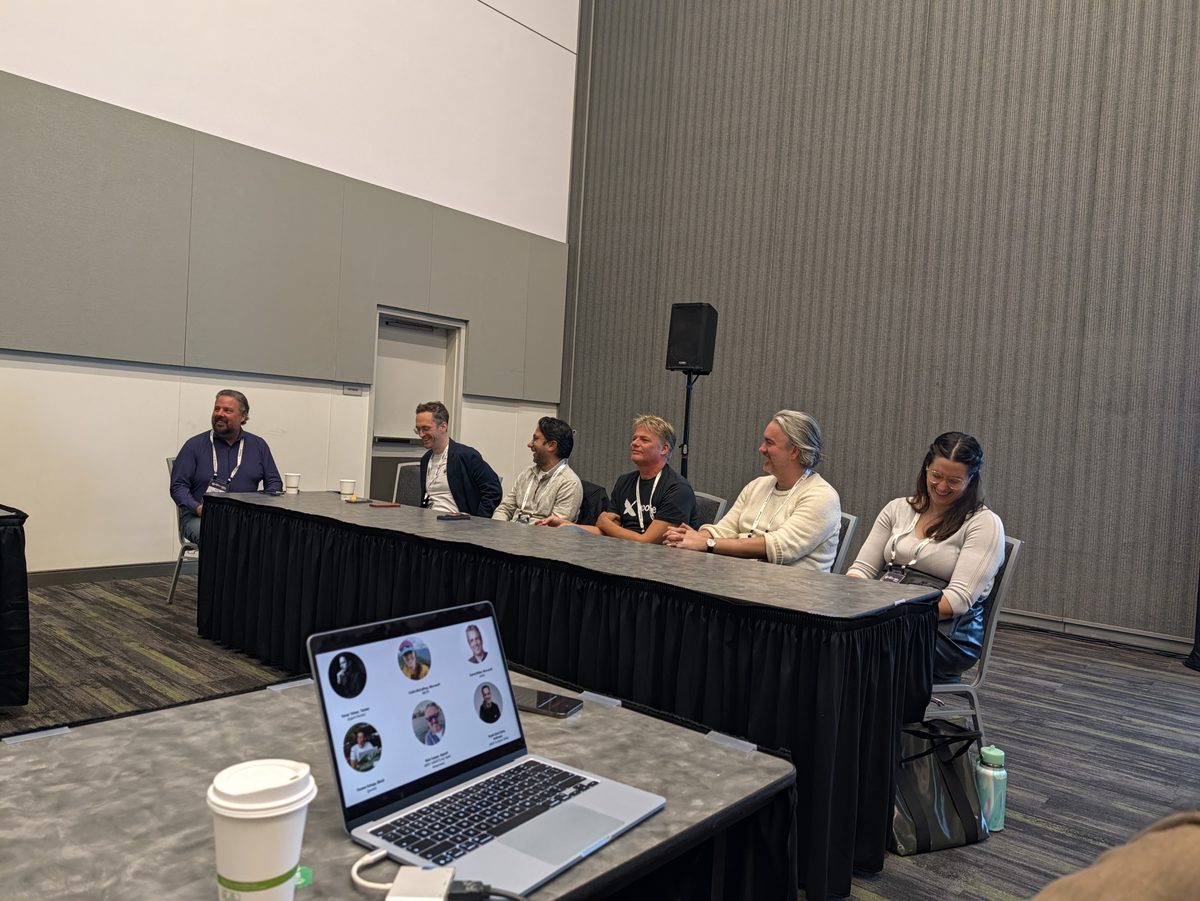
At 16:00 the attending media and analysts met the maintainers in a media room. Six of them sat at the table:
- David Soria Parra, Anthropic (MCP and Agent Skills);
- Caitie McCaffrey, Microsoft (MCP core maintainer);
- Nick Cooper, OpenAI (MCP, AGENTS.md and Open Responses);
- Darrel Miller, Microsoft (A2A Technical Steering Committee);
- Douwe Osinga, Block (goose);
- Varun Talwar, Tetrate (Agent Router).
It was a casual hour, and most of it went to questions from the room: analysts and journalists from IDC, Constellation Research and Dev Interrupted, and an analyst from finance. By the organisers’ rule there was no video. What follows comes from the audio Luca kept for his notes. Where the recording does not make clear who was speaking, the speaker is called “a maintainer”.
Many foundations, one stack. The first question was how the AAIF works with the CNCF, PyTorch and the other foundations around it. The answer went back to the old OSI layer model, standards built on top of each other: MCP for what a model reaches, Open Responses for the model’s interface. It also came down to people. “At the end of the day, we’re all the builders trying to solve problems,” a maintainer said, “and so I’m just going to go talk to another engineer,” even when that engineer works in a different foundation or standards body.
What agents do to your backend. Asked which assumption about agents the industry gets wrong, the maintainers refused absolutes: “MCP has fallen victim to skills versus MCP or MCP versus CLI,” and none of them is simply the wrong answer. They did offer warnings. “Any useful agent will talk to your back-end. So the traffic pressure on your back-end API is going to increase,” one said. A service that was never critical suddenly becomes critical “because the agent is pounding on it”. “Prepare for it.” Another warning was about security, for organisations that cannot afford a mistake: deny everything by default and allowlist, rather than the other way round.
Trust. One question came from someone who had just been at a public sector event: it would take one incident for an already sceptical public to turn. Darrel Miller of the A2A steering committee answered that “one of the big factors is trust.” Several projects are working on the discovery of AI artifacts, A2A agents among them, with a layer of trust built on existing standards: decentralized identifiers and verifiable credentials.
Hype cycles. Andrew, an engineer and journalist at Dev Interrupted, asked how to talk soberly about projects declared dead and alive again every few months. A maintainer answered with an early principle of the MCP project: avoid premature standardization, and wait for demonstrated value at scale. What lasts is what stays common: “AGENTS.md is very practically a concrete version of the traditional software engineering rule, that it’s a good idea to write documentation for your project.” Skills, MCP servers and CLIs “all still exist”, and the answer turned out to be combining them rather than choosing one. Another maintainer put it in four words: watch what people do.
Pace. The last question was whether open collaboration can keep up with AI, where “a year right now is like 10 years”. Caitie McCaffrey laughed. She said most people she meets across the industry tell her “I’m tired, but I’m also excited”. The MCP core maintainers are “shipping a protocol like twice a year, which is actually crazy fast for a protocol that has a lot of adoption”. Extensions let the community experiment without holding up the protocol, and what works consistently goes into the standard. Darrel Miller added the IETF view, consensus around interoperable implementations, and said that building those implementations is “very trivial in comparison to what it used to be”: the A2A community has test harnesses checking interoperability across six languages.
17:30 — Posters, and the last interview
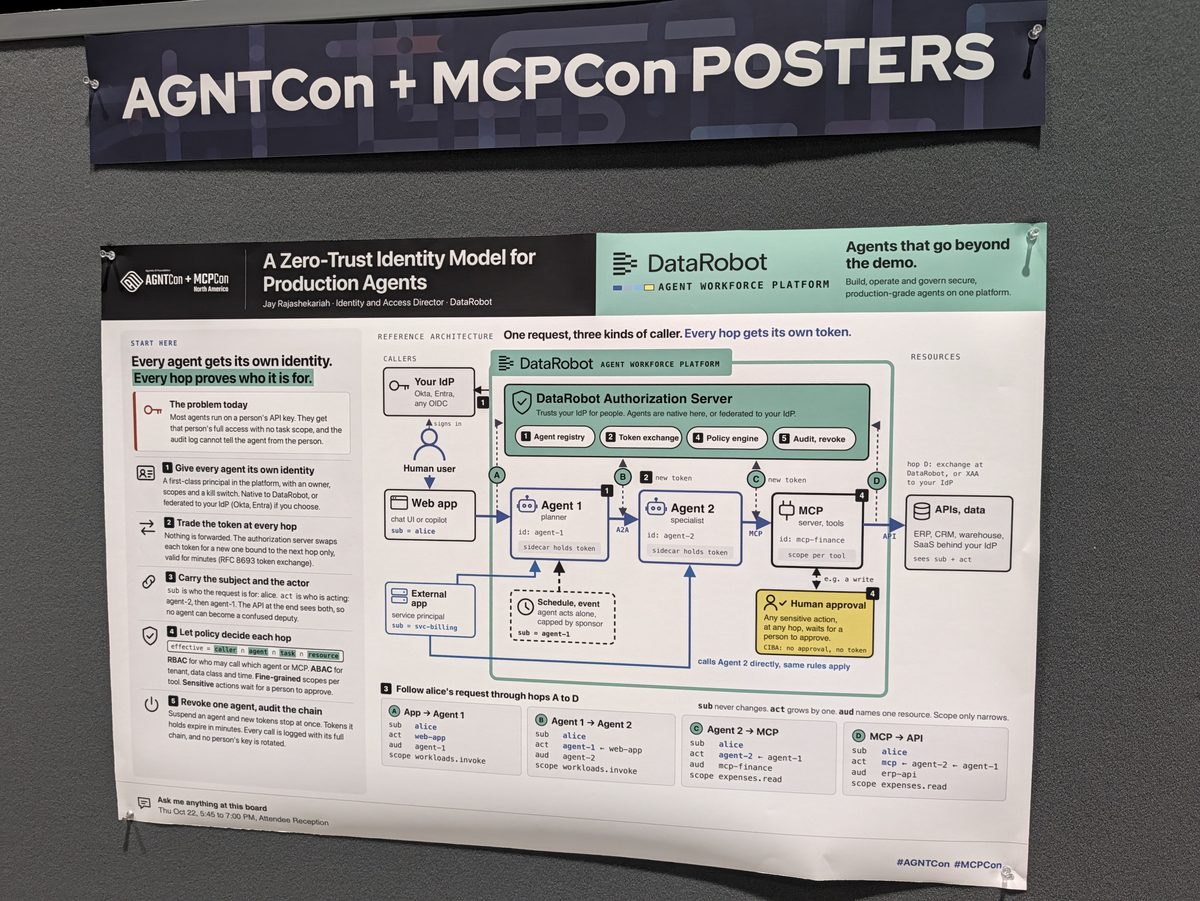
On the way out, the poster wall showed what the sessions had been about: a zero-trust identity model for production agents, and reliability for agent memory. At 17:34 came the last recording of the day, with Sean Knight, co-founder of SaturnDocs. The day before, in San Francisco, his co-founder Alec Reynolds had explained documentation written for agents; this was the other founder’s turn.
Evening — An Agent Walks into a Bar
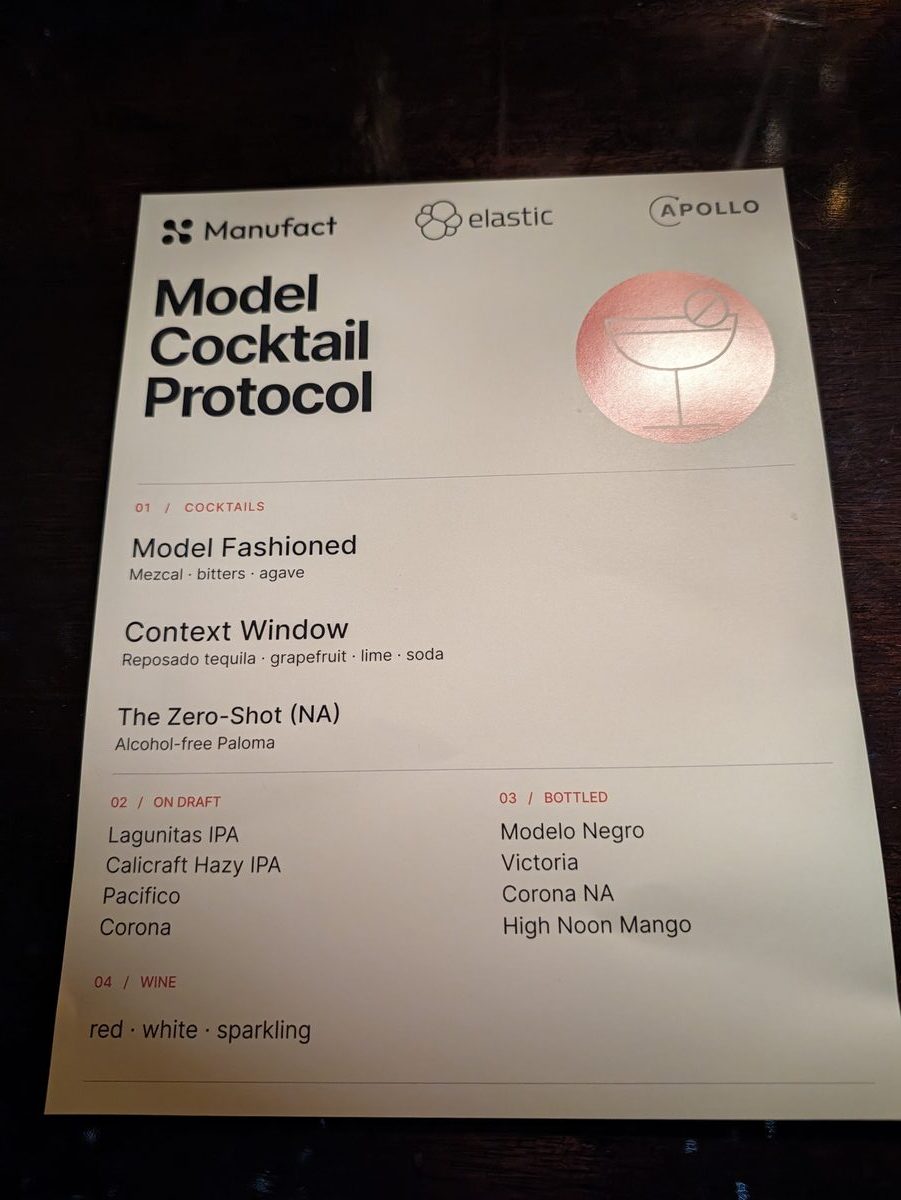
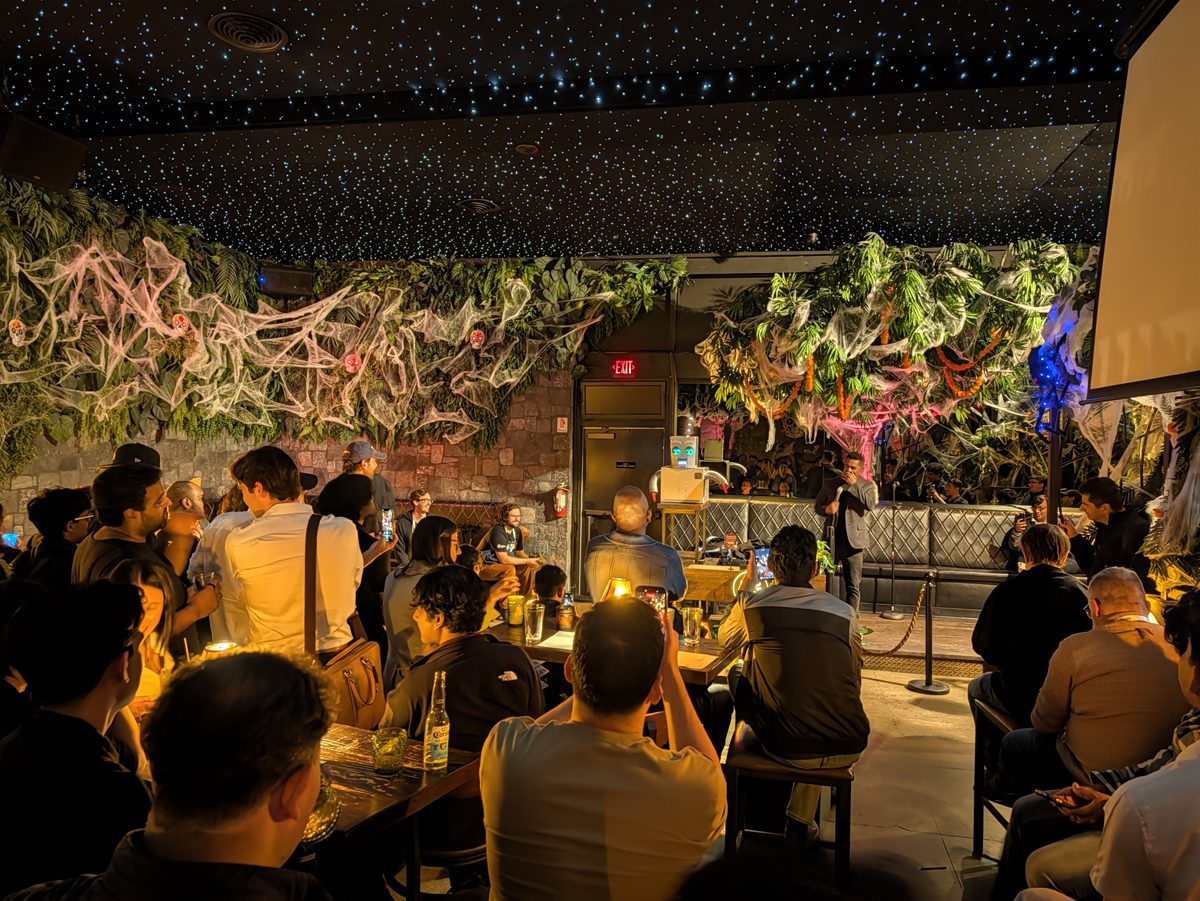
The day officially ended with the attendee reception in the Solutions Showcase at 17:45. Unofficially, it ended a few blocks away at Selva, where Manufact, Elastic and Apollo GraphQL hosted “An Agent Walks into a Bar”, a happy hour followed by a comedy show. The drinks menu was called the Model Cocktail Protocol. The Model Fashioned was mezcal, bitters and agave. The Context Window was reposado tequila, grapefruit, lime and soda. The alcohol-free Paloma was The Zero-Shot.
What comes next
Day two runs today. The day-one interviews are in the pipeline:
- Siddarth Shekhar, San Jose State University;
- Lena Hall, Akamai;
- Michael Levan, Solo.io;
- Matt DeBergalis, Apollo GraphQL;
- Daniel Hoang, Akuity;
- Rania Khalaf, WSO2;
- Nathan Slavik, Arcade.dev;
- Yuval Hazaz, Overcut;
- Sean Knight, SaturnDocs.
They will be published as episodes over the coming weeks. The week started in San Francisco, with Flexprice on billing for AI agents and SaturnDocs on documentation for agents. If you were in San Jose and want to be on Udienza, find Luca on day two.
Built something the rest of us run on? Being a guest is free. Take the other chair
The episodes in this article
All episodes →-
Episode 06 · 7 Oct
Manik Surtani: How goose led to the AAIF
-
Episode 60 · Coming
Nikhil Mishra: Billing for AI agents
-
Episode 61 · Coming
Alec Reynolds: Docs written by agents