Coming soon 6:20 Recorded at Open Source Summit Europe, Prague
What does it take to run AI agents in production on Kubernetes?
AI agents as microservices, but more
Lin Sun of Solo.io on running AI agents in production on Kubernetes: agentgateway, kagent and Agent Substrate, and keeping up with a field this fast.
Lin Sun, Open Source at Solo.io, Solo.io · with  Luca Berton
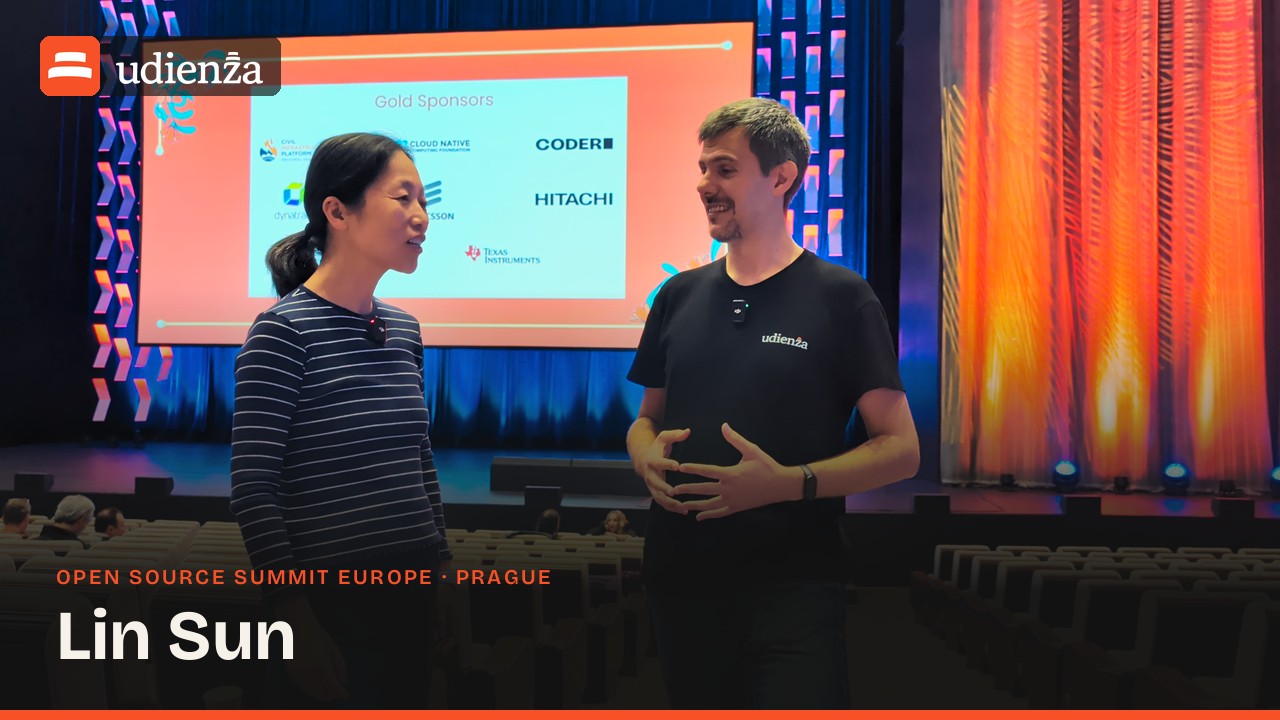
Not filmed yet.
Lin Sun works in open source at Solo.io. A Kubernetes contributor since January 2016 and a KubeCon speaker since 2017, Lin was one of the conference co-chairs of KubeCon in Amsterdam.
Follow the show and the episode arrives the morning it's published.
In brief
- Lin Sun first contributed to Kubernetes in January 2016, and has spoken at every KubeCon in Europe and North America since Berlin in 2017.
- The focus now is infrastructure that lets AI agents deploy, scale and stay secure in production, with the right governance and observability.
- agentgateway helps secure, observe and govern the communication from AI agents to MCP servers, to large language models and to other agents.
- AI agents are like microservices, but more: the same connectivity problem, with more weight on security, identity and policy, because agents are not trusted.
- That is why sandbox environments for AI agents are becoming super important.
- kagent deploys AI agents on Kubernetes; Agent Substrate adds a layer of scheduling to place agents on top of pods at efficient, large scale.
- Keeping up takes about half of Lin's time: learning, building on the projects, and fixing upstream what breaks.
- Each project has a weekly community meeting; Agent Substrate's draws 50 people or more.
Chapters
- 0:00 Speaking around the world
- 0:42 Ten years of CNCF
- 1:28 Infrastructure for AI agents
- 2:14 Agents as microservices, but more
- 3:36 Keeping up with the field
- 4:58 agentgateway, kagent, Agent Substrate
Why this conversation
Teams that learned to run microservices on Kubernetes now have to run AI agents there too, and the open source projects for it are moving fast. At Open Source Summit Europe in Prague, the host sat down with Lin Sun of Solo.io, who works on several of them and has been part of the Kubernetes community since its early days. The story of those three days in Prague is in Open Source Summit Europe 2026: who we met.
Ten years of KubeCon
The host opened with an observation: every time they open LinkedIn, Lin is in a different part of the world. Lin feels fortunate to speak in many countries and seasons, with Amsterdam twice that year, in March and again in September.
Lin’s involvement with the Linux Foundation runs through cloud native. Contributions to CNCF projects started about ten years ago, when Kubernetes had just started: the first contribution to Kubernetes was in January 2016. Lin has been a KubeCon speaker since 2017 in Berlin, and has attended and spoken at every single KubeCon in Europe and North America since. At KubeCon Amsterdam, Lin was one of the conference co-chairs, “so I was able to do a fun keynote for everybody.”
Agents as microservices, but more
What Lin focuses on now is the infrastructure that lets AI agents deploy, scale and stay secure in production, with the right governance and observability. One of the projects is agentgateway, which helps with the communication from AI agents to MCP servers, to large language models and to other agents, so that it can be secured, observed and governed.
“So you can think about AI agents as microservices, but more, right?” In the microservice world, the problem to solve was connectivity: how to connect, secure and observe your microservices. With AI agents the problem is the same, with a lot more focus on security, identity and policies, “because we don’t trust the AI agents”, and because agents can act on behalf of a person or a team. “That’s why a sandbox environment for AI agents is also becoming super important.”
Kubernetes for agents
Lin is excited about agentgateway and about kagent, which makes it easy to deploy AI agents on Kubernetes. A newer project, Agent Substrate, adds a layer of scheduling on top of Kubernetes, so that AI agents can be placed in a cluster on top of pods at efficient and large scale. Lin has started contributing to that one as well.
Half the time learning
The host listed the new protocols arriving for agents, MCP, WebMCP and CLIs, alongside talk of composability, accountability and evaluators, and asked how anyone keeps up. “It is hard. It is super hard.” Lin estimates that around 50% of the job is learning, because the space is evolving so fast. One good chunk of time goes to keeping up, another to building on top of these technologies, and another to fixing the problems Lin runs into, directly in the projects. That way, in Lin’s words, “I can not only be a consumer of these open source projects, but also be a contributor, be someone to help make the project successful.”
Where to join
Each project has a community meeting. agentgateway meets every Wednesday, and its website, agentgateway.dev, has the details; kagent.dev has its community information, with a meeting Lin believes is every Tuesday; Agent Substrate meets every Thursday. Agent Substrate is probably the largest community Lin has ever taken part in, with 50 people or more every time Lin joins. As Lin sees it, everybody wants to help shape the future of running AI agents in production on Kubernetes.
When it comes out
The episode is edited and in the release order. Like every episode it goes out on YouTube first, then on Apple Podcasts, Spotify and Amazon Music.
Mentioned in this episode
About Lin Sun
Lin Sun works in open source at Solo.io. A Kubernetes contributor since January 2016 and a KubeCon speaker since 2017, Lin was one of the conference co-chairs of KubeCon in Amsterdam.
Running this in production? Luca Berton helps platform teams take it from prototype to reliable production. See how he works
Built something the rest of us run on? Being a guest is free. Take the other chair
More episodes
All episodes →-
Episode 83 · Coming
Shaun Smith: Stateless MCP
-
Episode 85 · Coming
Ali Amjad & Zubair Zafar: Computers made of neurons
-
Episode 93 · Coming
Michael Levan: A thousand agents, one pod
-
Episode 98 · Coming
Kalle Westerling: Rethinking how we do open source