Coming soon 3:08 Recorded at Cloudflare Connect 2026, San Francisco
Can neurons grown on a dish help robots learn from less data?
Computers made of neurons
Ali Amjad and Zubair Zafar, co-founders of a young biocomputing startup, on computers made of neurons grown on a dish, and robots that learn from less data.
Ali Amjad & Zubair Zafar, Co-founder · with  Luca Berton
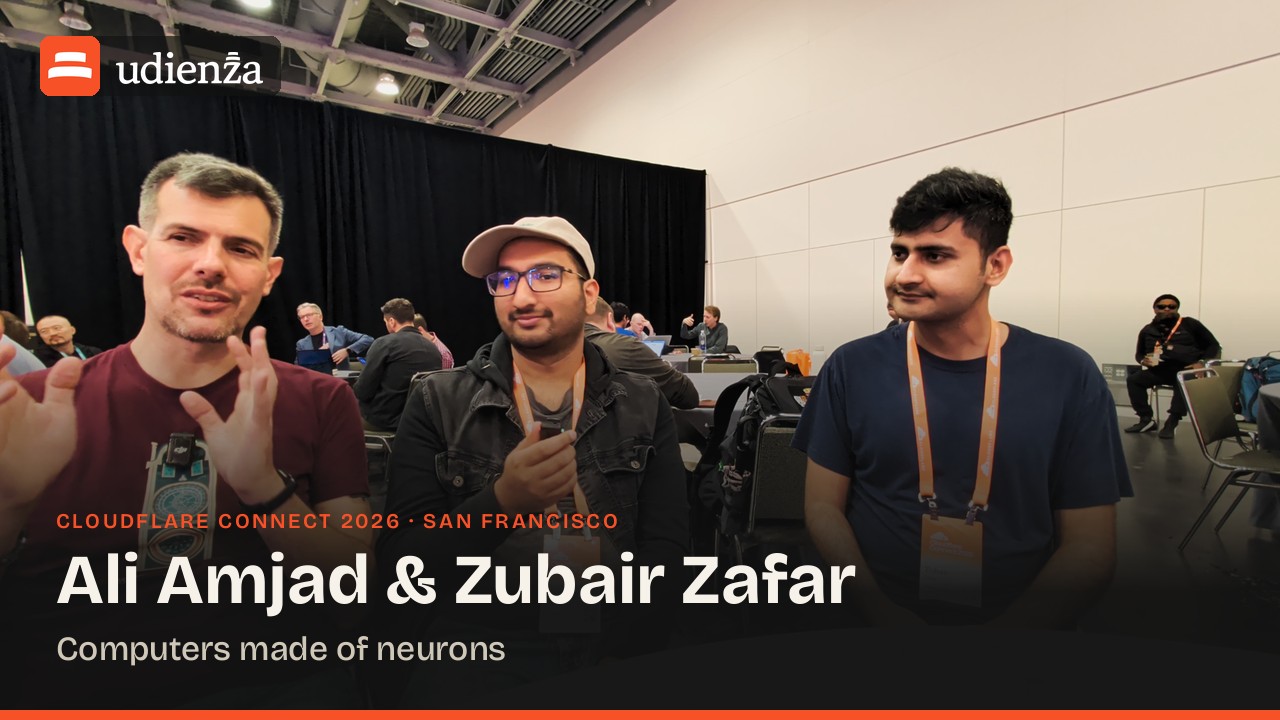
Not filmed yet.
Ali Amjad and Zubair Zafar met at hackathons and are co-founders of a biocomputing startup, with a third co-founder who is a postdoc in biology.
Follow the show and the episode arrives the morning it's published.
In brief
- Ali left a job in Canada five months earlier to explore startups in San Francisco; Zubair had graduated about six months earlier and came to build a startup.
- The two met at hackathons, won a lot of them together, and are now co-founders.
- A biocomputer grows neurons on a dish and connects them to a multi-electrode array, to teach those neurons to do the work.
- It is early stage: Ali sees it as a supplement to silicon chips, not yet a replacement.
- The bet: people learn faster from less data, so robots might too, with biological computers.
- They work with an existing biocomputer while building their own; a third co-founder, a postdoc in biology, will help build it.
- Zubair's hypothesis: training models on a neuron chip could cost less than on silicon, so more models could be trained with minimal compute.
Why this conversation
Most of the compute behind AI runs on silicon chips. At Cloudflare Connect 2026 in San Francisco, the host met two founders who are betting on something else: neurons grown on a dish. Ali Amjad and Zubair Zafar explained what a biocomputer is, why it might help robots learn from less data, and how far along they are. Alec Reynolds was recorded at the same event.
From hackathons to co-founders
Ali left a job in Canada five months before the conversation and came to San Francisco to explore startups. Along the way Ali started building in biocomputing and went to a lot of hackathons, which is where the two met. Zubair graduated about six months earlier and also came to San Francisco to build a startup, but first joined a different one. They did a couple of hackathons together. “We won a lot of them. And now we are co-founders. We’re building our own startup.”
What a biocomputer is
Ali’s definition: “the biocomputer is basically you grow neurons on a dish and connect with multi-electrode array to teach those neurons to do the work.” Think of it as an alternative to silicon, though it is still early stage, so Ali expects it to be a supplement to silicon chips. The bet behind it: humans learn faster with less data. Can that be replicated in robotics, with robots that learn from less data using biological computers?
Where they stand
They are working towards a prototype. Ali already has access to one biocomputer and makes algorithms and software on it, while they are in the process of building their own. Zubair comes in on the software, and a third co-founder, a postdoc in biology, will help build the computer itself.
Zubair found the field a couple of months before the conversation and expects it to be “really viral”, because training LLMs, VLA models and VLM models on silicon chips costs a lot more than it would on a neuron chip. The hypothesis is that biocomputers could train more models with a minimal amount of compute.
Asked how people can connect, they point to LinkedIn: “If you’re interested in biocomputing, please reach out.”
When it comes out
The episode is edited and in the release order. Like every episode it goes out on YouTube first, then on Apple Podcasts, Spotify and Amazon Music.
About Ali Amjad & Zubair Zafar
Ali Amjad and Zubair Zafar met at hackathons and are co-founders of a biocomputing startup, with a third co-founder who is a postdoc in biology.
Running this in production? Luca Berton helps platform teams take it from prototype to reliable production. See how he works
Built something the rest of us run on? Being a guest is free. Take the other chair
More episodes
All episodes →-
Episode 84 · Coming
Lin Sun: AI agents as microservices, but more
-
Episode 86 · Coming
Luise Freese: From AI Prototype to Production
-
Episode 80 · Coming
San Ramani: From startup to enterprise, with agents
-
Episode 98 · Coming
Kalle Westerling: Rethinking how we do open source