Coming soon 7:00 Recorded at Dutch Cloud Native Day 2026, Utrecht
When AI finds new vulnerabilities every day, where does security have to start?
Rethinking how we do open source
Kalle Westerling of Chainguard on a new security flaw every day: AI finding zero days, starting left, open source built from source, agent skills.
Kalle Westerling, Staff Developer Relations Engineer, Chainguard · with  Luca Berton
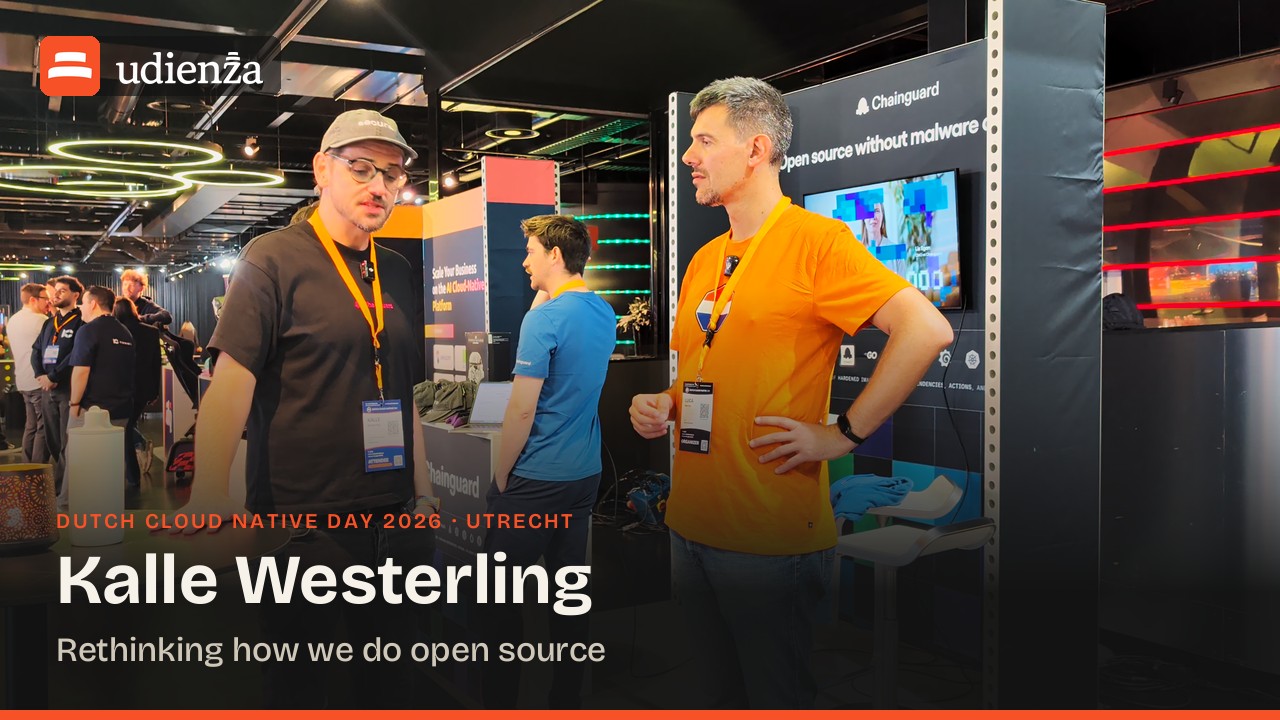
Not filmed yet.
Kalle Westerling is a Staff Developer Relations Engineer at Chainguard.
Follow the show and the episode arrives the morning it's published.
In brief
- Frontier models are discovering more and more vulnerabilities, in new releases, old ones and end-of-life ones, across the critical infrastructure built on open source.
- He named the big Trivy break, only a few months ago, and the Shai-Hulud worms; attackers now have the same models.
- Part of the defence is vigilance: do your research, read up, follow the good sources.
- Chainguard's answer is to start left: it builds essentially all of open source from source and patches zero-day vulnerabilities before they are exposed in the wild.
- It offers container images and library dependencies in Python, Go, JavaScript, Java and .NET, on its own rolling OS, with no wait for big distribution releases.
- CI/CD workflows and agent skills are attack surfaces too: skills can carry markdown that exposes you, and scripts.
- Five images from the paid catalog are free with a form on the website, and the 60 images of the free catalog need no authorization; there are over 3,000.
Chapters
- 0:00 A new security flaw every day
- 1:02 From the Trivy break to Shai-Hulud
- 1:30 Attackers have the models too
- 2:18 Start left: build from source
- 3:32 A rolling OS, no waiting for releases
- 3:56 CI workflows and agent skills
- 5:36 Free images, and over 3,000 more
Why this conversation
When models find vulnerabilities faster than people can patch them, the question is where security starts. Kalle Westerling is a Staff Developer Relations Engineer at Chainguard. The host recorded with him on 30 October 2026 at Dutch Cloud Native Day, at the Jaarbeurs in Utrecht.
A new security flaw every day
“Every day I wake up with a new security flaw”, he said. Frontier models are discovering more and more vulnerabilities, “both in new releases, in old releases, in end-of-life releases”, in the fabric of critical infrastructure built on top of open source: “things are moving at a pace and at a depth that we haven’t seen before.” It creates, in his words, “that sort of feeling in the morning of waking up and saying, oh no, another one that we haven’t seen ever.” He named the big Trivy break, “only a few months ago”, and the big worms, Shai-Hulud and Shai-Hulud 2.0. The attackers have access to the same kind of models, so there is “this acceleration driven by AI in discovering zero days”. Part of the defence is “trying to stay as vigilant as possible”: do your research, read up, follow the good sources.
Start left
At Chainguard the idea is that it is too late to shift left: “You have to start left.” Rather than mitigating things along the way, “we need to really rethink how we do security from the get-go.” The company has “a suite of tools and build essentially all of open source from source”, with its own harness to fix and patch zero-day vulnerabilities that do not have an exposure in the wild yet: “we’re trying to make sure that we’re mitigating these things at the very source code that we work with.” Customers get container images and library dependencies in Python, Go, JavaScript, Java and .NET, and more ecosystems are coming. “So we’re essentially rolling our own OS”, which brings rolling updates: no waiting for the big releases of bigger distributions.
CI workflows and agent skills
The CI/CD workflows are another attack surface: the dependencies they pull in get access to your keys, and from there to production and staging systems, so Chainguard provides hardened versions for them too. Then there are agent skills. Markdown files themselves can expose you to vulnerabilities, and skills can include scripts: “you really need to rethink the way that you’re doing AI development altogether”, from library dependencies and container images in production to the agent workflows and the CI/CD workflows that run them.
Getting started
Getting started is quite easy, he said. On Chainguard’s website you can sign up for five free images from the paid catalog: “You just fill out a form on the site.” And a free catalog of 60 images needs no authorization at all. Self-serve access to the libraries is rolling out soon. “We have over 3,000 images right now”, he said, with libraries backported in Python, Java and JavaScript and CVE remediation rolling out. They are hiring a lot too. “I love my job.”
When it comes out
The episode is edited and in the release order. Like every episode it goes out on YouTube first, then on Apple Podcasts, Spotify and Amazon Music.
Mentioned in this episode
About Kalle Westerling
Kalle Westerling is a Staff Developer Relations Engineer at Chainguard.
Running this in production? Luca Berton helps platform teams take it from prototype to reliable production. See how he works
Built something the rest of us run on? Being a guest is free. Take the other chair
More episodes
All episodes →-
Episode 97 · Coming
Tim O'Reilly: The architecture of participation
-
Episode 101 · Coming
Pieter Lewyllie: The Cloud Native Belgium meetup
-
Episode 93 · Coming
Michael Levan: A thousand agents, one pod
-
Episode 84 · Coming
Lin Sun: AI agents as microservices, but more