Coming soon 15:18 Recorded at AGNTCon + MCPCon North America, San Jose
Did MCP change the game we are playing in AI?
The architecture of participation
Tim O'Reilly on the O'Reilly Expert MCP, why human expertise still focuses AI, mechanism design, and MCP as the new architecture of participation.
Tim O'Reilly, Founder and CEO, O'Reilly Media · with  Luca Berton
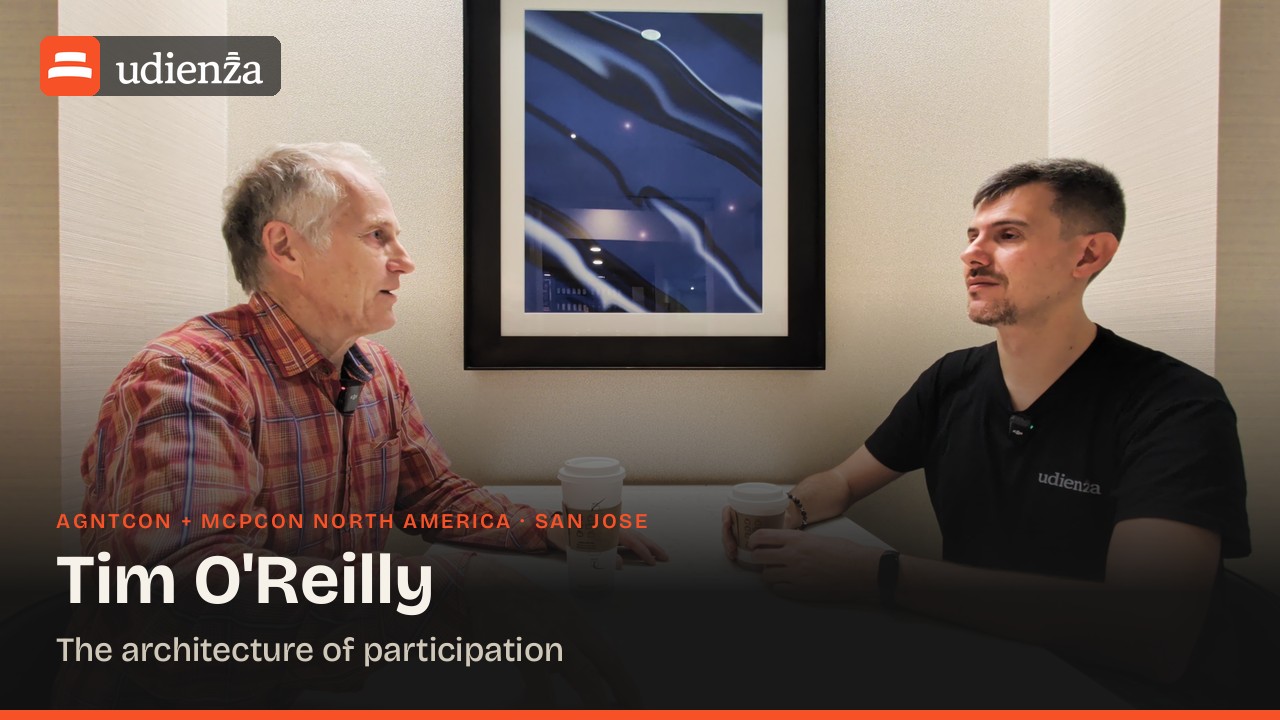
Not filmed yet.
Tim O'Reilly is founder and CEO of O'Reilly Media, today an online learning platform. In 1998 he organised the Freeware Summit, later called the Open Source Summit.
Follow the show and the episode arrives the morning it's published.
In brief
- O'Reilly's slogan is to create more value than you capture; today it is an online learning platform, and its new O'Reilly Expert MCP, in beta with a limited number of corporate customers, brings its experts into your agent.
- An LLM has so much information that you have to focus it, the way you capture the sun's power: he invokes the books like spells, by the wisdom of Kent Beck or of the Google SRE handbook.
- His CTO's research agent first said a group needed another engineer; with the O'Reilly MCP connected, it found the SRE handbook's idea of operational toil and said to fix that first.
- We are in a golden age of rediscovering the value of human expertise: knowing which problems to work on, and the hint that saves an agent from burning tokens.
- He cited the paper by Henry Farrell, Alison Gopnik, Cosma Shalizi and James Evans on AI as a social and cultural technology: the human superpower is cooperation and sharing.
- With MCP, he said, Anthropic did something unintentional, like IBM publishing the PC's specs: it changed the market structure of AI from calling the winners' APIs to a networked, collaborative, human-centred AI.
- The architecture of participation, systems people can add to and substitute parts of, as with Unix's small utilities, is the heart of open source, and it is moving up the stack, to MCP, skills and agents.
- What matters is diffusion through society, not bigness: open source and open standards tend to create value, and the innovation cycle depends a lot on openness.
Chapters
- 0:00 Create more value than you capture
- 0:43 The O'Reilly Expert MCP
- 1:30 The role of human expertise
- 3:28 A golden age of human expertise
- 5:54 AI as a social and cultural technology
- 6:35 MCP and mechanism design
- 7:55 MCP, like the IBM PC's open specs
- 8:46 The map is not the territory
- 9:36 From freeware to open source
- 10:25 The architecture of participation
- 12:17 Open source moves up the stack
- 13:44 Diffusion matters more than bigness
- 14:08 Openness drives the innovation cycle
Why this conversation
Tim O’Reilly has spent a career teaching people to work with technology, and he helped name open source. On the morning of his closing keynote at AGNTCon + MCPCon North America, he sat down with the host for the Udienza Breakfast, and talked about O’Reilly’s new MCP server, the value of human expertise in the age of AI, and why he thinks MCP changed the game the industry was playing. The host recorded with him in San Jose on 23 October 2026, the second day of the conference. The rest of that day is in AGNTCon + MCPCon North America 2026: day two.
Experts, invoked
The whole point of O’Reilly, he said, is to teach people how to work with technology, and one of its slogans is “Create more value than you capture.” Today it is an online learning platform, and its new product is the O’Reilly Expert MCP, which lets you invoke the power of the experts in your programming. It is still in beta with a limited number of corporate customers and rolling out more widely soon.
It answers a question he thinks about a lot: the role of human expertise in AI. For a while we were told the AIs would get so good that human expertise would not matter. In his experience, an LLM has so much information that you have to focus it: “the sun is abundant, but you get its power by capturing it”, or by focusing it. He compares the MCP to the spells Dr. Strange casts in the Avengers: “By the wisdom of Kent Beck or by the wisdom of the Google SRE handbook, think about this problem.” His CTO built a research agent that reads the organisation’s sources of truth, the product board, the Jira and the GitHub, and asked it whether to hire a new engineer for a project. The first report said the group was overloaded and should hire. With the O’Reilly MCP connected, the agent found the Google SRE handbook’s concept of operational toil and said to fix that first, or hiring would only make things worse.
A golden age of expertise
He does not think the point is to delegate everything to AI. When AI is thrown at a famous mathematical problem and solves it without anyone understanding the result, the knowledge is somewhere off to the side, and people like Terry Tao, who engage with it, bring a value AI cannot. Even deciding what to work on is human: someone had identified the problem as interesting in the first place. “So I think we’re in this golden age of redefining and rediscovering the value of human expertise.” In his own projects with AI, a hint from him about what the problem might be, once his Python configuration, saves the model from trying one thing after another and burning tokens. It is a partnership. He cited a paper by Henry Farrell, Alison Gopnik, Cosma Shalizi and James Evans, AI as a Social and Cultural Technology, which argues that the superpower of humans is cooperation and sharing, and that the great technologies in human history advanced our ability to share knowledge and build on the knowledge of others.
MCP and mechanism design
His closing keynote that day was about mechanism design, which one of the founders of the field described as “a kind of reverse game theory”: instead of the optimal strategy for a game’s rules, the rules most likely to produce the outcome you want. The game we were told we are playing in AI is a race to superintelligence, in which the frontier labs win everything and everyone else calls their APIs. Then Anthropic did something he thinks was unintentional, the way IBM did when it published the specs of the PC: IBM expected people to write device drivers for peripherals, and they built whole PCs, a clone market and a far bigger market. In the same way, “MCP changed the market structure of AI”, towards a much more networked, collaborative, human-centred form of AI.
The architecture of participation
He cannot see the future, he said, but he tries to see the present more clearly, with a lesson from general semantics: the map is not the territory. In 1998 he organised the Freeware Summit, later called the Open Source Summit, where free software developers came up with a new name. The Free Software Foundation’s map was drawn around a style of licence; his was drawn around Internet-enabled collaboration, and what he calls the architecture of participation: systems designed so that people can add to them and substitute one part for another. He had worked with Unix under the AT&T licence and seen the same behaviour, so it was not caused by the licence. It was the design: a small kernel surrounded by small utilities that read from standard in and write to standard out, so anyone could write a new piece that just fit. That is the world MCP has brought back. “So I think the architecture of participation is the heart of open source.”
Training a large model takes massive capital, so the heart of open source is going up the stack, to MCP, skills and agents; there is also a lot you can do with smaller open weight models and fine tuning. What matters, he said, is not bigness but diffusion through society: we have cars that do 250 miles an hour and planes that fly at three times the speed of sound, and we do not use them every day. Open source and open standards tend to create value, closed systems are better at capturing it, and the innovation cycle depends a lot on openness. Without Google publishing the Transformer paper and releasing BERT, ChatGPT would never have happened. His last word: “our willingness to share and cooperate is the human superpower.”
When it comes out
The episode is edited and in the release order. Like every episode it goes out on YouTube first, then on Apple Podcasts, Spotify and Amazon Music.
Mentioned in this episode
About Tim O'Reilly
Tim O'Reilly is founder and CEO of O'Reilly Media, today an online learning platform. In 1998 he organised the Freeware Summit, later called the Open Source Summit.
Running this in production? Luca Berton helps platform teams take it from prototype to reliable production. See how he works
Built something the rest of us run on? Being a guest is free. Take the other chair
More episodes
All episodes →-
Episode 96 · Coming
David Parry: Code review for the agent factory
-
Episode 98 · Coming
Kalle Westerling: Rethinking how we do open source
-
Episode 83 · Coming
Shaun Smith: Stateless MCP
-
Episode 09 · Coming
Shannon Williams: When enterprises trust agents