Coming soon 5:28 Recorded at AGNTCon + MCPCon North America, San Jose
Who reviews the code the agents in your factory write?
Code review for the agent factory
David Parry of Qodo on code review for the agents in a software factory, Qodo's MCP server for local reviews, and guardrails that work like a jig.
David Parry, Professional Services, Qodo · with  Luca Berton
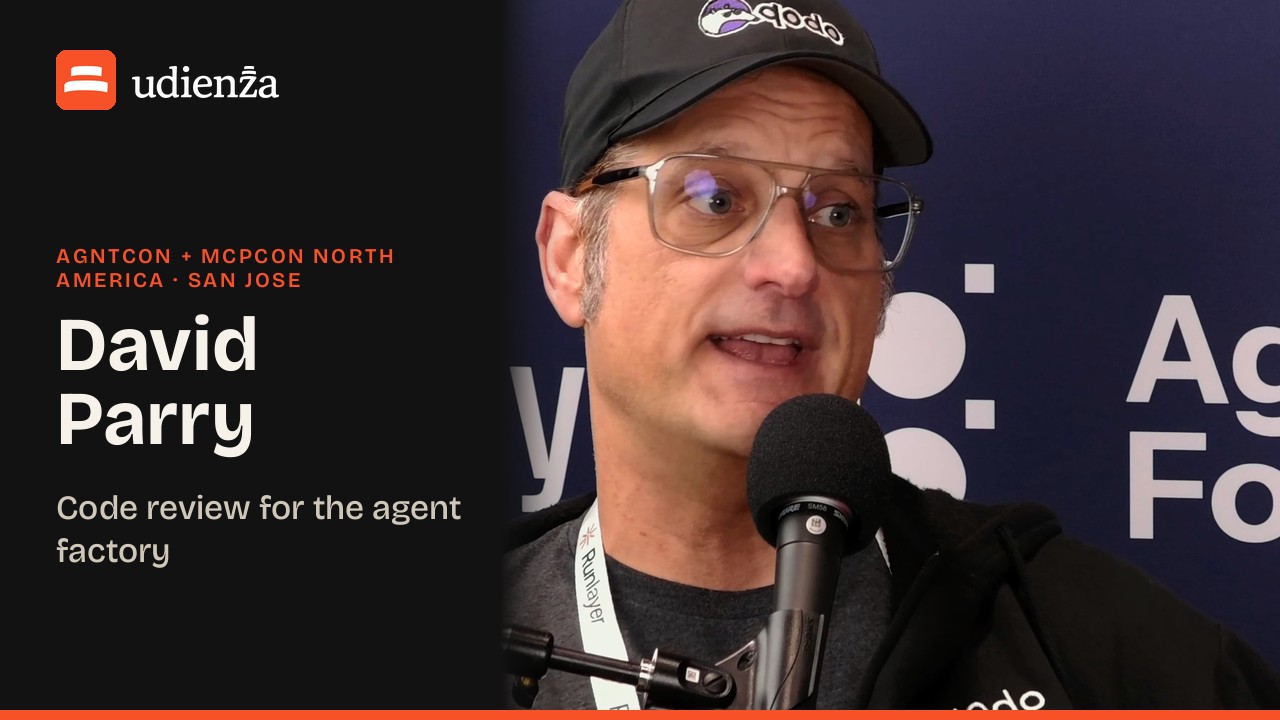
Not filmed yet.
David Parry works in professional services at Qodo, helping companies in their agentic journey; Qodo's own piece of that journey is code review.
Follow the show and the episode arrives the morning it's published.
In brief
- Qodo's piece of the agentic journey is code review: finding the bugs and the governance problems, so that developers, senior ones included, can think about the larger picture and the code base as a whole.
- Qodo has an MCP server at its core, so the agents in a software factory can call it and get their code reviewed before it moves on.
- He calls it the shift left of the review: local feedback on the code the agents write, so that the review at the end is a clean one.
- He does not want every company's software made the same way: a fully generalised SDLC would make every company essentially the same, competing on price.
- His professional services work goes to the parts that make a business unique, bringing in technologies its developers already use, such as Spring Boot and Spring AI, to make the company agentic.
- Guardrails, for him, are a jig: "one straight path or a turn that can be measured, understood", so a company avoids hallucinations and embarrassing moments.
- Open source projects get the same professional and enterprise reviews for free; everyone else can sign up at qodo.ai.
Chapters
- 0:00 Code review in the agentic journey
- 0:29 Who likes code review?
- 1:11 The agentic toolbox and MCP
- 2:08 Shifting the review left
- 3:27 Factories that make a company unique
- 4:10 Guardrails, like a jig
- 4:30 Free reviews for open source
Why this conversation
When agents write more of the code, someone still has to check it. David Parry works in professional services at Qodo, a company whose product is code review, and he helps companies in their agentic journey. In this conversation he explained where Qodo’s review sits in a factory of agents, and why he wants each company’s factory to make something of its own. The host recorded with him at the conference’s studio on the show floor in San Jose on 22 October 2026, the first day of AGNTCon + MCPCon North America. The rest of that day is in AGNTCon + MCPCon North America 2026: day one.
The review, done for you
He opened with a show of hands: how many of you like to do code review? There are many reasons for a review, and Qodo takes one of them off the developer: looking for bugs and dealing with the governance of the code. Qodo finds those problems, addresses them and works with the developer on the review. The regular developers and the senior ones can then worry about the larger picture, a larger part of the code base, and the system thinking: understanding what they have built.
An MCP server in the factory
“We understand MCP is very critical in this world,” he said, and Qodo has an MCP server at its core that agents can call. In a software factory, the agents take over the busy, repetitive work developers used to do, but you still want to check them at the end. With Qodo’s MCP server there, the code they produce gets local feedback, and what reaches the review is clean. He calls this the shift left of the review.
A factory of your own
The host asked whether that means a completely automated software factory. Not quite, in his answer: the software is what makes a company unique. “Target doesn’t want to do exactly what Walmart’s going to want to do,” and Ford does not want to do what Tesla does. Turn the whole SDLC into one generalised system and every company becomes essentially the same, competing on price. He does not think we are there yet, and his work goes the other way: helping developers build the factories that make their company unique and give business value, writing the MCP for the business, and bringing in technologies they already use, such as Spring Boot and Spring AI, to make the company agentic.
That takes guardrails, which he compares to a jig: “one straight path or a turn that can be measured, understood”. It keeps a company away from hallucinations and from embarrassing moments, such as giving out all its tokens.
Free for open source
To start, go to qodo.ai. This being a Linux Foundation event, he spoke for the open source people too: Qodo is very big on the community, he said, and if your project is open source, it gets the same professional and enterprise reviews for free. Everyone else can sign up there and start getting reviews.
When it comes out
The episode is edited and in the release order. Like every episode it goes out on YouTube first, then on Apple Podcasts, Spotify and Amazon Music.
Mentioned in this episode
About David Parry
David Parry works in professional services at Qodo, helping companies in their agentic journey; Qodo's own piece of that journey is code review.
Running this in production? Luca Berton helps platform teams take it from prototype to reliable production. See how he works
Built something the rest of us run on? Being a guest is free. Take the other chair
More episodes
All episodes →-
Episode 95 · Coming
Benjamin Hindman: A higher level of abstraction
-
Episode 97 · Coming
Tim O'Reilly: The architecture of participation
-
Episode 83 · Coming
Shaun Smith: Stateless MCP
-
Episode 09 · Coming
Shannon Williams: When enterprises trust agents