Coming soon 3:55 Recorded at SREday Amsterdam, Amsterdam
What should observability tell you about your code agents?
Lewis Isaac: Coralogix: telemetry to decisions
Lewis Isaac of Coralogix on observability over your own object storage, an AI center that watches code agents' tokens, and a CLI for your agents.
Lewis Isaac, Developer Advocate, Coralogix · with  Luca Berton
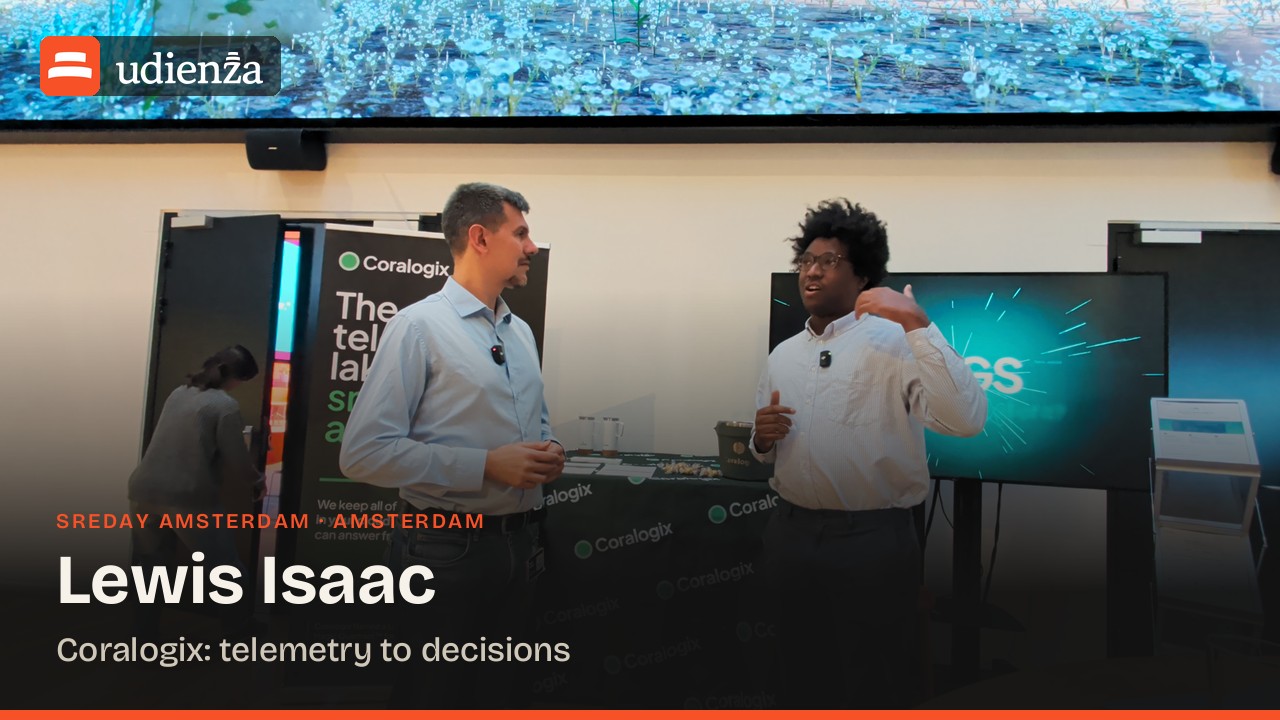
Recorded, coming soon.
Lewis Isaac is a Developer Advocate at Coralogix, an observability platform.
Follow the show and the episode arrives the morning it's published.
In brief
- Coralogix looks at your logs, metrics and traces, and goes one step further: business decisions from your telemetry.
- Customers keep their data in their own object storage, S3 for example: complete governance, good retention, quick and cost-effective queries.
- The AI center does code agent observability: how many tokens, which models and which agents cause the most cost.
- Cost can be married with usage, to advise an engineer who uses a lot of tokens on a different model.
- A CLI and MCP let your own agent navigate Coralogix and understand your telemetry, completing the feedback loop.
- Coralogix is big on OpenTelemetry, commits code to it every year and works on projects with it.
- To start: a free trial to ingest some data, or a demo; solution engineers help with onboarding and POCs.
Chapters
- 0:00 What Coralogix does
- 0:37 Fast, cheap retention
- 1:11 The AI center
- 1:56 A CLI and skills for your agents
- 2:34 Built on OpenTelemetry
- 2:52 Getting started
- 3:10 Onboarding your data
Why this conversation
The host had heard the word observability all day at SREday, so the question was the obvious one: “But this space looks so busy, I heard so many observability, why are you different?” Lewis Isaac is a Developer Advocate at Coralogix. The host recorded the conversation on 2 November 2026 at SREday Amsterdam.
The start is the usual one: “we are an observability platform. So, we look at your telemetry data, so your logs, metrics, traces, but then we go one step further, right?” The step further is the reason to collect it all: “So, we can allow you to make real business decisions based on the data that you have and your telemetry that you have.”
Your data, in your bucket
What sets Coralogix apart, in Lewis’s answer, is where the data lives: “So, all of our customers store their data in their own object storage, so S3, for example, which means a couple of things.” The first is control: “One, that they have complete governance over that data”. The second is time and money: “and also they have good retention, so they can query that data really quickly and it’s cost effective as well.” The host summed it up as connecting your own object storage and letting Coralogix do the magic, and Lewis agreed: “Yeah, so it’s your object storage and then you can query that.” That matters, Lewis said, “especially in the AI world that we’re in right now.”
Watching the code agents
There are many AI features, and the big one is the AI center: “And within the AI center we do something called code agent observability.” Anyone who has used code agents knows the first question it answers. “So how many tokens and what models and which different agents are causing the most cost.” Cost alone is half the picture: “But you can also marry that with usage as well.” The example is a single engineer: “maybe you have one engineer who is using a lot of tokens.” You might advise a different model, or whatever suits your business.
A CLI for your agents
The other direction is agents reading Coralogix. There is a CLI and MCP: “So if you’re using your own agent”, you connect it to the CLI through the terminal, “And then your agent has the skill set to navigate through Coralogix and get a really good kind of understanding of your telemetry data, especially if it’s changing code itself.” An agent that changes code can then see what its telemetry says, “complete that feedback loop” and “learn from its mistakes.”
Underneath it is an open standard. “Yeah, so we’re big on OpenTelemetry. We commit a certain amount of lines of code every year to that.” Coralogix works on a couple of projects with it, and listens to the people who use it: “But also it’s really good to get feedback from the community.”
Getting started
“We have got a free trial that you can go on and you can ingest some data.” Then you see the platform for yourself, “Or you can reach out and get a demo from one of our amazing team members.” How hard onboarding is depends on what you are bringing, Lewis said, but that is where Coralogix puts its effort: “I think one thing that we pride ourselves in is offering loads of support during an onboarding process or even a POC.” Solution engineers walk you through it, so you onboard your data in the right way first, and scale up from there.
When it comes out
The episode is edited and in the release order. Like every episode it goes out on YouTube first, then on Apple Podcasts, Spotify and Amazon Music.
Mentioned in this episode
About Lewis Isaac
Lewis Isaac is a Developer Advocate at Coralogix, an observability platform.
Read more on Udienza
Running this in production? Luca Berton helps platform teams take it from prototype to reliable production. See how he works
Built something the rest of us run on? Being a guest is free. Take the other chair
More episodes
All episodes →-
Episode 110 · Coming
Stephen Cihak: Harness: agents that deploy code
-
Episode 51 · Coming
Andi Mann: Observability for non-deterministic systems
-
Episode 34 · Coming
Vladimir Vučković: Catching agent failures
-
Episode 107 · Coming
Peter Marshall: Imply: logs, compression, agents