Coming soon 6:42 Recorded at SREday Amsterdam, Amsterdam
How much should an agent decide on its own when it deploys your code?
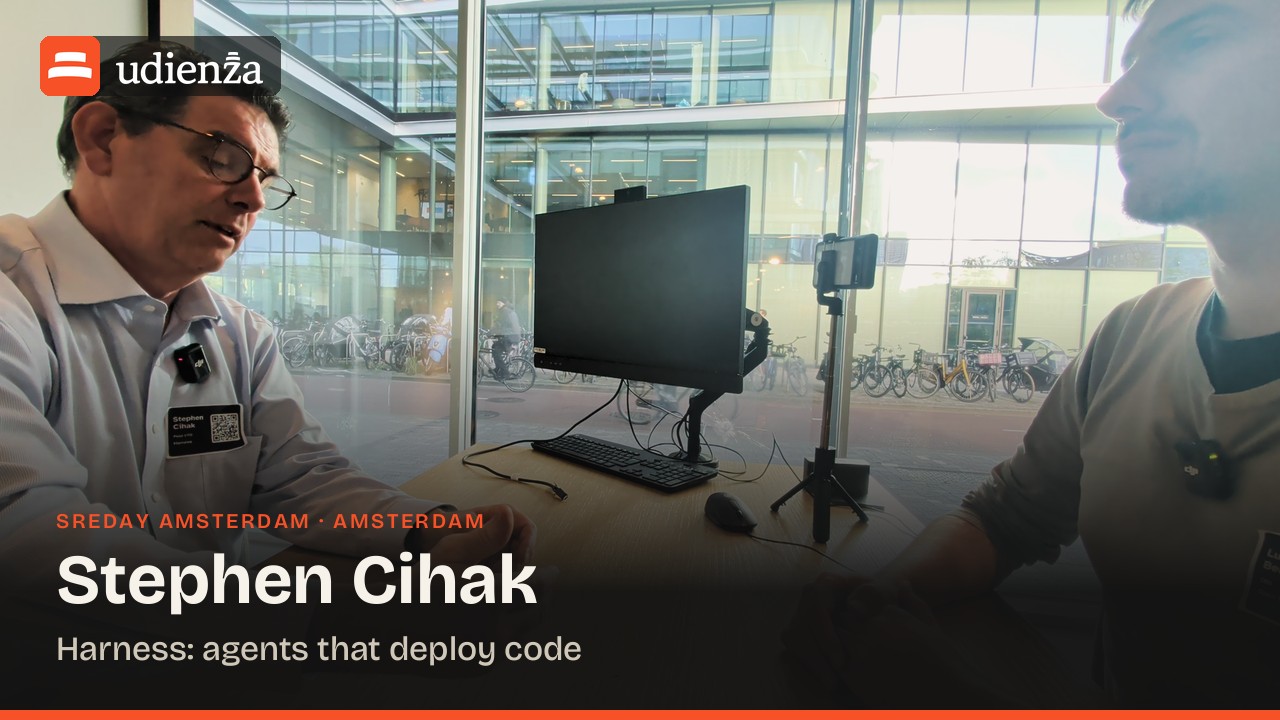
Stephen Cihak: Harness: agents that deploy code
Stephen Cihak, Field CTO of Harness, on an autonomous SDLC: agents that deploy, how much autonomy each step gets, and a change advisor that decides on data.
Stephen Cihak, Field CTO, Harness · with  Luca Berton
Recorded, coming soon.
Stephen Cihak is Field CTO at Harness, the software delivery platform.
Follow the show and the episode arrives the morning it's published.
In brief
- With so much agentic code coming out, Harness says delivery has to move to an autonomous SDLC: agents plan, write and deploy the code.
- Version 3 of the Harness platform, released at Unscripted, has autonomous steps that let agents deploy your code.
- You decide each step's autonomy: a deterministic step, a recommendation, a human in the loop, or the agent deciding alone.
- The change advisor weighs your policies: the size and complexity of the change, the services it touches, critical infrastructure.
- It gives a percentage, so a release becomes a data question instead of a change advisory board's subjective answer.
- Harness uses its own platform and ships a new feature at least every 12 hours.
- To start: the free tier at harness.io, where AI agents create your first pipeline.
Chapters
- 0:00 What Harness is doing
- 0:20 An autonomous SDLC
- 1:06 Deploying at machine speed
- 1:24 How much autonomy each step gets
- 2:41 How the change advisor decides
- 3:49 A data question, not a hunch
- 4:28 Getting started
- 4:48 A new feature every 12 hours
Why this conversation
Agents write code faster than people can review and ship it, so the bottleneck moves to delivery. Stephen Cihak is Field CTO at Harness. The host recorded the conversation on 2 November 2026 at SREday Amsterdam.
Harness, Stephen said, saw it coming a while ago: “there’s so much pressure with the agentic code that’s coming out that we really need to move to more of an autonomous SDLC.” That means agents at every stage: “you need to have agents plan the code, write the code, and agents that actually go out and deploy the code in a safe, secure, reliable way.”
Version three, at machine speed
They have built it over the past year and a half or so, “And just recently at Unscripted, we released our kind of version three of the Harness platform, which has autonomous steps in it”. The steps let agents deploy your code, and you choose how far each one may go. Stephen’s summary: “It’s a really good way to move away from deployment that operates at human speed to deployment that operates at machine speed.”
How much autonomy each step gets
The host asked how many levels of autonomy there are. Stephen walked up the scale. At the bottom, no agent at all: “I’m going to have a deterministic step that says, hey, no, you have to do this every single time.” Next, an agent that recommends, that you run the scan or do these things. Then a change advisor that puts a number on it, “there’s a 90 percent chance that this is OK to go”, with a human in the loop who says yes, or fails the build and sends it back for fixes. At the top, the agent decides: because the percentage is high and “blast radius is really small”, it moves forward on its own. “So you get to decide the level of autonomy each step in every stage”.
A data question, not a hunch
What does the change advisor look at? Policies you define. “So the size of the change, how complex of change is this in the code base? How many services does this touch? Is it part of critical infrastructure or not?” From those it can “basically give you a percentage-based decision matrix”, so you are informed about the change and the release by data. Above a threshold the agent goes ahead; below it, a human evaluates; or it only recommends, whatever the percentage.
The comparison Stephen drew is with the meeting most teams know, a decision taken on data “as opposed to a change advisory board”, where the developers come and describe the change and the service. With the change advisor, “it becomes more of a data question than a probabilistic kind of subjective answer that you were giving before.”
A new feature every 12 hours
The future is always hard to predict, Stephen said, but Harness is “drinking our own champagne”, and moving at a pace much faster than it has traditionally: “So we’re seeing a new feature being developed and released every 12 hours at this point.” Not a new model, Stephen corrected the host: “Well, it’s not a new model. It’s a new feature that’s within the Harness platform.” It can be as fully fledged as “a code coverage agent that can go out and automatically increase the code coverage for more critical areas of your code base”, or as small as a feature flag for an extra step. Harness, Stephen added, has just merged with Augment Code, and more and more capable models are coming, as Stephen sees it.
Getting started
“Actually, we have a free tier. You can go out today to harness.io and give it a shot.” It runs the latest version of Harness, and the first steps are done for you: “There’s AI agents out there that will create your first pipeline for you”, set up the repository and deploy it somewhere. For training and experimenting, the same advice: sign up for the free trial and try it.
When it comes out
The episode is edited and in the release order. Like every episode it goes out on YouTube first, then on Apple Podcasts, Spotify and Amazon Music.
Mentioned in this episode
About Stephen Cihak
Stephen Cihak is Field CTO at Harness, the software delivery platform.
Read more on Udienza
Running this in production? Luca Berton helps platform teams take it from prototype to reliable production. See how he works
Built something the rest of us run on? Being a guest is free. Take the other chair
More episodes
All episodes →-
Episode 109 · Coming
Piotr Zaniewski: vCluster: GPUs on demand
-
Episode 111 · Coming
Lewis Isaac: Coralogix: telemetry to decisions
-
Episode 94 · Coming
Matt DeBergalis: Time to get the architecture right
-
Episode 89 · Coming
Xander Van Buggenhout: Aikido Security