Conversations
5 min read
CNCF: who judges a project, and what agents ask
Bob Killen and Daniel Krook of the CNCF on how the Technical Oversight Committee moves projects up, and on the load AI agents put on Kubernetes.
By  Luca Berton
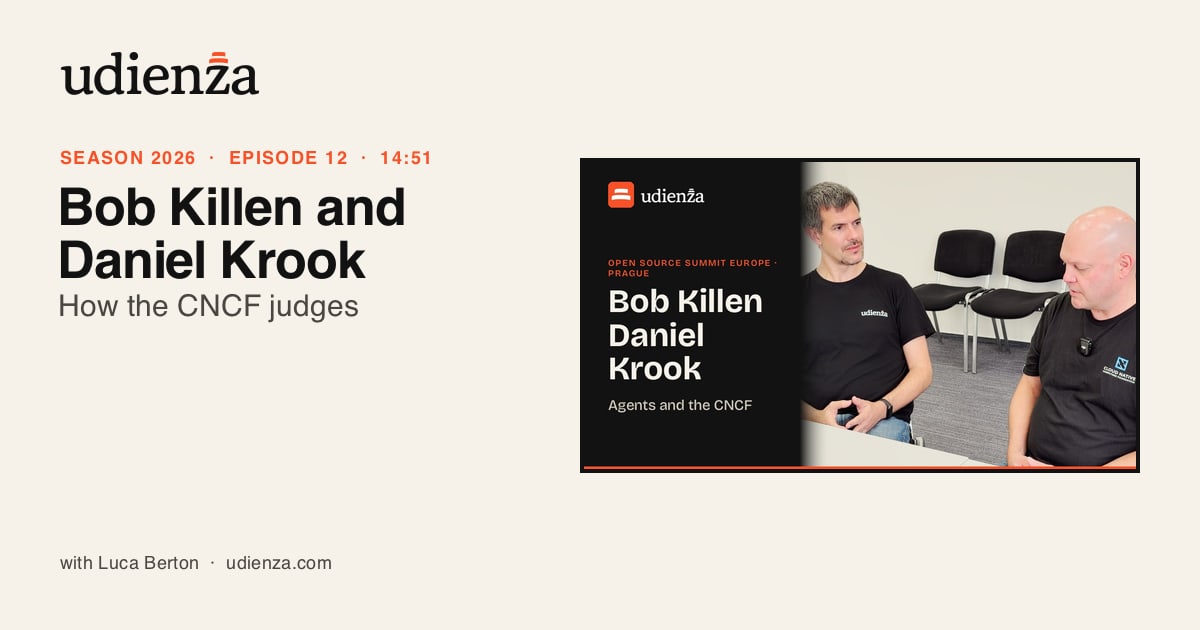
Bob Killen and Daniel Krook work at the Cloud Native Computing Foundation: Bob as Director of Technical Program Management, Daniel as Senior Director of Developer Experience. Luca Berton talked to them at Open Source Summit Europe in Prague.
Two roles, 230 projects
Bob splits the role between the projects and the end users, “and trying to bring them together”. Daniel calls the title “a long way of saying” that the team, Bob included, works on making sure the 230 projects hosted at the CNCF “are happy, have what they need to thrive”: support, credits, tech docs and mentorship.
And the count keeps moving. Some projects had been voted in but had not completed the process, so it would probably be about 240 within two weeks. About 40 are graduated, the most mature level, and 40 are incubating, “building momentum, building communities”, with a long tail of sandbox projects behind them. Projects also cycle out when they become irrelevant or are replaced by another one: about 30 or 40 are archived.
Who judges a project
Who decides which projects move up? “So that’s not so much on us specifically,” came the answer, “but on the CNCF Technical Oversight Committee.” It is an elected group from the governing board, the project maintainers and the end users. It decides what a project needs to meet to go from sandbox to incubating and from incubating to graduated, and it runs the reviews.
There are 11 professionals from the community, from different companies, each bringing their own insight into what makes a project healthy and what it needs to become “dependent on as a piece of critical world infrastructure.”
What a good project has
For projects that want to join, the community has produced a lot of material. There used to be something called Tag Contributor Strategy, with best practices and templates for the things that help projects succeed: a strong code of conduct and its enforcement, proper licensing, a great set of documentation, and governance that is transparent, so people can contribute and “see a way to join their communities.”
The sandbox application itself is public. “It’s a GitHub issue.” Anyone can read the template and see what the TOC is looking for. It asks how a project relates to other projects, what unique problem it solves and how it integrates into the overall ecosystem, which shows “what’s going to make you successful as a CNCF project, even before you apply to join.”
Kubernetes as the base layer
The really interesting trend of the last 18 months, they say, is how many more projects integrate with Kubernetes as a base layer. The day before, they had given a talk about Kubernetes as the AIOS, “the layer above the operating system”. On top of it, emerging projects are solving routing, gateways, serving and the splitting up of hardware resources. “And there’s no one stack”, but many projects for particular parts of that logical stack.
With a thousand things on the landscape, the CNCF has a collection of reference architectures contributed by end user members, describing their stacks, why they built them and the decisions they made. And “the CNCF doesn’t pick winners.”
Twenty agents for one human
Agents change how the systems are used. A human used to make one request, wait for the answer and make the next. “Now you see one human, they make one action, 20 agents spin out.” Bob is frank that Kubernetes itself “is honestly not the best to handle that kind of workload”. The guarantee for spinning up a pod is about one second, while agents look for sub 200 millisecond response times. New tools, agent substrate among them, bridge the gap by keeping warm pods up, so they can spin up agents in under 200 milliseconds.
Security, as they see it, is a story in two parts. Many problems are already solved in the Kubernetes ecosystem, which gives a good foundation. Then there are brand new projects: the most recent sandbox review included a couple of security projects for isolating agents. gVisor, around for many years to isolate containers, is being extended specifically for isolating agents. On credentials and identity, they point to OpenShell for declaring what an agent can and cannot do, and to older projects, SPIFFE and SPIRE, for machine and pod identity, with that identity tied to, say, an authenticated user who initiates the request.
More load on scarce hardware
For the future, AI is compared with mobile phones: communications became more pervasive, then apps did, and more happened at the same time. Expect much more load from non-traditional clients, and much more granularity in how it is routed to the right hardware and how that hardware is split up. A lot of the interesting innovation, they say, is “this software layer above the scarce hardware”, to make better use of those investments. There is also work on right-sizing: looking at an agent’s request, its size and actual requirements, and mapping it to the resources it should consume.
A global community
Luca has been to the KubeCons in London and Amsterdam; between them, the show’s guests had been to the ones in Japan, India and China. One of them calls the KCDs, the Kubernetes Community Days, a favourite: one day, a whole bunch of material, run by the local community. “If you can’t get to a KubeCon,” find something local. For the current state of the world, the suggestion is KubeCon NA in Salt Lake City.
Advice for newcomers
The advice for young talent is the same as for getting into web or cloud: “you’ve got to get hands-on.” Pick something, maybe an itch you want to scratch, such as a local inferencing project on your own machine; try a couple of options and learn the underlying principles. Another warning is about a common pitfall: people without much container knowledge jump right into Kubernetes, which sets them up for failure downstream. Learn each layer on the way up.
For 2027, they see a full end-to-end AI inferencing stack coming together on top of Kubernetes, filling gaps in the ecosystem as vendor-supported open source projects, OpenShell and gVisor among them, come into the CNCF. Then they will see which reference architectures emerge from people being successful with those stacks.
More
The whole conversation, with chapters, is on the episode page: Bob Killen and Daniel Krook, How the CNCF judges. The rest of the week in Prague is in Open Source Summit Europe 2026.
Questions and answers
Who decides when a CNCF project moves from sandbox to incubating or graduated?
The CNCF Technical Oversight Committee, an elected group of 11 people drawn from the governing board, the project maintainers and the end users. It sets the criteria for each level and reviews the projects.
How can a project see what the CNCF looks for before applying?
The sandbox application form is a GitHub issue, so the template is public. It asks how the project relates to other projects, what unique problem it solves and how it integrates into the overall ecosystem.
What should someone new to cloud native learn first?
Get hands-on with one problem, try a couple of options, and learn containers before jumping into Kubernetes and the tools that run on top of it.
Built something the rest of us run on? Being a guest is free. Take the other chair
Related articles
All articles →-
Conversations · 5 min read
CNCF: agents are the new microservices
Chris Aniszczyk, CTO of the CNCF, in Yokohama: agents as a new species of distributed system, pervasive local AI, and advice for young engineers.
-
Conversations · 3 min read
Edera: a micro-VM and a kernel for each workload
Kavitha Daula, VP of Engineering at Edera, on why containers sharing one kernel is a risk, zones per workload, and isolation for AI-written code.
-
Kubecon · 4 min read
KubeCon + CloudNativeCon Japan 2026: Yokohama
29 July 2026 in Yokohama: one conversation at KubeCon + CloudNativeCon Japan, with CNCF CTO Chris Aniszczyk on agents, local AI and young engineers.
The episodes in this article
All episodes →-
Episode 12 · 19 Oct
Bob Killen and Daniel Krook: How the CNCF judges