Coming soon 3:27 Recorded at Dutch Cloud Native Day 2026, Utrecht
Why do feature flags matter more when AI can change systems at runtime?
Simon Schrottner: OpenFeature and AI at runtime
Simon Schrottner on OpenFeature, a standard for feature flags: changing a system at runtime without a deployment, boundaries for AI, a calmer bug fix.
Simon Schrottner, Fractional Developer Advocate,  Flagsmith · with
 Luca Berton
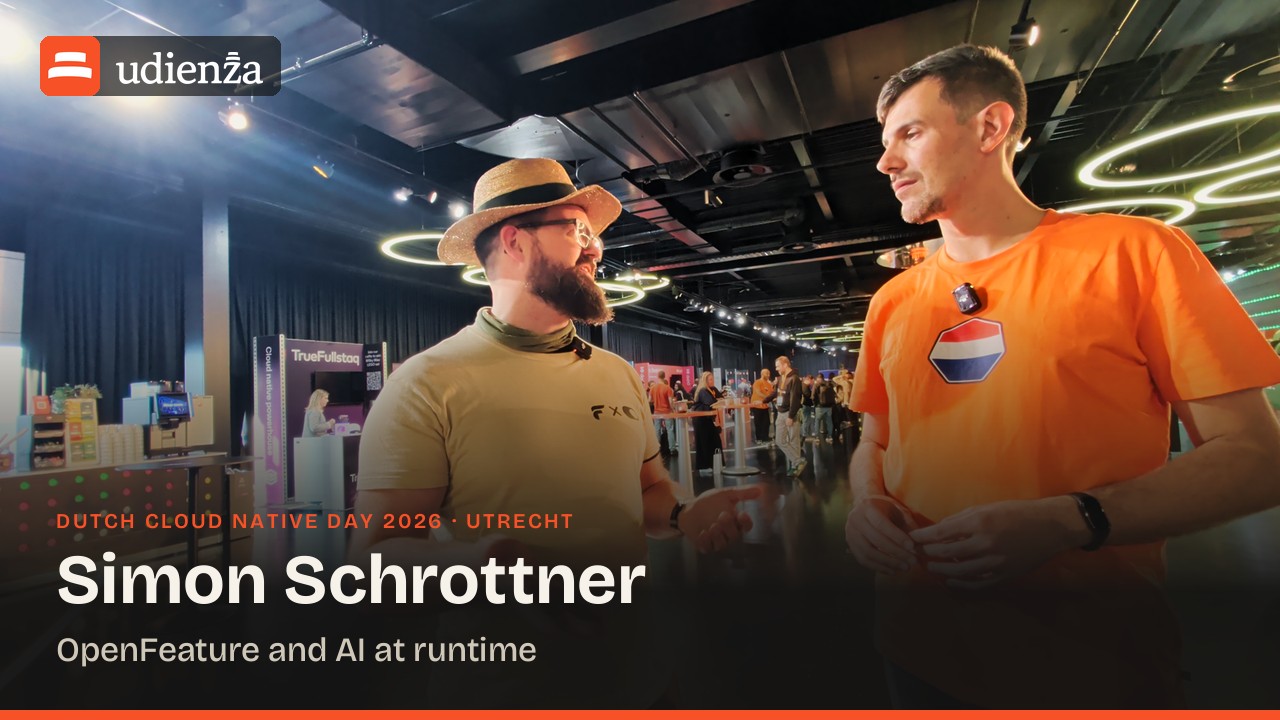
Recorded, coming soon.
Simon Schrottner is a Fractional Developer Advocate at Flagsmith, an OpenFeature maintainer and a CNCF Ambassador.
Follow the show and the episode arrives the morning it's published.
In brief
- OpenFeature is a specification and standard for feature flagging: changing services at runtime without a code deployment.
- With the rise of AI, flags define the boundaries within which AI can change a system at runtime.
- Its SDKs let you put any vendor behind them, wherever the flag information comes from.
- Flags are not just on and off: with context, a system can behave differently by country or by hyperscaler.
- A bug in production can be switched off and fixed on Monday, not on a Friday evening.
- OpenFeature supports seven languages, among them PHP, Java, Rust, Go, JavaScript and .NET.
- Its core SDK was at about 6 million downloads a week the last time he checked.
Chapters
- 0:00 OpenFeature, a standard for flags
- 0:23 Boundaries for AI at runtime
- 1:18 Targeting, not just on and off
- 1:36 A bug fix on Monday, not Friday
- 2:13 Seven languages, 6 million a week
- 2:46 Getting started: openfeature.dev
Why this conversation
When AI starts changing systems while they run, someone has to set the limits. Simon Schrottner is a Fractional Developer Advocate at Flagsmith and an OpenFeature maintainer. That morning he had spoken at Dutch Cloud Native Day on runtime agent control with OpenTelemetry and OpenFeature. The host recorded with him on 30 October 2026, at the Jaarbeurs in Utrecht.
A standard for feature flags
OpenFeature, he said, is “a really cool specification and standard for feature flagging”. Feature flagging means changing your services during runtime “without a code deployment”, and it gets a lot of attention with the rise of AI: it lets us “define actual boundaries” where AI can change a system during runtime “without a code manipulation.”
Any vendor, any context
OpenFeature provides core SDKs, and behind them you can put any vendor the feature flag information comes from. Many people think of it as on and off, “but it’s way more”, and “it’s really hard to describe in a short sentence what you can do with it.” In the end, “it depends on your use case.” The big benefit, for him: “with feature flags you can define also targeted behavior.” “You can provide context to the feature flag evaluation, so it’s not just on/off but you can say a user from this country or maybe on this hyperscaler something is behaving differently.”
A bug fix on Monday
Without flags, a bug brings “this stressful moment of the software delivery lifecycle where you need to do a bug fix running through all the stages, all the systems.” With feature flags you can step back: deactivate the feature, plan the fix in your normal lifecycle and “do it normally on Monday rather than on a Friday evening when the error appears.” “Wow, that’s magic!”, said the host.
Seven languages, millions of downloads
“OpenFeature supports a lot of languages, so PHP, Java, Rust, Golang, JavaScript, .NET”: seven are officially supported, and somebody even wrote another SDK that is not. Adoption is heavily increasing. For the core SDK, the downloads were “at, I think, 6 million the last time I checked per week”. “So it’s like heavily increasing”.
Getting started
“The best thing is you go to openfeature.dev. There are a lot of tutorials there that you also see the ecosystem and the overview and it gives you a great idea of what you can do, how you can do it. That’s the best starting point in general.”
When it comes out
The episode is edited and in the release order. Like every episode it goes out on YouTube first, then on Apple Podcasts, Spotify and Amazon Music.
Mentioned in this episode
About Simon Schrottner
Simon Schrottner is a Fractional Developer Advocate at Flagsmith, an OpenFeature maintainer and a CNCF Ambassador.
Running this in production? Luca Berton helps platform teams take it from prototype to reliable production. See how he works
Built something the rest of us run on? Being a guest is free. Take the other chair
More episodes
All episodes →-
Episode 103 · Coming
Frank Stavenuiter: T Cloud, a European hyperscaler
-
Episode 105 · Coming
Dario Tranchitella: Capsule and Kamaji at Clastix
-
Episode 106 · Coming
Katharina Sick: Backstage, properly configured
-
Episode 05 · 1 Oct
Chris Aniszczyk: After Kubernetes, what's next