Coming soon 4:11 Recorded at Dutch Cloud Native Day 2026, Utrecht
When should data stay with a European hyperscaler?
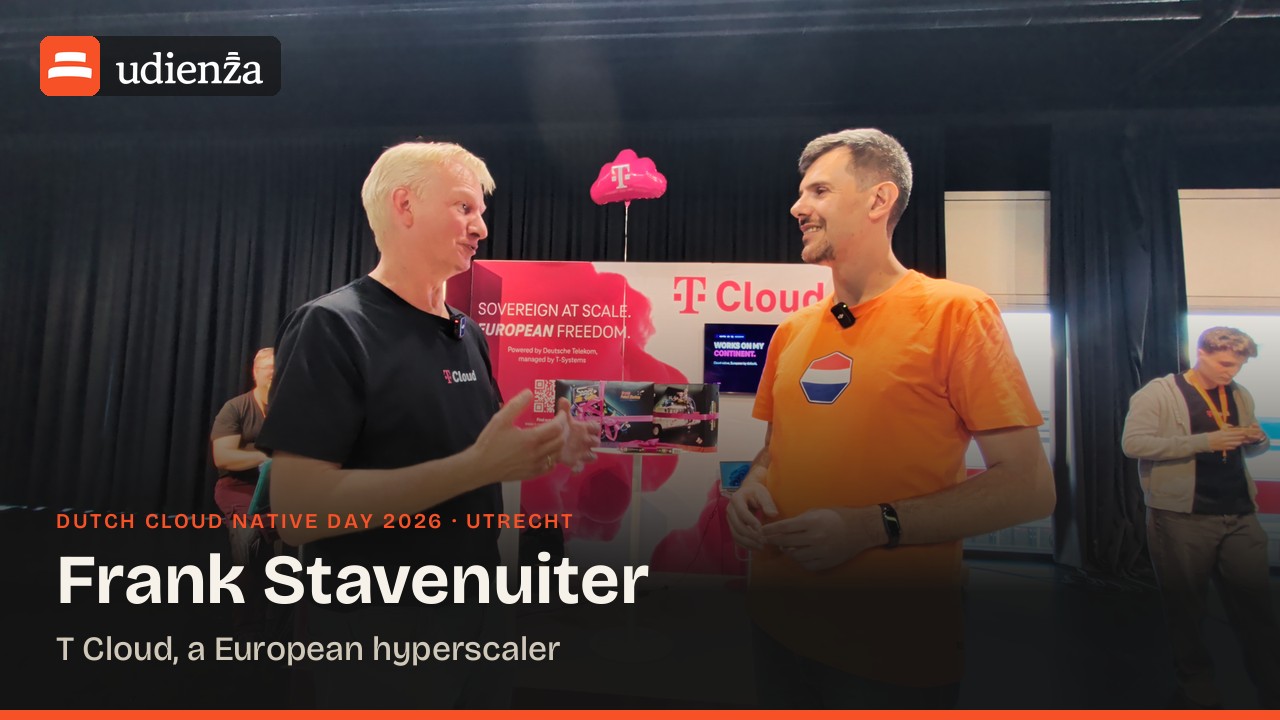
Frank Stavenuiter: T Cloud, a European hyperscaler
Frank Stavenuiter of T-Systems on T Cloud, a European hyperscaler: ten years old, three zones in the Netherlands, an AI factory with 10,000 GPUs.
Frank Stavenuiter, Chief Sovereignty Officer,  T-Systems · with
 Luca Berton
Recorded, coming soon.
Frank Stavenuiter is Chief Sovereignty Officer at T-Systems.
Follow the show and the episode arrives the morning it's published.
In brief
- T Cloud is a European hyperscaler for the data and workloads that should reside in Europe, and it has run for 10 years.
- It has several thousand end customers; in the Netherlands, more and more ministries, municipalities and healthcare.
- The point is not to leave the US hyperscalers, but to be an alternative for the data that should stay in Europe.
- In the Netherlands it has three availability zones over two data centers, interlinked with two in Germany.
- A fire in a data center in Almere moved customers' workloads to the other data centers: a real disaster recovery.
- Geopolitics, and how governments spend taxpayer money, are driving organisations to European clouds.
- T-Systems built an AI factory in Munich with 10,000 NVIDIA GPUs, a 1 billion investment, and is expanding it.
- T Cloud is OpenStack and looks like AWS; T-Systems sets up a tenant with vouchers to learn on.
Chapters
- 0:00 T Cloud, the European hyperscaler
- 0:52 Three zones over two data centers
- 1:06 A data center fire, a real test
- 1:45 Data, geopolitics and public money
- 2:41 An AI factory with 10,000 GPUs
- 3:07 Getting started with T Cloud
Why this conversation
Which data should stay in Europe, and where can it go? Frank Stavenuiter is Chief Sovereignty Officer at T-Systems. The host recorded with him on 30 October 2026 at the T Cloud booth at Dutch Cloud Native Day, at the Jaarbeurs in Utrecht.
The real European hyperscaler
“T Cloud is the real European hyperscaler, an alternative for specific workloads on data or workloads which should reside in Europe.” “We already have this for 10 years, so it’s nothing new, it’s not something about hyping stuff”. “It’s reliable, we have several thousand end customers already, also in the Netherlands we have more and more ministries, municipalities, healthcare, where data should reside in Europe.” The message is not to move everything out of the US hyperscalers: “they’re really well known, a lot of experience, but for sure some data should reside in Europe, so that’s what we offer, we want to become an alternative.”
Three zones, and a fire
“We have in the Netherlands three availability zones over two data centers, we have two data centers in Germany as well, so they are interlinked as well.” Workloads can move from one Dutch data center to the other, or to Germany. That was put to the test: “there was a fire in one of the data centers in Almere, and we have that location as well”, and customers saw their workloads move to the other data centers. A real disaster recovery, the host said. “You can prepare”, Frank answered, but “you cannot really test it, and then we found out that it works actually.” “And we were not surprised, but we were very relieved as well, as you can imagine.”
Geopolitics and taxpayer money
The use cases are about data, and more and more organisations are starting. “So they have to look for alternatives, because geopolitics have changed in the last two years”. Many had put everything in one hyperscaler. Then there is how governments spend money: “it’s European money, it’s taxpayer money, let’s spend it in Europe”, which is becoming a key driver for European hyperscalers.
An AI factory in Munich
For AI, T Cloud has GPUs, and T-Systems has built an AI factory in Munich: “you can model it in T Cloud and then run it in the AI factory. It’s 10,000 GPUs from NVIDIA.” “10,000, it was a 1 billion investment.” It is in high demand and will grow, “because we are reaching also the capacity.” Mistral, ChatGPT or whatever you want can run there.
Getting started
Reach out to T-Systems, through the website or a QR code. “And then we create a tenant with some vouchers so you can learn it on the job.” “You don’t have to believe me, but I really recommend just do some testing.” “You’ll see it’s OpenStack. It looks like AWS. So, if you have AWS experience, it’s quite easy to start.” The website he gave is tsystems.nl.
When it comes out
The episode is edited and in the release order. Like every episode it goes out on YouTube first, then on Apple Podcasts, Spotify and Amazon Music.
Mentioned in this episode
About Frank Stavenuiter
Frank Stavenuiter is Chief Sovereignty Officer at T-Systems.
Running this in production? Luca Berton helps platform teams take it from prototype to reliable production. See how he works
Built something the rest of us run on? Being a guest is free. Take the other chair
More episodes
All episodes →-
Episode 102 · Coming
Benoit Schipper: OpenCommit, a forge in Europe
-
Episode 104 · Coming
Simon Schrottner: OpenFeature and AI at runtime
-
Episode 99 · Coming
Paola Pimazzoni: Kubermatic, from the defense side
-
Episode 92 · Coming
Stephen Watt: The right model for the right job