Coming soon 4:27 Recorded at Dutch Cloud Native Day 2026, Utrecht
Why does AI infrastructure come down to the network?
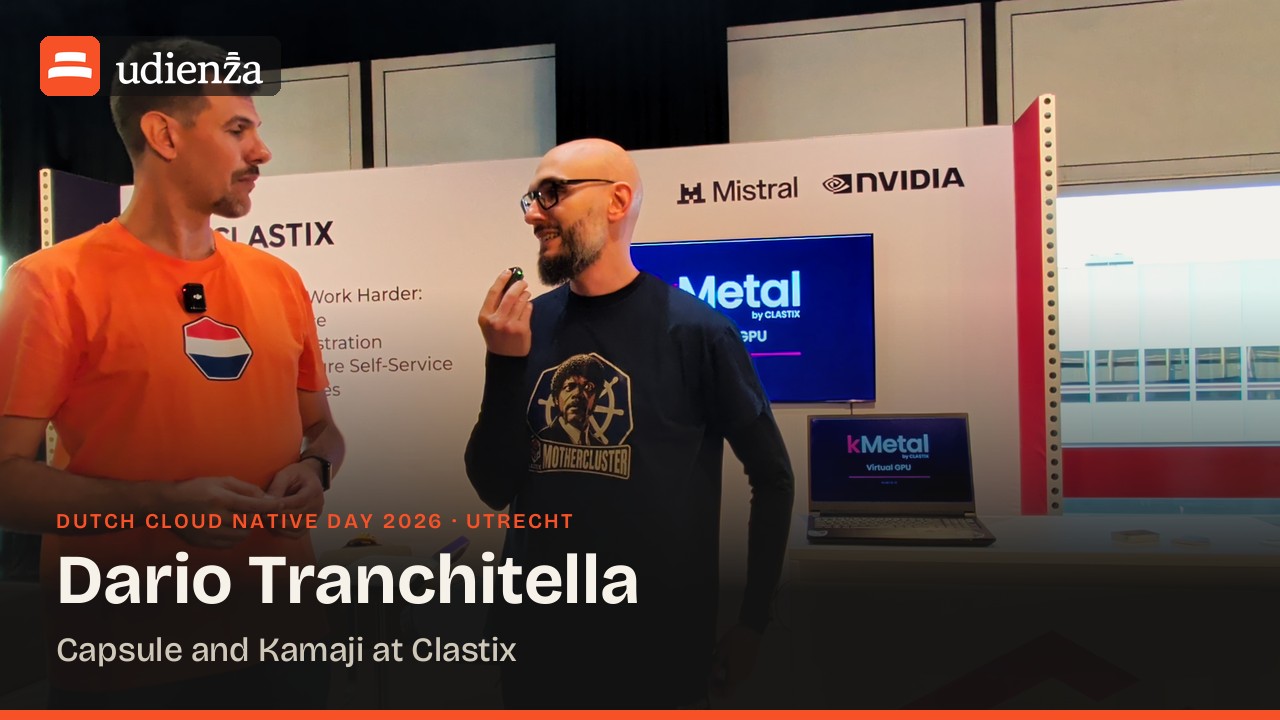
Dario Tranchitella: Capsule and Kamaji at Clastix
Dario Tranchitella, CTO of Clastix, on Capsule and Kamaji: multi-tenant Kubernetes, control planes in pods, Mistral's GPUs, and why AI is all about network.
Dario Tranchitella, CTO,  Clastix · with
 Luca Berton
Recorded, coming soon.
Dario Tranchitella is co-founder and CTO of Clastix, and the creator of Capsule and Kamaji.
Follow the show and the episode arrives the morning it's published.
In brief
- He co-founded Clastix in 2020, during the pandemic, out of the stress of managing many Kubernetes clusters.
- Capsule shares one Kubernetes cluster across tenants by grouping namespaces; it was donated to the CNCF.
- Kamaji runs Kubernetes control planes in pods of a management cluster instead of on virtual machines: cheaper, more secure, quicker.
- Mistral runs Kamaji in production, the backbone for training its models, to fit more into its data center.
- NVIDIA uses Clastix's technology in its DOCA Platform Framework, which orchestrates DPUs.
- For AI, he says, everything is about the network: models move across many GPUs.
- Clastix has its headquarters and an R&D department in Naples, researching DPUs with NVIDIA.
Chapters
- 0:00 Clastix, born from cluster stress
- 0:23 Capsule: multi-tenancy, now in CNCF
- 1:03 Kamaji: control planes in pods
- 1:25 Mistral GPUs, denser data centers
- 2:07 NVIDIA, DPUs and the network
- 3:17 Naples: research, and pizza
- 3:54 Getting started: clastix.io
Why this conversation
Every GPU in an AI data center needs a Kubernetes cluster around it, and someone has to run them all. Dario Tranchitella is co-founder and CTO of Clastix and the creator of Capsule and Kamaji. The host recorded with him on 30 October 2026 at the Clastix booth at Dutch Cloud Native Day, at the Jaarbeurs in Utrecht, the day after his two workshops there.
Born from cluster stress
“Okay, so I’m the co-founder of Clastix. I co-founded the company back in 2020, during the pandemic.” It started with open source, “and it was born from my experience in managing multiple Kubernetes clusters.” “I was very stressed, besides the pandemic, also for the Kubernetes clusters”. The first project was Capsule, which groups namespaces together, “so implementing the multi-tenancy to share a single Kubernetes cluster across multiple tenants, and it worked very well because we donated to CNCF.” “We have a diverse contribution basis, and also external maintainers, so we’re very proud of that”.
Kamaji: control planes in pods
One shared cluster has its limits: “but it wasn’t enough, because when you’re sharing just a single cluster, it could be problematic.” So came a second project, Kamaji, named after the boiler man of the film Spirited Away, built on an architecture named Hosted Control Plane. “So, instead of running Control Plane on virtual machines, we are running within pods from a management cluster. So, you got Control Plane, cheap, more secure, quicker, and essentially with automation.”
Mistral’s GPUs
With AI there are two use cases. “We have Mistral, which is using Kamaji in production for the Mistral compute. So, essentially, it’s the backbone for training the models.” Mistral has plenty of bare metal nodes with a lot of GPUs, and every blade in a data center pays rent: “you have to pay for the rent, and you want to maximize the utilization.” Instead of bare metal servers just for control planes, Mistral runs them in Kamaji, “and they’re able to increase the density in the data center.”
All about the network
The second use case is NVIDIA, which uses Clastix’s technology in DPF, the DOCA Platform Framework, to orchestrate DPUs. “Everybody’s talking about GPUs, but the real evolution and the most, I will say, most interesting stuff about AI, it’s about DPU, because everything is all about network.” Models have to move across many GPUs, “and network must be very, very performant.” For him DPUs are “a hidden gem that nobody’s talking about, but we should speak more and talk more about DPUs.” RoCE or InfiniBand, the host asked? “I can’t disclose so many details.”
Naples, research and pizza
“Our headquarters are based in Naples. We have an R&D department there.” With a university in Naples and with NVIDIA, Clastix researches DPUs, and a recent post on its blog argues that “if you are owning the network, you are truly taming the infrastructure.” The host promised a visit, and Dario a pizza: “Even though I would say I’m sorry for the Neapolitan guys, my pizza is way better compared to the Neapolitan guys.”
Getting started
The website is “clastix.io, and you can learn more about our open source commitment, our kMetal offering”, and the technical posts on its blog.
When it comes out
The episode is edited and in the release order. Like every episode it goes out on YouTube first, then on Apple Podcasts, Spotify and Amazon Music.
Mentioned in this episode
About Dario Tranchitella
Dario Tranchitella is co-founder and CTO of Clastix, and the creator of Capsule and Kamaji.
Running this in production? Luca Berton helps platform teams take it from prototype to reliable production. See how he works
Built something the rest of us run on? Being a guest is free. Take the other chair
More episodes
All episodes →-
Episode 104 · Coming
Simon Schrottner: OpenFeature and AI at runtime
-
Episode 106 · Coming
Katharina Sick: Backstage, properly configured
-
Episode 05 · 1 Oct
Chris Aniszczyk: After Kubernetes, what's next
-
Episode 115 · Coming
Marcel Timmer: The question behind the question