Coming soon 11:43 Recorded at Red Hat Summit: Connect, Nieuwegein
If AI writes the code, what is left that is hard?
Ruud Zwakenberg: Code is the easy part
Ruud Zwakenberg of Red Hat on why code is the easy part: requirements, security built in, and software generated on demand.
Ruud Zwakenberg, Associate Principal Ecosystem Solution Architect, Red Hat · with  Luca Berton
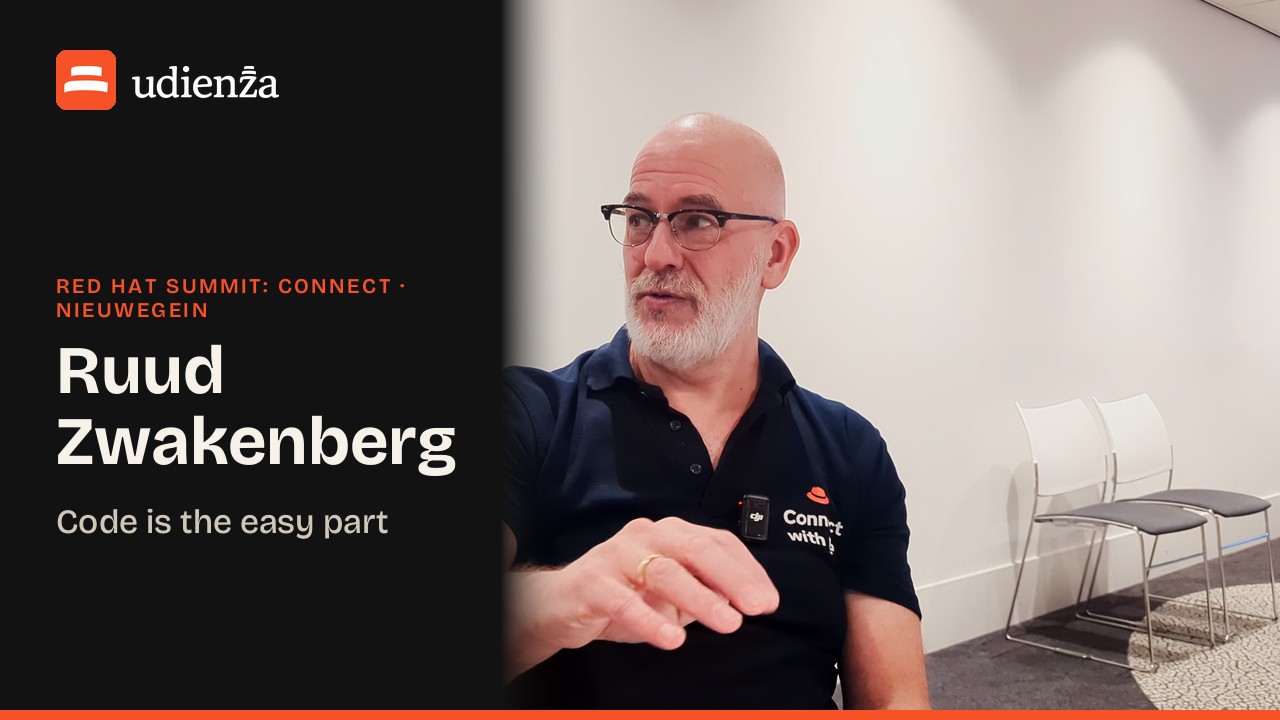
Recorded, coming soon.
Ruud Zwakenberg is Associate Principal Ecosystem Solution Architect at Red Hat. They have been with Red Hat for 10 years and in IT for 30, starting as a programmer.
Follow the show and the episode arrives the morning it's published.
In brief
- Ruud Zwakenberg has been in IT for 30 years and with Red Hat for 10, and started as a programmer doing very manual work.
- Around 25 years ago they learned model-driven development: you model the data, UIs and business logic, and the environment generates the code.
- In their view creating code is the easiest part of developing applications; the hard part is requirements, especially the non-functional ones.
- AI is very good at prototyping, but a production-ready application must be automatically upgradable, patchable with security, and fit on any environment.
- The goal they describe is code generated in real time and tested for function, stress, bugs and vulnerabilities, with the patching done up front, within the constraints of the company.
- Constraints such as security and non-functional requirements change little, while logic and data are fluid and need protecting.
- Red Hat has long focused on security built into the platform, with zero trust and detection of intrusions, including from AI agents going rogue.
- You can start small: the modules are separate, small setups are supported, and OpenShift will run even on a laptop.
Chapters
- 0:00 Thirty years of code
- 1:13 From models to AI
- 2:21 Code is the easy part
- 3:56 Agents for every stage
- 4:41 Code generated on demand
- 6:16 Logic is fluid, like data
- 7:03 Security, built in
- 8:40 Start small
- 9:47 Any model, any cloud
Why this conversation
The host met Ruud Zwakenberg, Associate Principal Ecosystem Solution Architect at Red Hat, at Red Hat Summit: Connect 2026 in Nieuwegein, next to Utrecht. Ruud has been with Red Hat for 10 years and in IT for 30, starting as a programmer. This conversation, about twelve minutes, is about what changes when AI writes the code: if code is “the easy part”, what is left that is hard, and what should a platform do about it?
Thirty years of code
Ruud started as a programmer, when the work was very manual: “we did everything by hand”. Projects took ages. At university they studied the assembly of a processor and learned C, which they still love because it generates very compact binaries. They remember the favorite errors too, like index out of bounds. “So basically it’s craftsmanship”, and you get better the more you do it.
A couple of years later came model-driven development, about 25 years ago. You were no longer programming by hand: you modeled what you wanted, with the data, the UIs and the business logic, and the environment generated the code. Today they are asking AI to help build applications, at home, as a hobby: they still program, but no longer professionally.
Code is the easy part
Large language models are very capable of producing code. You explain a little of what you want and they generate it, and you can run it more or less everywhere. That, Ruud says, is the easy part. What they learned is that “creating code is actually the easiest part of developing applications”.
The difficult part is requirements: collecting them, deciding how the application should look and what it should do, and all the constraints about the data, especially the non-functional requirements. AI is very good at prototyping, they say: you talk a bit in natural language and it generates something. But a real production-ready application is a different ballgame. It has to be automatically upgradable, patchable with security, since a lot of open source is used, and fit on any environment, not only your own.
Agents for every stage
Red Hat, like a lot of companies, wants to facilitate this modern way of working: model-driven, with AI-powered generation of code. Beyond the code there is how to synthesize and collect the information you need to design the application and create the model, and how to make it efficient. Every one of those use cases within software development can use AI, and so can working together.
Ruud also mentions agents for every stage, which is still very relevant, and designing a scalable environment, because you start small and want to grow. They note the big discussion on swarm agents, coordination, agents and sub-agents, and the communication protocols between them.
Code generated on demand
Then the question: what if the code is generated in real time, on demand? The most important part is the requirement study, the non-functional requirements, the model of your business. These do not change a lot. Imagine an environment that is very safe, very secure and well designed, that generates code in real time and tests it: not only functional testing but stress, bug and vulnerability testing, with the patching done up front, before it can be hacked. Ruud calls this the ultimate goal, a software factory but in real time, and it still has to fit within the constraints of your company.
So you would only define your constraints, security and the non-functional requirements. The logic can be fluid and change at any time, and data is fluid too, so you need to protect it. If the data is immutable, no one can delete it, not even a rogue AI. Ruud’s summary: “we are currently in a paradigm shift within IT, where we treat logic the same way as data”.
Security, built in
Which tool protects this logic? In open source, Ruud says, there are already many tools that guardrail your applications in your platform. Red Hat has long focused on security built into the platform, and that is why many companies take a subscription: the software is developed in open source communities, and Red Hat makes it enterprise secure. The idea is “zero trust, you should trust nobody, even not in your own company”. The second thing is to detect an intrusion, from outside, like a hacker, but also, with AI agents running, from inside, “your code is going rogue”, and to mitigate it automatically when it violates your constraints. Red Hat has the security scanners and the vulnerability scanners for that.
It sounds like magic from the outside, Ruud says, but for Red Hat it is what they have been doing for many years.
Start small
How do you get started? The environment consists of separate modules, so you can start small, and Red Hat supports small setups too. “Don’t install for millions of hardware just from day one”, they say, because the whole idea of open source software is that it scales. OpenShift, the flagship, will even run on your laptop, though like running AI on a laptop, do not expect a lot of it: for serious work you need proper compute.
Version 5 of OpenShift was released that week. Ruud had not spent much time on it yet and still has to learn the new features, but is looking forward to it: “It’s game-changing.”
Any model, any cloud
Open source, Ruud says, has been upfront in recent years in providing the tools to work with AI: to develop safe AI applications and agents, and to run large or small language models in a secure, efficient way, getting the maximum out of expensive GPUs. The host recalled the claim of the day, any agent, any model, any cloud. Red Hat does not favor any specific model or hardware: “we favor the any”, as long as the hardware meets the standards.
To get in contact, start with your local Red Hat organization. Ruud is also on LinkedIn, under their own name, and there are not a lot of people with it, so they are easy to find.
When it comes out
The episode is edited and in the release order. Like every episode it goes out on YouTube first, then on Apple Podcasts, Spotify and Amazon Music.
Mentioned in this episode
About Ruud Zwakenberg
Ruud Zwakenberg is Associate Principal Ecosystem Solution Architect at Red Hat. They have been with Red Hat for 10 years and in IT for 30, starting as a programmer.
Read more on Udienza
Running this in production? Luca Berton helps platform teams take it from prototype to reliable production. See how he works
Built something the rest of us run on? Being a guest is free. Take the other chair
More episodes
All episodes →-
Episode 117 · Coming
Jeffrey Kusters: Bring AI to where your data lives
-
Episode 115 · Coming
Marcel Timmer: The question behind the question
-
Episode 116 · Coming
Boudewijn Haas: Agents attack, agents defend
-
Episode 105 · Coming
Dario Tranchitella: Capsule and Kamaji at Clastix