Coming soon 7:54 Recorded at Red Hat Summit: Connect, Nieuwegein
Why bring AI to where your data lives?
Jeffrey Kusters: Bring AI to where your data lives
Jeffrey Kusters of ITQ on private AI for a hospital and a telecom on Aruba, business cases first, the organizational reset and a virtual race engineer.
Jeffrey Kusters, CTO, ITQ · with  Luca Berton
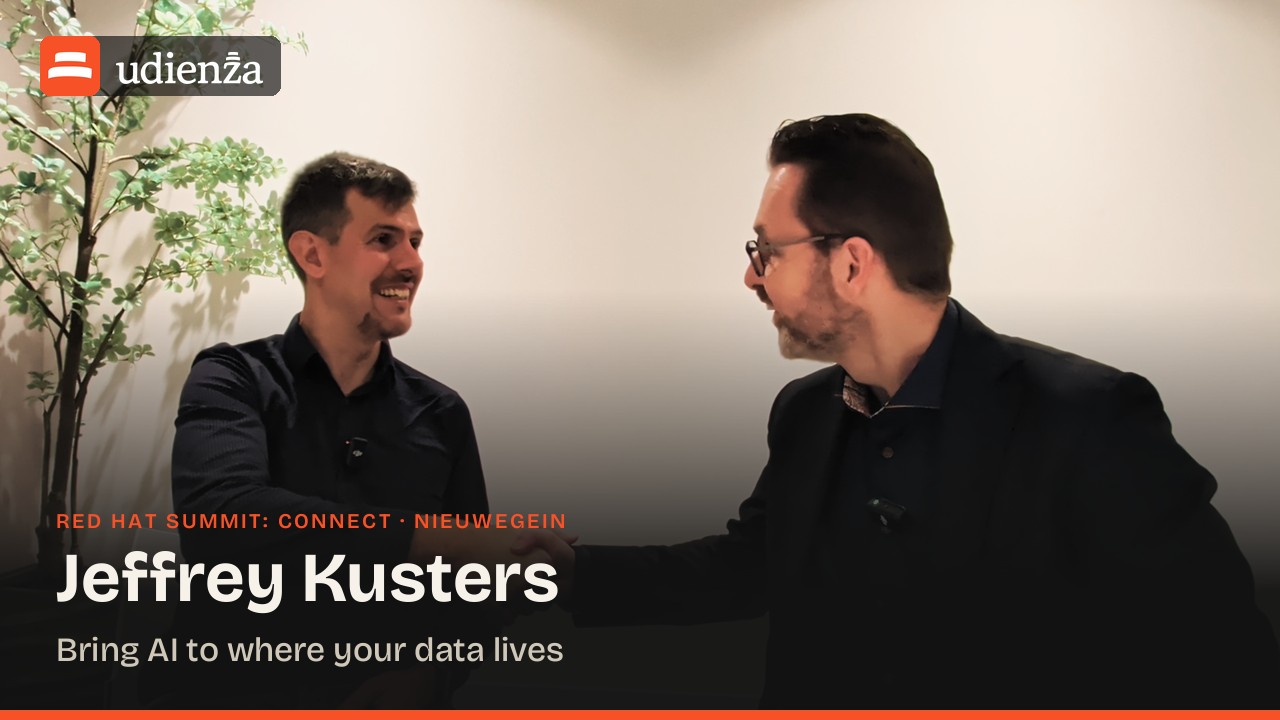
Recorded, coming soon.
Jeffrey Kusters is CTO of ITQ. They presented three customer cases in the keynote of Red Hat Summit: Connect 2026 in Nieuwegein.
Follow the show and the episode arrives the morning it's published.
In brief
- A hospital chose a private AI platform for research in oncology and cardiology, because medical data, patient information and scans should not go to a public cloud service, for regulation and privacy reasons.
- Imagery and scans grow into terabytes; moving them continuously to a public cloud AI service is slow and expensive, so it is healthier to bring the AI and the models to where the data lives.
- A telecom provider on Aruba asked ITQ to build a private AI platform, because they see AI as something that will disrupt their business development.
- ITQ's use case factory tries to find compelling use cases in the business and get them into production as quickly as possible.
- You need a strong use case with a strong business owner and a sponsor; pushing AI into a company from a technology push is bound to fail.
- Speeding up one process just moves the bottleneck: in software development coding is no longer the bottleneck, it moves further down the pipeline.
- As Jeffrey describes the article, the answer is a radical reset: put AI at the center and model the organization around fleets of AI agents.
- ITQ built an AI powered virtual race engineer at a hackathon, running on a Dell GB10 as local edge AI.
Chapters
- 0:00 Three cases from the keynote
- 0:50 A private AI platform on Aruba
- 1:39 Business case first
- 2:36 Bring AI to the data
- 3:30 The organizational reset
- 6:02 A virtual race engineer
Why this conversation
The host met Jeffrey Kusters, CTO of ITQ, at Red Hat Summit: Connect 2026 in Nieuwegein, on 11 November 2026, the same morning Jeffrey was on stage in the keynote presenting customer cases of AI on OpenShift, from healthcare to car racing. It is a short conversation, about eight minutes, on why private AI platforms make sense, why a strong business case beats a technology push, and what an organization built around AI could look like.
Three cases from the keynote
In the keynote Jeffrey presented three customer cases. The first is a hospital, “supporting research in oncology and cardiology, and really doing good stuff to improve healthcare.” The second is a telecom provider on the island of Aruba, for which ITQ is building a private AI platform. The third is the racing story, which comes back at the end of the conversation.
A private AI platform on Aruba
The telecom provider is, Jeffrey thinks, the biggest one on the island. They came to ITQ with a request to build a private AI platform, because they realized AI is “an area that’s going to disrupt our business development”, so they need to be early on in the journey. A colleague, Maxim, ran a use case factory engagement there: that is where ITQ tries to find compelling use cases in the business and get them into production as quickly as possible, in a step by step approach.
Business case first
The host said that telecom providers sometimes struggle to find the added value and new services to offer on top. For Jeffrey that was one of the key takeaways, and the most challenging part: you need a really strong use case in your business, with a strong business owner and a sponsor behind it. “If you try to push AI into a company just from a technology push, then yeah, quite honestly, that’s bound to fail.”
Bring AI to where your data lives
Healthcare is a highly regulated area, with a lot of compliance and regulation to be aware of, and that is exactly why the hospital chose a private AI platform. Think of medical data, patient information, scans and images: data you do not want in a public cloud service because of regulation and privacy concerns. Jeffrey also highlighted in the keynote that these data sets, especially the imagery and the scans, “grow into terabytes of data”. Moving that around continuously to a public cloud AI service is slow and expensive. So having it on-prem and “bringing the AI and the models to where your data lives” is, in the end, a much healthier model for the hospital.
The organizational reset
Asked where we are heading, Jeffrey described an article read a couple of weeks earlier, titled “The Generative AI Organizational Reset”, which was shared on LinkedIn by the author of Team Topologies, as Jeffrey describes it. Today people typically look at one process, put AI in it and accelerate it. But there is always a bottleneck somewhere. In software development, coding is no longer the bottleneck, because in the past it was how fast people could type and write code; now “the bottleneck just moves further down the pipeline”. The host added that the software development lifecycle is a lot of operations, not only coding.
So the position of the article, as Jeffrey describes it, is a radical reset of the organization: start with AI at the center from the start, and model the organization around fleets of AI agents. That is where Jeffrey thinks the biggest benefit of AI will come from.
It is natural, Jeffrey said, that in this phase people experiment with AI and use it to speed up specific processes, like getting from a sales conversation to a proposal for a customer. The host summed it up as quick wins now and more AI embedded in the day-to-day later, and Jeffrey agreed: “That’s exactly it.” There are big public headlines of companies running “tens of thousands of AI agents” in their business, but only a small number of organizations are at that level. Still, Jeffrey thinks this will have a real big impact on society.
A Formula 2 car and a virtual race engineer
ITQ is a performance partner and sponsor of MP Motorsport, a Dutch racing team in Formula 2, 3, 4 and Formula 1 Academy. A Formula 2 car in full ITQ colors was standing outside at the event. The host was surprised by how narrow the cockpit is; Jeffrey joked that neither of them would fit in the seat.
As part of the 25 years anniversary of ITQ, the company ran a hackathon and built an AI powered virtual race engineer. It takes the sensor data out of the race cars and helps the race engineers support the drivers in “carving the milliseconds out of the lap times”. It all runs on a Dell GB10, so local edge AI on a very powerful but portable machine. A racing sim hooked up to the GB10 was at the event too, and the host promised to come and take a lap.
The conversation closed with the host wishing ITQ another 25 years of fun, and Jeffrey pointing people to the ITQ website to get in contact.
When it comes out
The episode is edited and in the release order. Like every episode it goes out on YouTube first, then on Apple Podcasts, Spotify and Amazon Music.
Mentioned in this episode
About Jeffrey Kusters
Jeffrey Kusters is CTO of ITQ. They presented three customer cases in the keynote of Red Hat Summit: Connect 2026 in Nieuwegein.
Read more on Udienza
Running this in production? Luca Berton helps platform teams take it from prototype to reliable production. See how he works
Built something the rest of us run on? Being a guest is free. Take the other chair
More episodes
All episodes →-
Episode 116 · Coming
Boudewijn Haas: Agents attack, agents defend
-
Episode 118 · Coming
Ruud Zwakenberg: Code is the easy part
-
Episode 115 · Coming
Marcel Timmer: The question behind the question
-
Episode 108 · Coming
Mark Pawlikowski: SREday, LLMday and PLATFORMday