Coming soon 6:31 Recorded at Red Hat Summit: Connect, Nieuwegein
How is agentic AI changing software development?
Boudewijn Haas: Agents attack, agents defend
Boudewijn Haas of Levi9 on agentic workflows in the software lifecycle, modernizing legacy code, and agents on both sides of security.
Boudewijn Haas, Director Cloud and Partnerships, Levi9 · with  Luca Berton
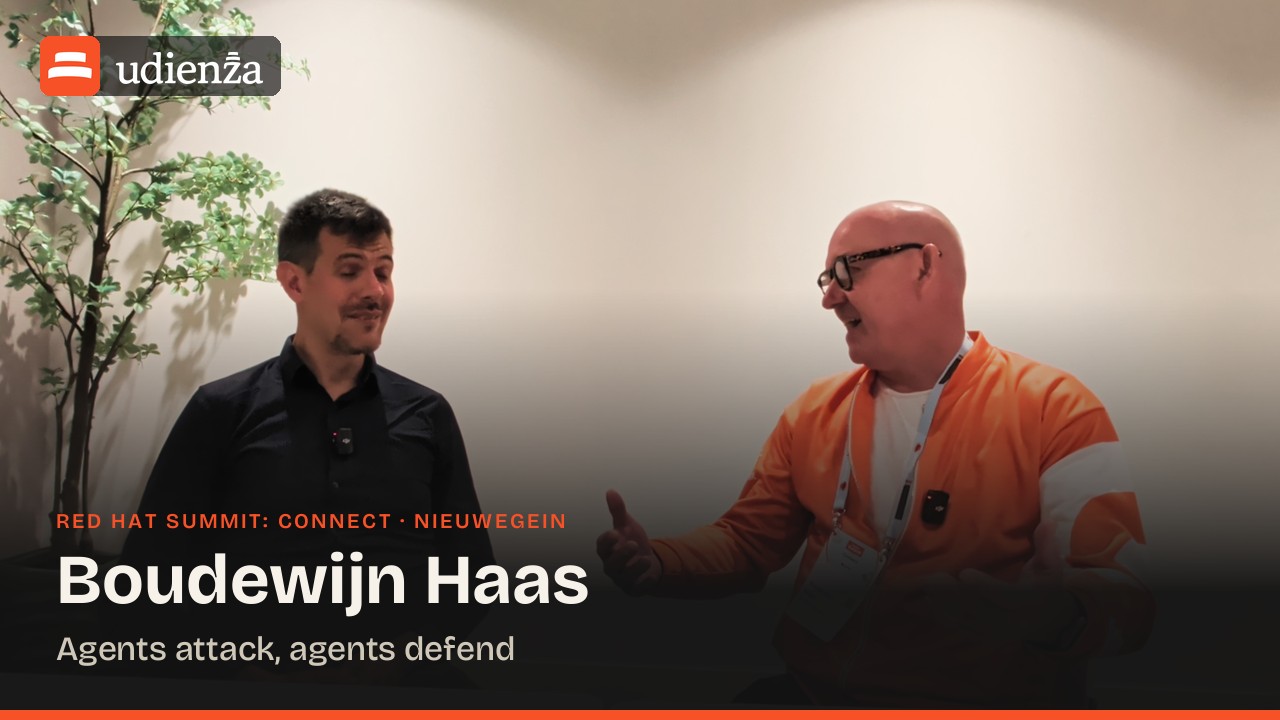
Recorded, coming soon.
Boudewijn Haas is Director Cloud and Partnerships at Levi9, an IT services provider with about 1000 colleagues in Serbia, Ukraine and Romania.
Follow the show and the episode arrives the morning it's published.
In brief
- Levi9 has existed for 20 years, works with about 1000 colleagues in Serbia, Ukraine and Romania, and serves around 70 customers in the Netherlands and Western Europe.
- Customers increasingly ask for sovereignty solutions, open source solutions and agentic AI software development.
- Levi9's yearly event focused on embedding AI in the software development lifecycle in a controlled and safe way.
- Agentic AI is also becoming part of customers' own products; Levi9 works for SaaS companies and ISVs and helps them accelerate product development.
- Software modernization is becoming feasible: AI can generate documentation and explain what an application does, so projects need not take years or carry large risk.
- Levi9's ideal customers are in fintech and financial services, advertising, media and retail, transportation and logistics, and energy, where software is the differentiator.
- Levi9 invites customers and prospects to inspiration visits at its delivery centers in Ukraine, Romania and Serbia.
- A customer whose policy was to patch within eight weeks now needs to respond the same day, and security becomes a race between agentic attackers and agentic defenders.
Chapters
- 0:00 Levi9 and 1,000 engineers
- 0:59 AI in the software lifecycle
- 1:33 Agents inside the product
- 2:08 Modernizing legacy software
- 3:16 Where software makes the difference
- 4:02 Visiting the delivery centers
- 5:11 Attackers and defenders
Why this conversation
The host met Boudewijn Haas, Director Cloud and Partnerships at Levi9, at Red Hat Summit: Connect 2026 in Nieuwegein, next to Utrecht. Levi9 is an IT services provider, and Boudewijn had just come from the event, where the host had seen the use cases. This is a short conversation, about six minutes, on how AI changes the way software is built, how it ends up inside customers’ products, and why the next security race will be fought by software on both sides.
Levi9 and 1,000 engineers
Boudewijn describes Levi9 as an IT services provider that has existed for 20 years. About 1000 colleagues from Eastern Europe work there, located in Serbia, Ukraine and Romania, for around 70 customers in the Netherlands and in Western Europe. They build custom software, but they also run platforms, a lot of it on AWS and on Azure.
What they see now is increasing demand for sovereignty solutions and open source solutions, and of course for agentic AI software development. That is where they help customers “create agentic workflows in their SDLC.”
AI in the software lifecycle
Levi9 holds a yearly flagship event, which this year was on the 3rd of November. There were speakers from ABNAMRO and other customers, and they were all talking about how you really embed AI in your software development lifecycle “in a controlled and safe way.” Boudewijn calls that one part of the AI revolution.
Agents inside the product
The other part is that agentic AI becomes part of the software solutions of the customers themselves. Levi9 works for a lot of SaaS companies and ISVs, among them a market leader in digital asset management solutions that has embedded agentic workflows in its product. Levi9 helps develop such solutions with its customers and accelerates them in their product development.
Modernizing legacy software
Asked about the roadmap, Boudewijn answers that what becomes really feasible now is software modernization. There is a lot of legacy out there: applications people do not understand anymore, projects whose people have left or retire. In the banks there are COBOL and mainframe applications that nobody can work on anymore.
Now, they say, is “the first time that actually you can do these modernizations within a reasonable effort and in a controlled way.” You can generate documentation with AI, understand what the application does, and build new applications, without projects that take years and years and carry a lot of risk.
Where software makes the difference
The ideal customers are in a number of industries: fintech and financial services, advertising, media and retail, but also transportation and logistics and energy. Boudewijn’s reasoning is that these are the industries where a lot of money and investment goes, and where software is the differentiator in being successful. It is also where most of these things are currently happening.
Visiting the delivery centers
To get in contact, people can go to the Levi9 website or reach out through LinkedIn. What the team likes to do is bring customers to one of its delivery centers in Ukraine, Romania and Serbia. For customers it is “always like a great eye opener” to see the spirit of the people there and the engineering power available in those countries. Levi9 invites customers and prospects to these inspiration visits and tries to wow them.
Attackers and defenders
On the future, Boudewijn expects the acceleration to simply continue. They point to the keynote of the day and its security threats and patches. They work for a customer whose policy was to patch software within eight weeks. Now you need to be able to respond on the same day.
So it will be a battle of agentic software being the attacker, but also agentic software being the defender: “a new race where a lot of intelligence will go to actually to keep us all secure.” Systems being hacked and personal data being exposed is almost daily news, and Boudewijn says winning this battle requires a lot of our common intelligence.
When it comes out
The episode is edited and in the release order. Like every episode it goes out on YouTube first, then on Apple Podcasts, Spotify and Amazon Music.
Mentioned in this episode
About Boudewijn Haas
Boudewijn Haas is Director Cloud and Partnerships at Levi9, an IT services provider with about 1000 colleagues in Serbia, Ukraine and Romania.
Read more on Udienza
Running this in production? Luca Berton helps platform teams take it from prototype to reliable production. See how he works
Built something the rest of us run on? Being a guest is free. Take the other chair
More episodes
All episodes →-
Episode 115 · Coming
Marcel Timmer: The question behind the question
-
Episode 117 · Coming
Jeffrey Kusters: Bring AI to where your data lives
-
Episode 118 · Coming
Ruud Zwakenberg: Code is the easy part
-
Episode 103 · Coming
Frank Stavenuiter: T Cloud, a European hyperscaler