Coming soon 4:47 Recorded at AGNTCon + MCPCon North America, San Jose
How do you let an agent act on your behalf, and no more?
Agents that actually work
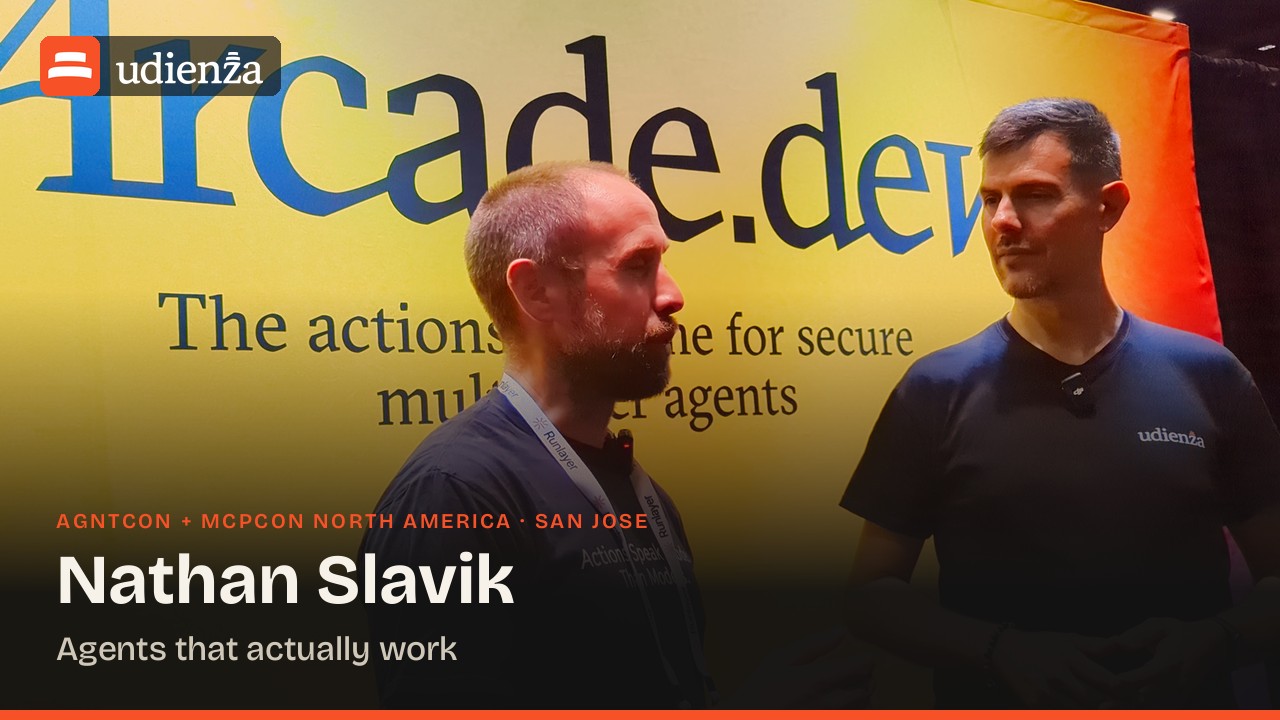
Arcade.dev's Nathan Slavik on three layers that make agents work: who an agent acts for, exactly what it may do, and an audit trail of everything it did.
Nathan Slavik, Editor, Arcade.dev · with  Luca Berton
Not filmed yet.
Nathan Slavik leads content at Arcade.dev, whose action runtime lets agents act on behalf of their users.
Follow the show and the episode arrives the morning it's published.
In brief
- Arcade.dev makes agents actually work, in three steps: authorization, enforcement and governance.
- Authorization asks whether an agent can act on behalf of its user, for example signing into Salesforce as them.
- Enforcement means the agent can do what its user can do, nothing more and nothing less.
- Governance is a complete audit trail of which agent did what, on whose behalf, and when; that layer is why large banks trust Arcade in their systems.
- Use starts with engineering and dev teams and spreads, with traction now in go-to-market teams and in HR, such as booking time off in Workday.
- Arcade sits as an action runtime between the user and a program such as Gmail, so an agent can do nothing without approval.
- It is model agnostic, whether you use Claude, Cursor or Grok, with no limit on the number of agents; at a thousand employees with ten agents each, policies have to be checked automatically.
- You can sign up for free at arcade.dev; enterprises can run it on premises or air-gapped.
Chapters
- 0:00 Agents that actually work
- 0:20 Authorization, enforcement, governance
- 1:15 From dev teams to HR and Workday
- 2:14 An action runtime between you and Gmail
- 3:03 Any model, any number of agents
- 3:56 Getting started, and on-prem
Why this conversation
An agent that works inside a company’s systems raises a question every team meets sooner or later: how do you know the agent is acting for the right person, and that it cannot do more than that person could? Nathan Slavik leads content at Arcade.dev. The host recorded with him at AGNTCon + MCPCon North America in San Jose on Thursday 22 October 2026, and Nathan answered with three steps, a story about booking time off, and the host’s own inbox as the example. The rest of that day is in AGNTCon + MCPCon North America 2026: day one.
Authorization, enforcement, governance
Asked what Arcade.dev does, Nathan said that it “makes agents actually work”, and he split that into three steps.
The first is authorization: is this agent really allowed to act on behalf of this user? His example was someone in a business who wants an agent to sign into Salesforce. The question then is how anyone can be sure the agent is signing in as that person.
The second is enforcement. Once inside Salesforce, the agent should be able to do exactly what its user can do, with no extra rights and none missing. If the user has not allowed it to delete a customer record, it should not be able to.
The third is governance, meaning a record of everything the agent does. With a full audit trail, anyone looking back can tell which agent acted, for which person, what it did and when. Nathan says it is the combination of those three layers that leads large banks to trust Arcade inside their systems.
From engineering teams to HR
The biggest use case, as at so many businesses in the industry, begins with engineering and dev teams. Once Arcade is in their systems, it spreads from there. Much of the traction Nathan sees today is with GTM teams, and the company learned quickly about a use that may sound simple: HR. Most employees would rather not log into Workday at all. They would rather tell their agent they will be off for a week and let it handle the scheduling. The same questions apply: the agent has to reach Workday securely and book the time on the employee’s behalf.
An action runtime in the middle
The host asked whether every employee gets a digital companion, or whether there is one general agent that everyone shares. Nathan’s answer was that Arcade takes the permissions and policies a company already has and translates them to its agents. To make it concrete, he asked the host which program he uses all the time; after Slack, they settled on Gmail. Arcade then sits between the host and Gmail as an action runtime. When the host tells his agent to send an email, Arcade first checks that this really is his agent, and the agent goes into Gmail. When the moment comes to send, the request passes back through Arcade, which checks that the agent may send it. Nothing happens, at any time, without the user’s approval.
Any model, any number of agents
What if a new model comes out that the host wants to try? Arcade is completely model agnostic, Nathan says: whether a team works with Claude, Cursor, Grok or something else, it can connect what it uses to Arcade.
Nor is there a limit on the number of agents. In his view, “the more that you use Arcade, the more benefit you see”. A small team with five employees and ten agents might decide it can keep an eye on them by hand. A business with a hundred or a thousand employees, each with ten agents connecting to 50 business systems, is another matter: “That’s when you need Arcade to be able to automatically check all of those policies”. Otherwise someone would have to sit and check by hand every time anyone wanted to use an agent, and that would take ages.
To try it in an organisation, go to arcade.dev and sign up for free, which gives access to the basic tools and to the best of the platform. Enterprises that want to run Arcade on premises or air-gapped, or that have other special needs, can reach out to the team to be set up. The host closed by proposing to build the AI agent of tomorrow; Nathan suggested doing it today.
When it comes out
The episode is edited and in the release order. Like every episode it goes out on YouTube first, then on Apple Podcasts, Spotify and Amazon Music.
Mentioned in this episode
About Nathan Slavik
Nathan Slavik leads content at Arcade.dev, whose action runtime lets agents act on behalf of their users.
Running this in production? Luca Berton helps platform teams take it from prototype to reliable production. See how he works
Built something the rest of us run on? Being a guest is free. Take the other chair
More episodes
All episodes →-
Episode 65 · Coming
Rania Khalaf: AI governance at WSO2
-
Episode 67 · Coming
Yuval Hazaz: Overcut
-
Episode 58 · Coming
Tony: Secrets and identity for AI agents
-
Episode 74 · Coming
Mark Fussell: Durable execution for agents