Coming soon 8:30 Recorded at AGNTCon + MCPCon North America, San Jose
What happens to a long-running agent's work when the machine under it dies?
Durable execution for agents
Mark Fussell, Chief Product Officer and co-founder of Diagrid, on durable execution: agents that recover their state after a crash, with every step signed.
Mark Fussell, Chief Product Officer and Co-founder, Diagrid · with  Luca Berton
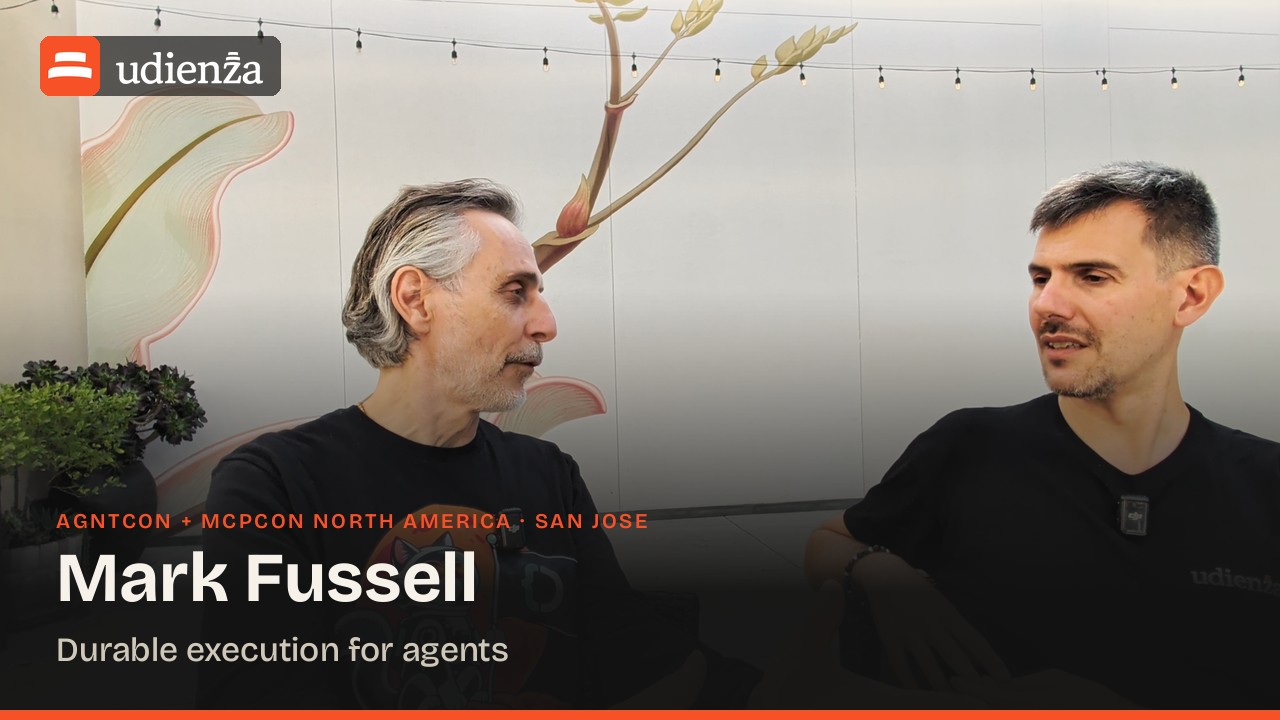
Not filmed yet.
Mark Fussell is Chief Product Officer and co-founder of Diagrid, which focuses on durable execution: long-running, stateful business processes and agents that survive failures in production and carry on where they left off.
Follow the show and the episode arrives the morning it's published.
In brief
- Durable execution recovers a long-running, stateful process after it or its machine dies, every state variable and everything it was executing, so the work carries on from where it left off.
- Retries handle an external system that is not there; the harder part is a process that has itself failed, which takes snapshots, checkpoints and detecting that the service is down.
- Agents built with LangGraph, Strands, Google ADK or Microsoft Agent Framework are long-running systems in a loop, which makes durability much more important in the agentic era.
- Recovered state means an agent does not send the same email or write to the database a second time, and does not waste token calls on work it has already done.
- Diagrid focuses on business agents rather than coding agents, such as a warehouse agent reading incoming emails, or an agent for Zeiss that turned prescription information into glasses sent out to people.
- Each agent has an identity that limits which agents and MCP servers it may talk to, and every step it takes is cryptographically signed, proof that logs and audits, which can be tampered with, cannot give.
- It runs completely disconnected, in a manufacturing plant or a company's own cloud, on a local Kubernetes cluster; to start, Diagrid Catalyst has a free account, and Diagrid University has free courses that run in the browser.
Chapters
- 0:00 What durable execution is
- 1:00 More than retries
- 1:44 Why long-running agents need it
- 3:10 No duplicate emails, no wasted tokens
- 4:06 Business agents: warehouses, Zeiss
- 4:47 Agent identity and signed steps
- 5:55 Finance and manufacturing, offline
- 6:29 Kubernetes at the edge
- 7:08 Diagrid Catalyst and Diagrid University
Why this conversation
An agent that works for a long time will, sooner or later, be running on a machine that dies. What happens to its half-finished work is the question Diagrid is built around. Mark Fussell is the company’s Chief Product Officer and co-founder, and the host recorded with him on 23 October 2026, the second day of AGNTCon + MCPCon North America in San Jose. He explains durable execution, why agents make it more urgent, how Diagrid proves what an agent did, and where it runs. The other conversations from that day are in the day-two article.
More than a few retries
Diagrid’s focus is what Mark calls durable execution. His starting point is a stateful business process that runs for a long time, such as an order form that sends out inventory and then moves through a series of steps, much like a state machine. If the process or the machine underneath it dies, durable execution recovers every state variable and everything that was executing, and the work continues where it stopped.
The host wondered whether retries alone would do. Mark separates two kinds of failure. In the first, an external system is not there, and the engine retries the call. The second is harder: a process that was running has itself failed. That needs snapshots and checkpoints of the running processes, and a way to detect that the service is down. External retries and process recovery are both required.
Why agents raise the stakes
This matters more now, he says, because the agents built today with LangGraph, Strands, Google ADK or Microsoft Agent Framework are long-running systems working in a loop. A RAG application that reads many documents is one example: if a single document cannot be read because of a network timeout, the work pauses and the business logic may retry it, but the whole machine can fail as well.
Recovery is also what stops an agent from repeating itself. If it has already written to a database or sent an email, restarting it from scratch would do those things a second time and leave a mess, and it would pay again for token calls it had already made. His way of putting the guarantee: run a thousand agents, attack and kill them with chaos testing, and every one of them recovers its state and carries on to completion.
Business agents, signed step by step
The host recalled leaving a task running in Claude Code and coming back to find it had stopped. Mark draws a line there. Coding agents have their own ways of coping with failure; Diagrid concentrates on business agents, the ones that run a company’s processes. One, built for a warehousing company, reads all of its incoming emails. Another was with Zeiss, the lens manufacturer, where an agent took the information from prescriptions, created the glasses and sent them out. “They need to be accurate as well.”
The other focus is security. Each agent gets an identity, which decides which agents it may talk to and which MCP servers it may use. The same identity lets Diagrid sign every step an agent takes. Logs and audits are still needed, and are very good for debugging, but they can be tampered with. When someone asks whether an agent really acted on their behalf and sent a given email, “we show that cryptographically that that’s actually what happened.”
Offline, at the edge, and how to start
A lot of Diagrid’s customers are in finance, where they build trading systems or plain business workflows; a lot of others are manufacturers. “One thing that we’re very proud of is that our solution will actually work completely disconnected offline.” It can run inside a manufacturing plant or in a company’s own cloud infrastructure. Asked about the edge, Mark says Diagrid is Kubernetes-first: a set of machines running a local Kubernetes cluster is enough. At the conference he had just spoken to a chip designer that wanted to optimise its manufacturing with language models and described exactly that situation.
The product is called Diagrid Catalyst. To try it, sign up for a free account at diagrid.io, where there are demos, scenarios and a guide to getting started. “We think it’s a fun name, you know, it catalyzes your company.” There is also Diagrid University, with courses hosted in a VM that run in the browser. His advice is to take the free courses, build a few applications, and check how well they survive failure.
When it comes out
The episode is edited and in the release order. Like every episode it goes out on YouTube first, then on Apple Podcasts, Spotify and Amazon Music.
Mentioned in this episode
About Mark Fussell
Mark Fussell is Chief Product Officer and co-founder of Diagrid, which focuses on durable execution: long-running, stateful business processes and agents that survive failures in production and carry on where they left off.
Running this in production? Luca Berton helps platform teams take it from prototype to reliable production. See how he works
Built something the rest of us run on? Being a guest is free. Take the other chair
More episodes
All episodes →-
Episode 72 · Coming
Hari Krishna Sunder: A context layer for every agent
-
Episode 75 · Coming
Spencer Reagan: Securing agents inside the enterprise
-
Episode 66 · Coming
Nathan Slavik: Agents that actually work
-
Episode 65 · Coming
Rania Khalaf: AI governance at WSO2