Coming soon 5:16 Recorded at AGNTCon + MCPCon North America, San Jose
What does it take to run agents across the software lifecycle?
Overcut
Yuval Hazaz, co-founder and CEO of Overcut, on a software factory of autonomous agents across the development lifecycle, and a dark factory to come gradually.
Yuval Hazaz, Co-founder & CEO, Overcut · with  Luca Berton
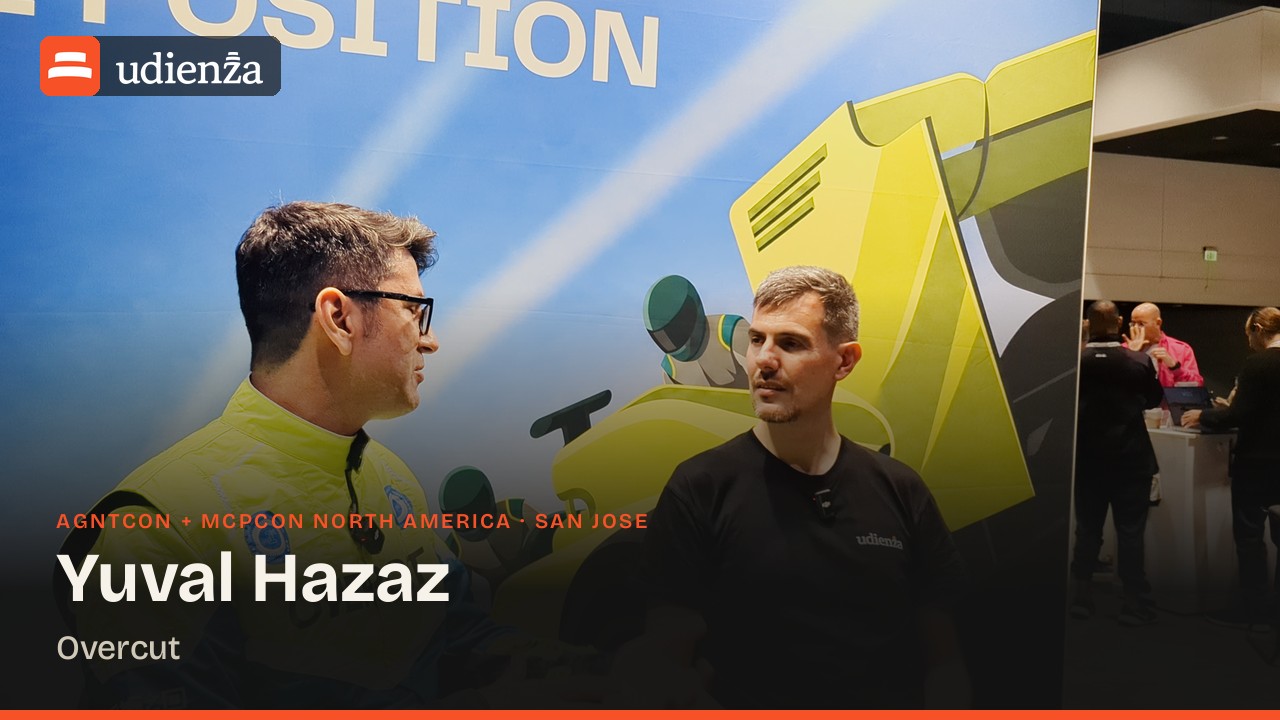
Not filmed yet.
Yuval Hazaz is co-founder and CEO of Overcut, a software factory for running autonomous agents on top of the software development lifecycle.
Follow the show and the episode arrives the morning it's published.
In brief
- An overcut is a Formula One pit-stop strategy; the name came through his daughter, a Formula One fan.
- A software factory runs autonomous agents on top of the software development lifecycle.
- As in Formula One, almost every team has the same engine, the model; the winners differ in orchestration, teamwork and strategy.
- Overcut manages the whole stack: agents, MCP servers and skills, deterministic and non-deterministic steps, sandboxed execution, monitoring and audit trails.
- Logs and monitoring feed back into the workflows and into memories: a self-improving loop.
- The biggest use case is spec to code, or ticket to PR; customers also run root cause analysis, code review, documentation updates and testing.
- Overcut is not tied to an industry; it also runs on premises, in private clouds and regulated environments, usually in the customer's own VPC.
- Yuval expects the dark factory, with no human inside, but gradually, and probably not in the next 12 to 18 months.
Chapters
- 0:00 Overcut, a Formula One strategy
- 0:42 A software factory for agents
- 1:18 The whole stack, MCPs to skills
- 2:18 Spec to code, and root causes
- 3:05 Getting started, on-prem too
- 4:11 The future: a dark factory
Why this conversation
Most teams building with AI now run on much the same models, so the difference lies in how the work around them is organised. Yuval Hazaz, co-founder and CEO of Overcut, made that case to the host at the Overcut booth at AGNTCon + MCPCon North America in San Jose on Thursday 22 October 2026. He explained what a software factory is, how Overcut feeds what its agents do back into how they work, and when he expects a factory with nobody inside. The rest of that day is in AGNTCon + MCPCon North America 2026: day one.
A pit-stop strategy
The host opened by thanking Yuval for having him in pole position, and Yuval welcomed him to the team’s pit stop. The setting comes from the name. In Formula One, an overcut is a strategy that determines where a car makes its pit stop. The choice came through Yuval’s daughter, a fan of the sport, and it fitted how the company thinks about winning and bringing the best result. So the software factory was called Overcut, and that is why the team wore uniforms at the conference.
Asked how a pit stop works with AI, Yuval first defined his terms. A software factory gives an organisation a way to run autonomous agents across its whole software development lifecycle. Then he went back to racing: almost every team has the same engine, and here the engine is the model. “But the good teams winning because of orchestration, because of teamwork, because of strategy.” That, he says, is what Overcut lets organisations build.
The whole stack, and a loop
The host pointed out how many moving parts a modern stack has, MCP and composability among them. Overcut, Yuval says, manages all of it. It starts with building the agent and connecting MCP servers and skills. It goes on to workflows that can combine deterministic and non-deterministic steps, so a team can mix and match for better results. Overcut sandboxes and executes those workflows, monitors them, and collects logs and audit trails.
What it collects then flows back: the monitoring and the logs are used to improve the workflows and to create memories, and the other way round, so the factory keeps improving itself. In Yuval’s words: “We do the triggering, we get the signals, we decide what to run, we run it, we monitor that, and we fix it and improve it for next time.”
What customers build
The biggest use case is probably spec to code, or ticket to PR: taking an item from the backlog almost to production, with perhaps a human merging it when the team is ready. A lot of customers use it as well for root cause analysis, for code review and checking those reviews, for keeping documentation current and for testing.
Overcut is agnostic about industries, and also about how each job is done. It does not impose its own opinions or flavour; it gives customers the infrastructure and the platform, and they talk with Overcut to build workflows that fit their needs. One customer’s code review, root cause analysis or pull request will therefore look different from another’s.
Getting started means signing up at overcut.ai. Bigger organisations are usually onboarded white-glove, with a pilot, and Overcut helps them build, connect and integrate their workflows. Overcut can also run on-prem or in a private cloud, and regulated environments usually run the entire stack and cluster in their own VPC. Once access is set up, a team connects GitHub and Jira and starts configuring workflows. The host likened that to leaving the pit lane to change a wheel, and Yuval praised his terminology.
Towards a dark factory
Where is this going? Nobody really knows, Yuval says, but people already talk about the dark factory. A software factory today still has a human in it, supervising. Turning the light off means nobody is in the factory and everything runs automatically: you give it an intent and get a product at the end. He believes it will happen at some point, though probably not within the next 12 to 18 months. Things are moving very fast, yet legacy enterprises and large regulated organisations are not ready, so it will arrive gradually, as AI and LLM models get more advanced and as organisations improve their infrastructure and AI readiness.
When it comes out
The episode is edited and in the release order. Like every episode it goes out on YouTube first, then on Apple Podcasts, Spotify and Amazon Music.
Mentioned in this episode
About Yuval Hazaz
Yuval Hazaz is co-founder and CEO of Overcut, a software factory for running autonomous agents on top of the software development lifecycle.
Running this in production? Luca Berton helps platform teams take it from prototype to reliable production. See how he works
Built something the rest of us run on? Being a guest is free. Take the other chair
More episodes
All episodes →-
Episode 66 · Coming
Nathan Slavik: Agents that actually work
-
Episode 68 · Coming
Sean Knight: Docs for agents, from the other founder
-
Episode 72 · Coming
Hari Krishna Sunder: A context layer for every agent
-
Episode 61 · Coming
Alec Reynolds: Docs written by agents