Coming soon 11:36 Recorded at Remote interview
What does zero known CVEs actually mean for a container image?
Harrison Ripps: Zero known CVEs at ship time
Harrison Ripps of Red Hat on hardened container images: zero known CVEs at ship time, a rebuild pipeline, and where your responsibility starts.
Harrison Ripps, Director of Engineering, Red Hat · with  Luca Berton
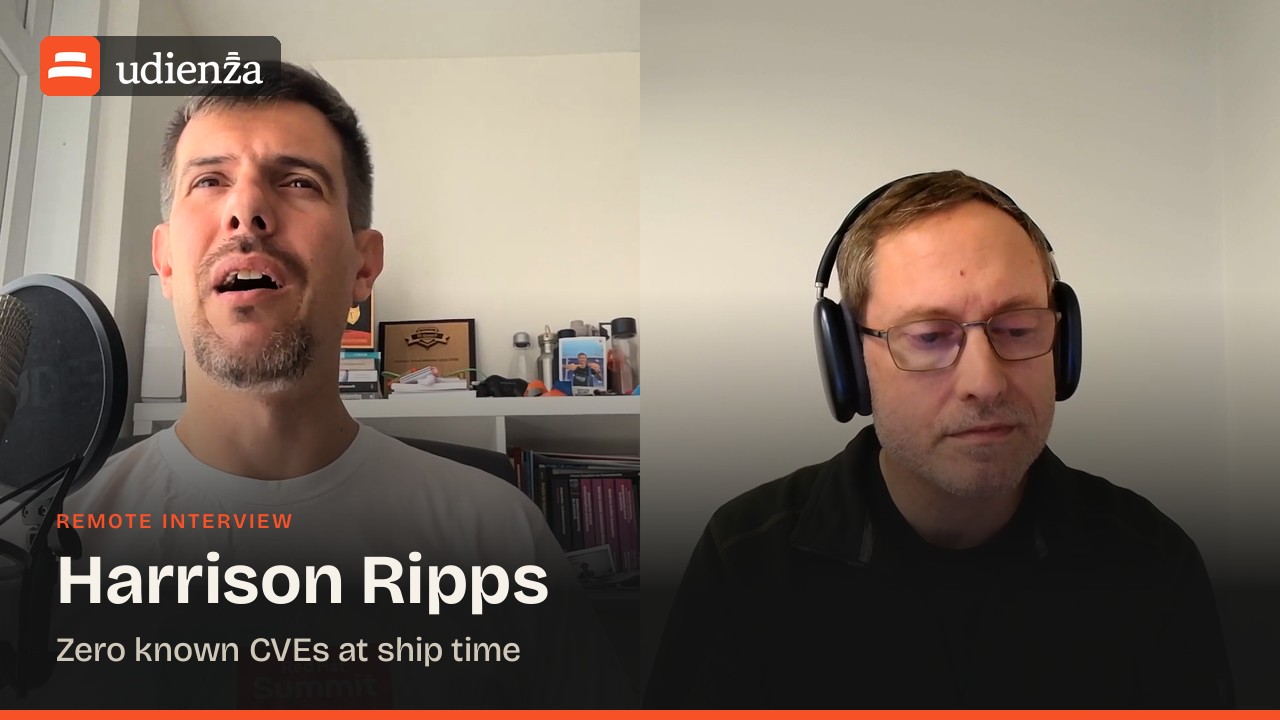
Recorded, coming soon.
Harrison Ripps is a Director of Engineering at Red Hat, where he has worked since 2012; the team that makes Red Hat Hardened Images is part of the organization he leads.
Follow the show and the episode arrives the morning it's published.
In brief
- The precise claim is zero known CVEs at ship time: in his words, not a property of the images but of the pipeline that keeps rebuilding them.
- Red Hat Hardened Images do not backport patches: the team watches upstream repositories for CVE fixes, applies them in its own build toolchain, rebuilds, tests, signs and publishes against a measured SLO.
- The images are only as valuable as the user's own automation: a system that keeps checking for new images and rebuilds when they change.
- His own project checks the images' digests on the server instead of pulling every night, and rebuilds only when they differ.
- Red Hat's responsibility ends at the FROM line of the container file; from there on, tracking updates and triggering rebuilds is the app developer's.
- images.redhat.com needs no account and lists a little over 100 images, with variants for FIPS and for different architectures, and more packages added every week.
Chapters
- 0:00 Welcome
- 1:15 Zero known CVEs at ship time
- 2:08 Your pipeline has to consume the updates
- 2:58 From an upstream fix to a signed image
- 4:47 One line in the Dockerfile
- 6:25 Responsibility ends at the FROM line
- 7:57 Getting started: images.redhat.com
- 8:50 Over 100 images
- 9:41 A change of mindset
- 10:53 One takeaway
Why this conversation
The host introduced the promise in his own words: zero known CVEs at delivery, with hardened container images available at no cost. Harrison Ripps, Director of Engineering at Red Hat, leads the organization whose team makes Red Hat Hardened Images, and he had presented the project at a recent conference, where the host had seen him rebuild a service on the new images. The conversation was recorded remotely on 5 November 2026. The host wanted to know what the promise means for an engineer who builds production systems on those images, and what is still left to that engineer.
A property of the pipeline
He started by making the claim precise: “the precise claim is zero known CVEs at ship time”. Zero CVEs, he said, “is not a property of the images that we make per se. It’s a property of the pipeline that keeps rebuilding them.” When a fix appears, the workflow takes it from triage to a fix to a rebuilt, tested and signed image, automatically whenever it can, and publishes it against a measured SLO. What distinguishes Hardened Images from other Red Hat images such as UBI is that they are rebase only: the team does not backport patches. It watches the upstream repositories for CVE fixes, applies them in its own copy of the sources and its own build toolchain, rebuilds, tests and verifies, releases, and then updates the public CVE trackers, so that users know the fix is out.
One line, and a digest to watch
That puts a demand on the user, and he was frank about it. “Red Hat hardened images are only as valuable to you as a developer as your system is prepared to continuously consume the updated images that we produce.” His own example is a personal project, an application that already ran in Linux containers in the public cloud. Moving it took little more than changing the images it used: the Go builder image and the static image now both come from Red Hat Hardened Images. The nightly rebuild he showed on stage was simplified, he explained. He does not pull every night: he checks the digest of the images on the server, and only when it differs from the one he already uses does he rebuild and republish, because a new digest tells him there is a new CVE fix to consume.
The FROM line
The host asked where Red Hat’s security responsibility ends and the developer’s begins. His answer was a line in the container file: “the Red Hat responsibility ends at the from line”. Everything up to that point, watching for CVEs and rebuilding and republishing as quickly as possible, is on Red Hat. The developer first decides to switch to the hardened images, and then owns tracking what changes in those repositories, watching for digest changes as the hint that it is time to trigger a rebuild.
Getting started
The catalogue is at images.redhat.com, and it needs no account: anyone can go there, pull the images that suit a project and experiment with automation around them. The documentation leads back to the source code, and the team has made that code “extremely agent-friendly”, so that someone who is no expert can clone the repositories, point an agent at them and ask questions about how the system works. The catalogue holds a little over 100 images, depending on how the variants are counted, with variants for FIPS and for different architectures, and more packages are added every week. Many customers, he said, have always put stability first; the CVE situation has “gotten so out of hand” that it may make them rethink those priorities and rebuild much more often. Asked whether the service could take the load, he said his teams are ready: “bring it on”. His one takeaway for a developer who wants better container security tomorrow: “Go to images.redhat.com. Check it out and try out some images.”
When it comes out
The episode is edited and in the release order. Like every episode it goes out on YouTube first, then on Apple Podcasts, Spotify and Amazon Music.
Mentioned in this episode
About Harrison Ripps
Harrison Ripps is a Director of Engineering at Red Hat, where he has worked since 2012; the team that makes Red Hat Hardened Images is part of the organization he leads.
Read more on Udienza
Running this in production? Luca Berton helps platform teams take it from prototype to reliable production. See how he works
Built something the rest of us run on? Being a guest is free. Take the other chair
More episodes
All episodes →-
Episode 111 · Coming
Lewis Isaac: Coralogix: telemetry to decisions
-
Episode 113 · Coming
Tarek Becker: NeoNephos and digital sovereignty
-
Episode 115 · Coming
Marcel Timmer: The question behind the question
-
Episode 118 · Coming
Ruud Zwakenberg: Code is the easy part