Conferences
4 min read
FOSDEM 2026 in Brussels: where the show began
FOSDEM 2026, where the Udienza podcast filmed its first episode with Monty Widenius: what he said, what else the host saw that weekend, and where to read more.
By  Luca Berton
One booth, one question
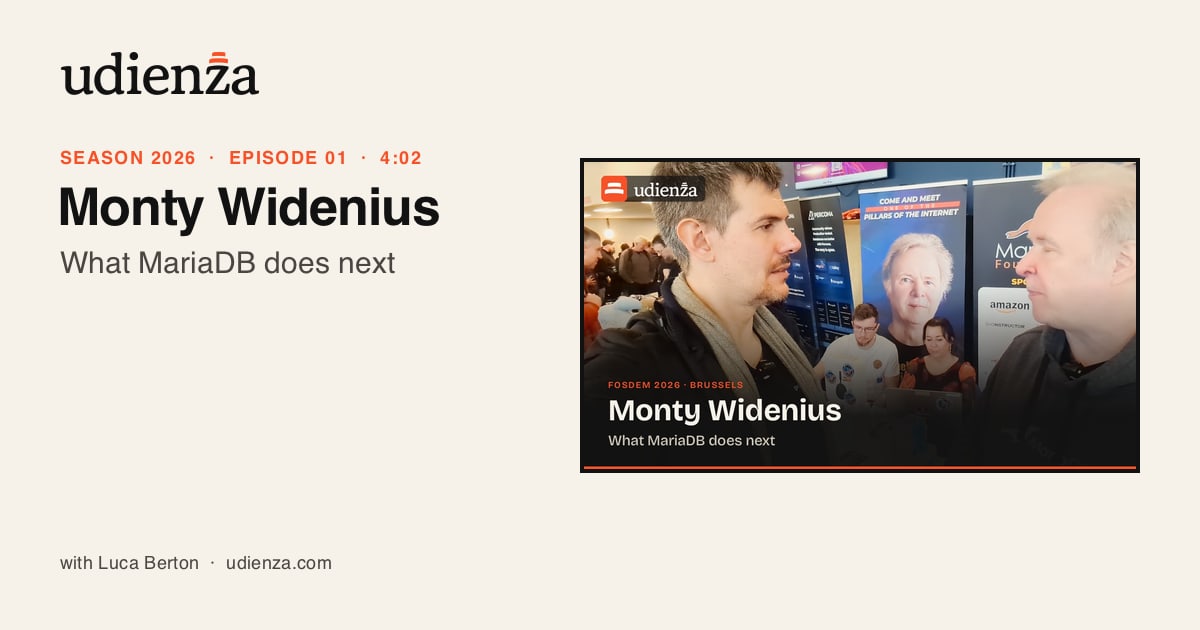
The Udienza podcast has one episode from FOSDEM 2026, and it is the first one. It was filmed on the weekend of 31 January and 1 February in Brussels, at the MariaDB Foundation booth, with Michael “Monty” Widenius: the original creator of MySQL and MariaDB, who still writes code for MariaDB and works with the Foundation on its community and university programmes. The conversation runs just over four minutes. It went out as episode 01 on 17 March 2026.
The overview of where the show films gives that weekend one paragraph. This is the longer version: what the conversation covered, what else the host saw in Brussels, and where the full notes are.
What the conversation covered
The episode asks one question: where is MariaDB going in 2026, and does it still speak MySQL? Monty’s answer starts with compatibility. MySQL users are arriving, he said, because of “the entertainment that Oracle has done the last few weeks”, and his job this year is to make the move from MySQL one-to-one. After that come two larger projects on his own list: full outer joins and parallel queries.
The main challenge of the year, in his account, is adoption: growing it, and keeping the people who already run MariaDB happy. The developer community keeps growing as well. With the Foundation’s help, the team now handles pull requests from university students, who submit them as part of their courses.
Asked about TiDB and the other databases built on the MySQL protocol, Monty did not treat them as replacements. They share a protocol and many features, but “they are all different”. He put MariaDB at about 400 million installations, which would make it the largest open source database apart from SQLite. He also conceded that MySQL still has the better-known name, and that changing that in developers’ minds will take time.
The last part is career advice. Open MariaDB’s Jira, filter for issues marked beginner-friendly, write the fix, work with the team until it is merged, and do it again. In his words: “After you’ve done lots of contributions, you will be known and people will compete to hire you.”
What else the host saw
The episode was one stop in a two-day weekend. Luca Berton also recorded short clips at the stands and in the corridors, and sat in on devroom talks. Those are not episodes of the show. They are his notes from the same campus, published on lucaberton.com, and three threads run through them.
Databases were the first. Besides MariaDB, the host stopped at the Percona stand, in the year the company turns twenty, and at the PostgreSQL stand, where Magnus Hagander of the core team talked about the I/O changes in PostgreSQL 18 and why pgvector moves faster than the database it extends. A session in the Databases devroom explained how ClickHouse splits data into granules and log lines into tokens.
Policy and money were the second. The Eclipse Foundation described itself as a neutral home for projects many companies share, and its work on the Cyber Resilience Act. The TODO Group, a community of open source programme office practitioners, expected the CRA to take up much of 2026. Two talks in one funding session asked who pays: one on funding open source in the energy sector, one from SAP on how a large company can give money to an individual maintainer.
RISC-V was the third. Yuning Liang, founder of DeepComputing, showed a K3 board at the RISC-V stand. The Fedora on RISC-V talk showed a distribution still building a separate kernel for each board while it waits for an RVA23 reference platform. Around those threads sat identity and infrastructure, with FreeIPA and ansible-freeipa from Red Hat engineers and image-mode machines in Foreman, plus a FreeSewing talk and a dinner-table demo of small programmable robots. FOSDEM is not only servers.
Why it starts here
Every later episode follows the shape of this one: one guest, one question, filmed at the event where the guest already is. Nobody flew to a studio. The person who wrote the database was standing at a booth, and the show asked him what comes next.
Where to read more
The host’s write-ups of the weekend are on lucaberton.com. The text there is his own; the episode page here carries the video, the chapters and the transcript.
- The written interview with Monty Widenius, which became episode 01.
- Hallway interviews: the short clips, sorted by subject, from community and policy to databases, Linux and hardware.
- The devroom talks: seven sessions, reconstructed from his photos of the slides.
- The weekend recap: the RISC-V stand, the people he met, and the robots at dinner.
Next
Watch episode 01 on YouTube, where every episode is published first, on a Tuesday; the rest of the season is in the playlist.
Built something the rest of us run on? Being a guest is free: how it works.
Built something the rest of us run on? Being a guest is free. Take the other chair
Related articles
All articles →-
Conversations · 2 min read
MariaDB: more MySQL compatibility, and a way in
Monty Widenius at FOSDEM 2026 on MariaDB's year: more MySQL compatibility, full outer joins, parallel queries, and how young programmers get hired.
-
Open Source · 1 min read
Monty Widenius, creator of MySQL and MariaDB
Monty Widenius (Creator of MySQL and MariaDB) on Udienza: Where is MariaDB going in 2026, and does it still speak MySQL?
-
Conferences · 6 min read
IBC 2026: a cloud-native walk through broadcast
Fourteen halls of media technology at the RAI, seen by someone who usually covers Kubernetes: open standards, sovereignty, provenance and a lot of AI.
The episodes in this article
All episodes →-
Episode 01 · 17 Mar
Monty Widenius: What MariaDB does next